
IOLTA asks Massachusetts high court to remand settlement distribution over alleged Rule 23(e) notice lapse
Get AI-powered insights, summaries, and transcripts
Subscribe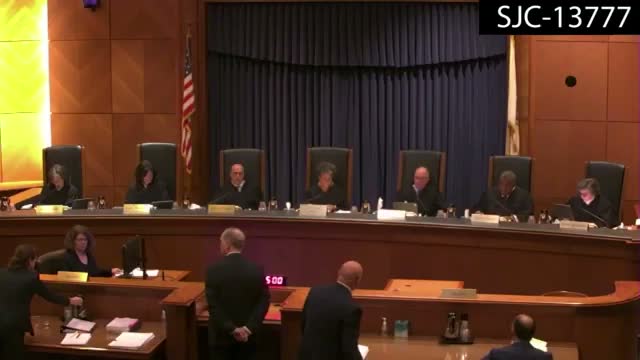
Summary
The Massachusetts IOLTA Committee told the Supreme Judicial Court it received notice of a 2021 class-action settlement only after final approval and seeks a remand or limited vacatur so the court can permit IOLTA to be heard about roughly $500,000 in alleged residual funds; defendants say any error was harmless and the trial judge already addressed distribution.
The Massachusetts IOLTA Committee urged the Supreme Judicial Court to remand or vacate part of a 2021 class-action settlement so the committee can be heard about whether residual funds should be redirected to IOLTA rather than returned to the defendants.
"The very first time that the committee received any notice of this matter was two years after the final hearing on approval of the settlement agreement" and only at a later hearing before Judge Howe, counsel Doug Salvesen told the court, arguing that absence of timely notice violated Rule 23(e).
Salvesen said the settlement documents presented to a prior trial judge (Judge Liu) included a $4,000,000 cash settlement with a paragraph capping any return to defendants at $500,000 — a guardrail Judge Liu used in assessing the deal’s reasonableness. He told the justices the version later enforced by Judge Howe omitted that cap and effectively allowed more money to revert to defendants by reallocating the cap to a separate ‘‘settlement fund.’'
"Residual funds are funds that remain after payment of all approved class member claims, expenses, litigation costs, attorney's fees and other court-approved disbursements," Salvesen told the court, and under Rule 23(e) such funds may not revert to defendants but should instead be allocated to cy pres recipients or to IOLTA.
Defense attorney Jeffrey Turf countered that IOLTA’s statutory role was narrow: "the rule makes clear that IOLTA only has the right to be heard on the limited purpose to allow IOLTA to be heard on whether it should be the recipient of residual funds," not to relitigate the fairness of the settlement or the claims process. Turf said the trial record shows Judge Liu had repeatedly considered how residuals would be distributed and that any notice lapse was harmless error because the judge expressly discussed IOLTA and housing-related cy pres candidates during multiple hearings.
Plaintiffs’ counsel told the court that IOLTA received late notice but that the committee later sought enforcement of a $500,000 payment to IOLTA; counsel said the transcript record shows the parties and the trial judge focused the dispute on that $500,000 figure.
The bench pressed both sides on the proper remedy: whether the court must vacate the entire settlement or instead remand narrowly to permit IOLTA to be heard about the limited question of whether it should receive any portion of the roughly $500,000 identified in the record. Counsel agreed that a limited remand to permit IOLTA to be heard on the $500,000 would be legally workable and would avoid upsetting disposals already made to class members and cy pres recipients.
Counsel and the court also discussed the mechanics and scope of the ‘‘residual fund’’ at issue. Salvesen said an $800,000 initial settlement-fund account was established for claims and that the parties later put a $500,000 cap on a settlement fund that had been intended to limit reversion to defendants. Turf and plaintiffs’ counsel described a multi-step claims-made distribution, noted evidence placed on the record about response rates and actual payments, and said some cy pres recipients had already received funds: North Shore Community Development received roughly $100,000 and Action Inc. had received none, while approximately a dozen individual claimants remained unpaid pending resolution.
The court did not announce a decision during argument. The core factual disputes — whether the trial judge saw the same settlement document with a $500,000 cap, whether notice to IOLTA was timely under Rule 23(e), and whether remanding only to decide entitlement to the $500,000 would leave the overall settlement intact — were central to the arguments presented to the justices.
Next steps: the justices will take the argument under advisement and issue an order resolving whether remand or vacatur is required and, if remand, how narrowly it should be framed.