
Board adopts second reading of early-entry kindergarten policy; staff to waive screening fee and expand early screening
Get AI-powered insights, summaries, and transcripts
Subscribe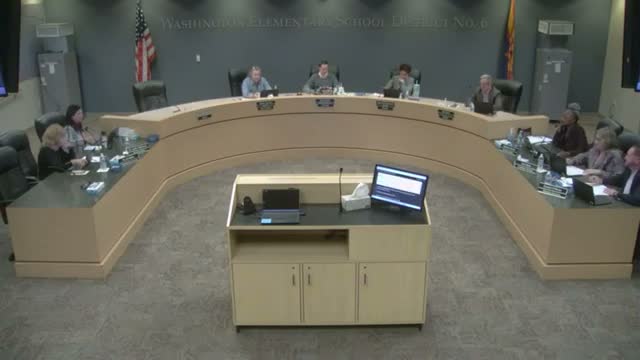
Summary
The board approved the second reading of policy 5‑102 to allow earlier, more frequent screenings aligned to Teaching Strategies GOLD and to waive the former $100 nonrefundable screening fee; board members pressed staff on limits in preschool capacity and outreach.
WASHINGTON, Ariz. — The Washington Elementary School District Governing Board on Dec. 11 approved the second reading of Policy 5‑102 (enrollment requirements), adopting changes to the district’s early‑entry kindergarten process.
Assistant Superintendent of Academic Services Laurie Mora told the board the district proposes to begin early‑entry screenings earlier in the year (as early as January), align assessments to Teaching Strategies GOLD, increase screening frequency and waive the prior $100 nonrefundable fee to lower barriers for families.
"We would waive the fee for our families, which we feel has been a bit of a barrier," Mora said during her presentation, adding the district would use Wednesday afternoons and existing staff time so teachers could participate without extra summer staffing costs.
Vice President Lindsey Peterson voiced concerns that early entry can exacerbate maturity mismatches and said many parents seek early entry for practical child‑care reasons rather than readiness. "What I see is parents looking for an option for support for a place to send their kids ... maybe they think the only option is accelerating them to kindergarten," Peterson said, urging expanded preschool access and outreach.
Superintendent Dr. Hightower and staff acknowledged preschool supply constraints; staff said the district has roughly 350 ECE/preschool slots and that running a single preschool classroom costs about $150,000 per year, citing licensing and staffing costs.
After board discussion about reserving limited preschool spots and outreach to families about Head Start and other options, President Kyle Clayton moved to approve the second reading of Policy 5‑102 (enrollment requirements). The motion passed by voice vote with all members present voting in favor.
The revised policy formalizes earlier screening windows and removes the screening fee; staff said the district will continue to market and coordinate preschool and Head Start options while monitoring capacity. Board members asked staff to report back on outreach plans and geographic placement of ECE programs, particularly in the district’s southern neighborhoods.
What happens next: the district will implement the revised policy for the 2026 enrollment cycle, begin earlier screenings and provide families with information about early childhood options and jump‑start summer programs.