
Highlands board opens review of room-occupancy tax; stakeholders urged to join task force
Get AI-powered insights, summaries, and transcripts
Subscribe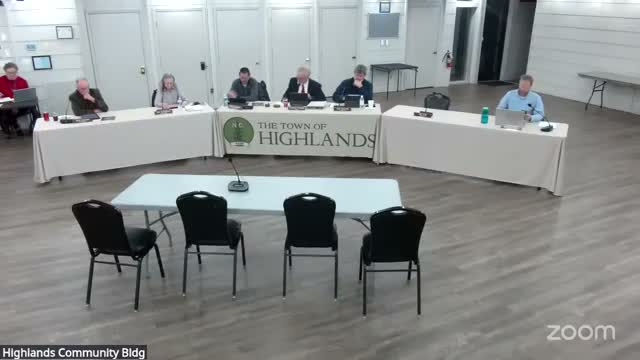
Summary
At a Dec. 11 Highlands workshop, the mayor outlined proposals to update Macon County—s 1985 room-occupancy law and consider shifting from a 100% tourism-promotion model to a 2/3 promotion / 1/3 tourism-related allocation; the board agreed to form a stakeholder task force but took no formal votes on tax changes.
The Highlands Town Board held a Dec. 11 workshop to explore possible changes to local room-occupancy (tourism) tax rules, with the mayor outlining four propositions including updating Macon County—s 1985 enabling legislation, considering an increase to the occupancy-tax rate, expanding local decision-making about allocations and increasing transparency around the Tourism Development Commission (TDC).
"As any workshop session, nothing is final," the mayor said as he presented comparative county models and a summary from the Magellan Strategy Advisors report showing a range of local approaches. He noted many nearby counties use a two-thirds promotion / one-third tourism-related split, while Macon County currently directs 100% of occupancy revenue to tourism promotion. The mayor also advised that any legislative change would require county cooperation and possibly action by the state legislature, and he flagged a likely April 2026 deadline for local-legislation requests.
Why it matters: room-occupancy tax money funds tourism marketing and related projects across the county, and how that revenue is allocated affects who controls spending and which local services might be supported. Mayor proposals included using a portion of funds for parking improvements, downtown landscaping, playground and restroom maintenance, greenway work, ice-rink operations and workforce childcare — items several board members said could relieve pressure on the town—s general fund.
Public comment at the workshop underscored sharp differences in priorities. Blythe Hunsinger, a Highlands Chamber leader and representative of Visit Highlands NC, urged keeping occupancy-tax dollars in Highlands and said the Chamber would participate in a task force and work within existing rules. "We keep the dollars in the Highlands and use those dollars responsibly," Hunsinger said.
An unidentified local hotel representative warned that raising the occupancy tax would raise the "bottom line" for guests and could reduce bookings, saying the industry would "fight this with everything we have at the town level, the county level, and the state level." He added that some tourism expenses, such as the ice rink, could be legitimate uses of tourism dollars.
Resident John Reimer pressed for greater transparency, describing difficulties obtaining clear financial information and criticizing a survey he called biased. Joanna Fine, the new executive director of the Highlands Chamber of Commerce, said she has provided financial numbers on request, that the Chamber's financials are available online, and invited board members to meet with her treasurer and board chair to review budgets.
Board reaction centered on two questions: what the community should be allowed to spend occupancy-tax money on, and who should decide. Several board members said they were less concerned about broadening allowable uses than about preserving local input and avoiding a loss of local control to county-level decisionmakers. One board member cited the ice rink as an example of a facility that costs roughly $50,000 a year to operate while bringing in about $20,000 in fees, creating an annual subsidy the town currently covers.
Outcome and next steps: the board agreed to pursue a stakeholder task force to analyze options, gather data and recommend a path forward. The mayor and a commissioner said they would meet after the holidays to propose a representative, limited-size group of stakeholders — including town officials, county representatives, TDC/TDA members and business and Chamber leaders — and to outline the task force—s scope. No formal vote on changing the occupancy tax rate or law was taken during the workshop.
Authorities and context: the mayor cited the Macon County 1985 room-occupancy enabling law and referenced 1997 reform legislation (GS1538-155) as the source of the 2/3–1/3 model widely used elsewhere in North Carolina; he also cited a Magellan Strategy Advisors report and a 2022 statewide room-tax collection figure of about $391 million.
The board adjourned the workshop and said it would continue stakeholder outreach and follow-up work; any change would require county approval and, if necessary, state legislative action before local-legislation deadlines in spring 2026.