
Mountlake Terrace staff propose tighter critical-area protections, revised tree-replacement ratios and floodplain rules ahead of public hearings
Get AI-powered insights, summaries, and transcripts
Subscribe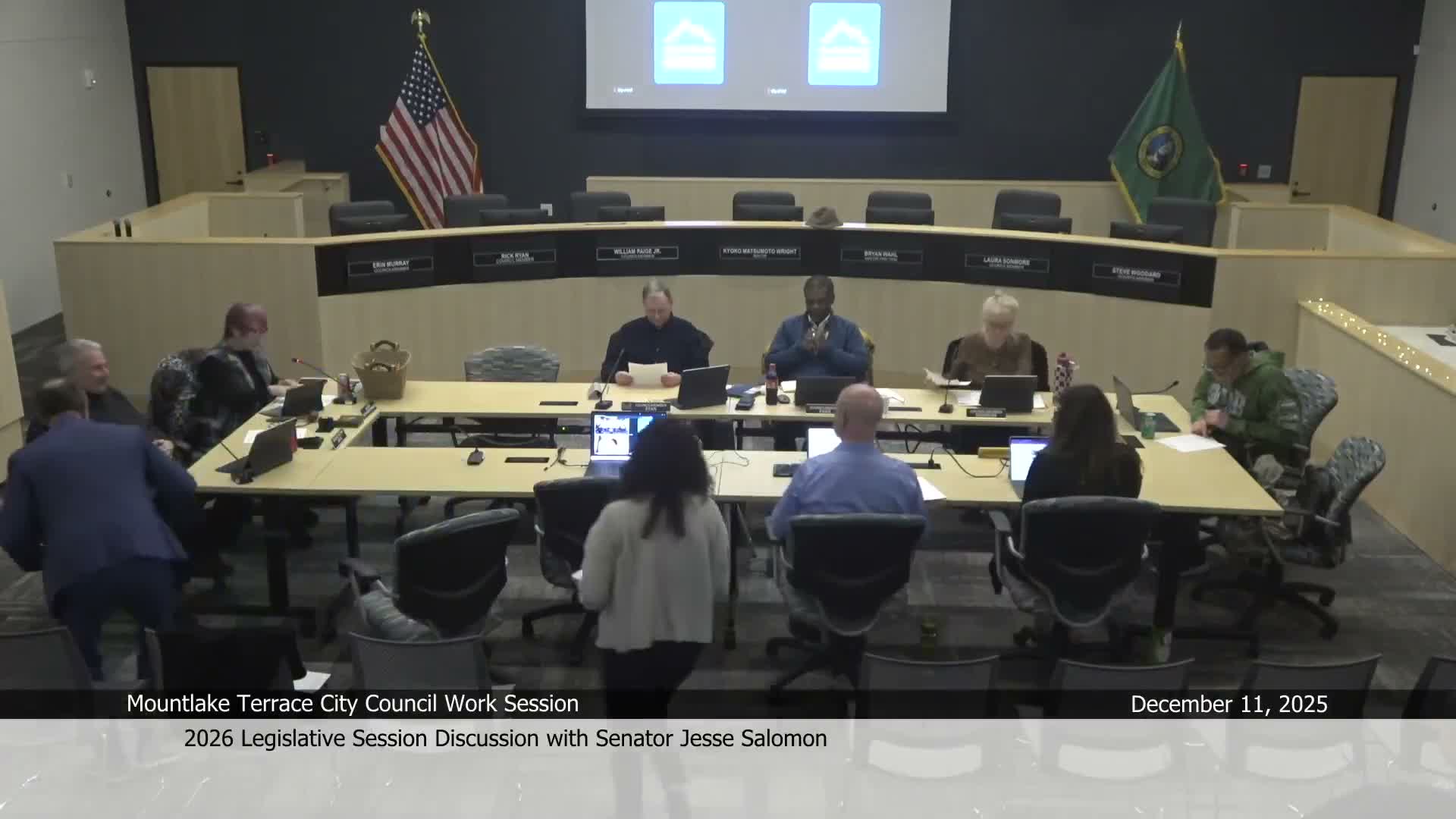
Summary
Staff presented a draft critical areas ordinance and floodplain-management amendments that would expand wetland and stream buffers, require hearing‑examiner review for wetland/stream alterations, raise tree-replacement standards, and adopt model floodplain provisions including a one-foot elevation requirement for new residential lowest floors.
City planning staff presented a detailed draft update to Mountlake Terrace’s critical‑areas ordinance and a companion floodplain‑management update at the council’s Dec. 11 meeting, saying both are intended to align local code with state guidance and the Growth Management Act timing requirements.
Senior Planner Sarah Pitzel said the draft increases applicability around water bodies, adds critical aquifer recharge areas to the applicability section, establishes a nonconformance pathway for repairs after damage, and raises enforcement measures for unlawful tree removal in critical areas. On tree replacement, staff proposed lowering the currently discussed 10:1 ratio to align more closely with Department of Ecology and neighboring jurisdictions — recommending approximately 2:1 for smaller trees and 4:1 for larger trees to mirror Ecology guidance.
On wetlands, staff proposed broader vegetated buffer requirements, steeper-slope buffer increases, and limiting administrative buffer reductions because Ecology and best available science do not support reductions in many cases. Pitzel said Ecology advised restoring a 50-foot standard buffer for Category 4 wetlands after staff initially proposed removing that requirement, and recommended that any wetland alteration requests proceed to the hearing examiner rather than be handled administratively.
For streams and fish‑and‑wildlife habitat, staff recommended simplifying classifications to a single type, increasing stream buffers by 50 feet consistent with state best‑available‑science recommendations, requiring mitigation (and preferring mitigation before disturbance), and introducing monitoring and maintenance plans tied to mitigation approvals.
The floodplain update follows the Washington model ordinance: staff recommended requiring new residential lowest floors to be built at least one foot above base flood elevation (where that elevation is known), tighter construction standards for utilities and enclosed spaces, recordkeeping for base flood elevations, and FEMA notification procedures for annexations or elevation changes. Staff said Mountlake Terrace currently has special flood hazard areas but not floodways; some model provisions (floodway rules) were added for program consistency though not immediately applicable.
Council discussion focused on enforcement and the balance between development and habitat protection. Several council members urged stronger penalties and asked staff to present comparative data with nearby cities. Staff noted some tribal and agency recommendations (including timing for revisiting critical-area reports and more protective tribe-suggested language) arrived after the planning commission hearing and recommended council direction on whether to incorporate those comments now or send them back to the planning commission for additional review.
Next steps: staff said the public hearings for both the critical areas and floodplain amendments are scheduled for next week and council is expected to consider adoption thereafter. Staff offered to return proposed language incorporating Ecology and Department of Health comments and to provide comparative examples if council wants additional detail before a vote.