Board approves Panorama contract with added academic-outcomes language after debate on student data and AI
Get AI-powered insights, summaries, and transcripts
Subscribe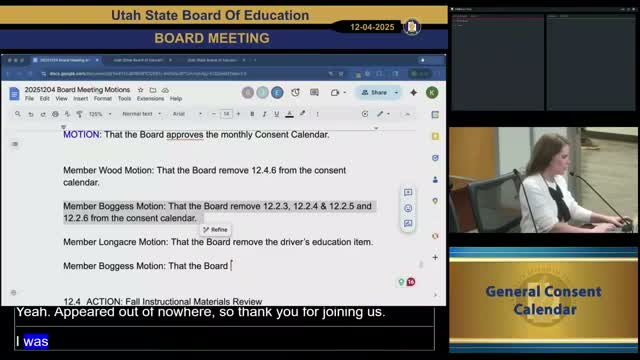
Summary
The board approved Panorama-related contracts and an amendment adding the phrase "leading to higher academic outcomes" to 'other criteria' language; members questioned student-data handling, parental consent translation, and whether PII would be used in AI, and staff described a 'walled garden' approach.
The board approved Panorama-related contract items from the consent calendar, adding contract language to require any "other criteria" to be "leading to higher academic outcomes as determined by the LEA," and recorded votes and reservations about data privacy and AI use.
Member Earl moved an amendment to the contract that would change language wherever it reads "other criteria" to read "other criteria leading to higher academic outcomes as determined by the LEA." Staff said they could request the change from the vendor; the amendment was seconded and passed 14–1 (the transcript records an abstention by Chair Himas on the amendment). The underlying consent items, as amended, were later approved 12 in favor, 1 abstention (Member Earl) and 2 no votes (Member Green and Member Bogus/Boggess per transcript).
During debate board members pressed staff on key privacy and implementation details. Katie Challis, identified in the meeting as director of privacy, described the contracts as dispute-resolution work under IDEA and said "these dispute resolution officers... do actually receive data for specific to the cases that they are working on" — including IEP records, emails and documentation — and that contractors send documentation to appropriate parties and are "required to destroy that data from their own records." Challis emphasized this is not a bulk data dump.
Members also asked whether parental consent is "implied or informed." Challis and Aaron Brough, director of data and statistics, characterized consent as informed: LEAs must opt in, and parents must provide consent at registration after receiving the purpose, a copy of the questions, and who will have access to the information. Staff said vendors have supported translations (for example Spanish) and that accommodations can be provided "in any language needed." The contract language also says data-privacy training content will be approved by the state data-privacy team; staff noted that wording was intended though not yet in contract text.
On AI oversight, staff said the base purchases do not include an AI component; AI functionality is an optional add-on LEAs could purchase. When asked whether student PII would be put into AI, staff said PII could be accessed by an AI feature in a "walled garden" implementation: the vendor's generative AI could process contained data but the vendor would not use that data to train external models or move the data outside the system. Staff also said that, at present, verification that the "walled garden" remains intact is largely reliant on vendor assurances rather than independent external audits.
What happens next: The contract items and amendment were approved at the meeting and staff indicated they would follow up on drafting and vendor confirmation for the amended language and implementation details (training content approval, translation availability, and technical assurances for any AI functionality).