
Planning commission backs 145‑unit Baylands townhome project at 2100 King Road, adds dark‑sky and native‑tree conditions
Get AI-powered insights, summaries, and transcripts
Subscribe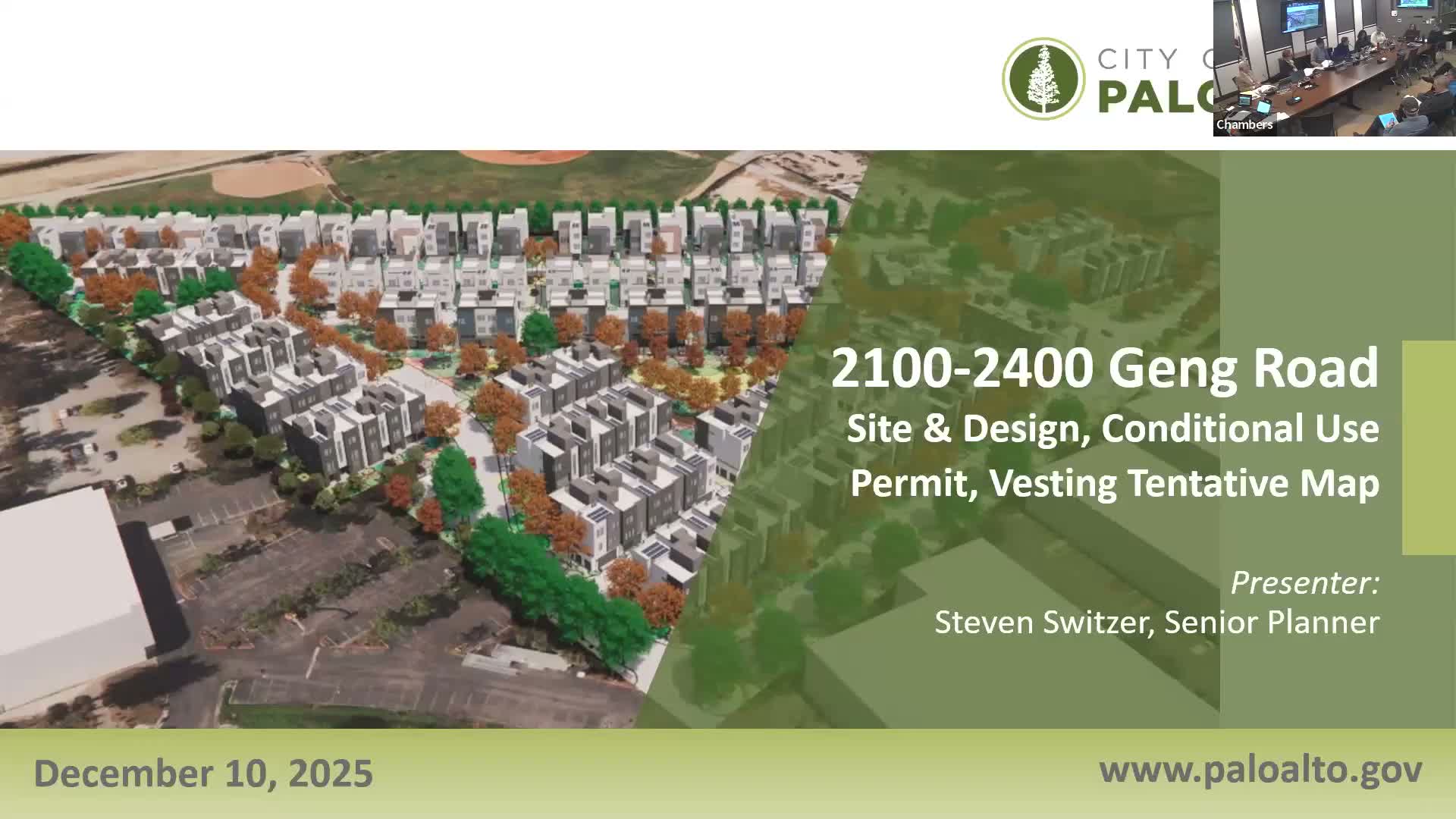
Summary
The Planning & Transportation Commission voted 7–0 Dec. 10 to recommend approval of a 145‑unit townhome development at 2100 King Road, a builder’s‑remedy application, while adding a condition to comply with Palo Alto’s new dark‑sky ordinance and asking staff to work with the developer to increase native tree plantings.
The Palo Alto Planning & Transportation Commission recommended approval on Dec. 10 of a developer’s proposal to convert an 11‑acre office park at 2100 King Road into about 145 townhomes, finding the application consistent with state “builder’s remedy” protections and local objective standards.
Staff described the project as a mixed set of three‑ and four‑bedroom townhomes — detached units, duplexes and attached townhouses — with 332 parking spaces (290 in garages, including tandem stalls) and 19 below‑market‑rate (BMR) for‑sale units to meet the state’s reduced affordability requirement for builder’s‑remedy projects. The applicant and design team emphasized open space and landscaping, showing a central green and two pocket parks totaling about one acre.
Why it matters: The site sits adjacent to Baylands parkland and a ballfield and is partly in a FEMA floodplain, so the project requires substantial grading and a conditional letter of map revision (CLOMAR/LOMAR) from FEMA before the site is removed from the flood zone. The proposal would remove existing on‑site trees and replace them at a 3:1 ratio; staff told the commission replacement plantings would occur on the project site while any work on city‑owned parkland will be considered by the Parks & Rec Commission under a Parkland Improvement Ordinance.
Public reaction was mixed. Supporters said the project would add family‑sized ownership opportunities and reduce vehicle trips compared with the existing office use. Opponents raised concerns that the 13% BMR set‑aside under the builder’s‑remedy is low compared with local expectations, questioned the environmental effects of raising the site, and asked that affordable units not be segregated.
Developer Michael Cohen said the affordable units are distributed across building types and that the project would “triple the number of trees on the site” compared with current conditions and voluntarily comply with Palo Alto’s new dark‑sky rules. A public commenter argued the project’s location in a flood‑sensitive bayland and inclusion of rooftop decks could harm wildlife and increase greenhouse‑gas emissions from trucked fill.
Commission action and next steps: Vice Chair Chang moved the commission’s recommendation to forward staff’s proposed findings and approvals — the site and design permit, conditional use permit and vesting tentative map — to City Council with two additions: a condition that the project comply with the newly adopted dark‑sky ordinance and a formal request that staff work with the applicant to increase the percentage of native trees. The motion was seconded and passed unanimously, 7–0. Staff will prepare the record and the item is tentatively scheduled to advance to the Architectural Review Board and then to City Council for final land‑use decisions.
Legal and technical context: Staff said the application was submitted under provisions and timelines tied to state laws referenced in the record (including an SB 330 pre‑application) and that CEQA review used the initial study/consistency approach (CEQA Guideline section 15183), with standard mitigation conditions noted in the staff report. The project team explained they are pursuing a conditional Letter of Map Revision with FEMA so future homeowners can obtain flood insurance.
What remains unresolved: Commissioners pressed staff and the applicant on tree‑replacement accounting, whether replacement plantings could occur on adjacent city property (the Parks & Rec Commission will consider the question Dec. 16), details of BMR selection (Alta Housing will administer sales and eligibility), and bicycle parking counts for family households. City Council will see the commission’s recommendation and supplementary materials when staff forwards the application for its review.
Quote: “These types of projects convert former office uses into housing and can reduce daily vehicle trips,” Michael Cohen said in the applicant presentation. “We have thought a lot about the affordability mix and the landscape program, and we won’t plant a single eucalyptus on the site.”
The commission’s recommendation and supporting findings will be included in the formal record transmitted to City Council.