
Kane County weighs sale, industrial development or community solar for idle 32-acre Fabian property
Get AI-powered insights, summaries, and transcripts
Subscribe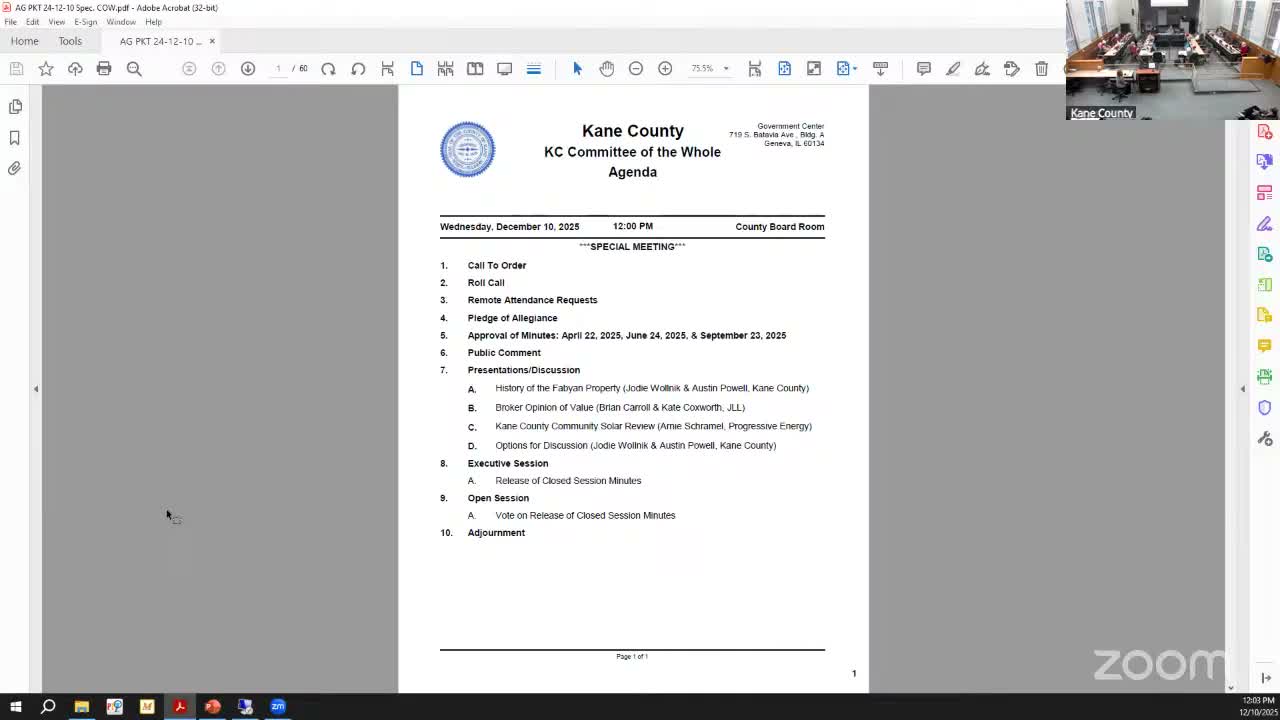
Summary
Kane County board members reviewed a staff history, a JLL broker opinion of value and a community-solar RFP response Dec. 10 for the 32-acre Fabian property. Presenters outlined a possible mixed approach — solar on part of the site with frontage sold for industrial use — and the E & E committee will study next steps.
Kane County board members met Dec. 10 to consider how to use the 32-acre Fabian property, hearing staff, a JLL broker and an energy consultant outline options that include selling the land, pursuing industrial or multifamily development, or leasing part of it for community solar.
Joan Wollnick, the county presenter, traced the site's history from a 2014 aerial photo through demolition of the former jail, use for sheriff storage and a 2025 remediation that addressed underground storage tanks. Wollnick said the cemetery near the site is on adjacent forest-preserve land, not county property, and framed the meeting as an initial discussion of revenue-producing options and further study.
Kate Coxworth, an industrial broker with JLL, presented a broker opinion of value based on roughly 32 acres. Citing a land-residual analysis and local market comps, Coxworth said industrial was the "highest and best use" in the near term because of nearby industrial activity and access; she gave timing and pricing bands that ranged from quicker, lower-price sales to higher-price outcomes for a full-site user. Coxworth summarized the high-end scenario as roughly $3.1–$3.5 million for the full 32 acres if the county waits for the best buyer and takes 18–24 months.
Energy consultant Arnie Schrammel of Progressive Energy summarized the county RFP and three responsive bidders' analyses for community solar. Schrammel said community solar could be built on either an 11-acre or 22-acre portion of the site and estimated annual generation in the range of about 4 to 6.8 million kilowatt-hours depending on system size. He gave lease-payment ranges of about $3,500 to $9,500 per acre and said first-year lease revenue on the analyzed parcels would be roughly $100,000–$130,000, with total lease payments over a 35-year term in the low-$5 million to just under $6 million range. Schrammel warned that many community-solar proposals stall when local grid interconnection capacity is insufficient: "about 80% of them never go forward because there isn't enough ComEd infrastructure to take the power," he said, adding that developers often must fund substation or distribution-system upgrades.
Board members focused on trade-offs. Staff and JLL told the board that industrial, multifamily and commercial development produced similar short-term local tax revenue estimates at the city-of-Geneva level — roughly $11,000–$15,000 for a 10-acre development, which scaled to about $30,000 a year across 32 acres in the staff example — but members noted multifamily would create additional school enrollment pressure. Several commissioners pressed staff about remediation: Wollnick said remediation in 2025 targeted underground storage tanks but did not address a former firing range area that would require lead testing. Members compared cleanup costs to a prior county remediation they recalled in the low‑teens of millions of dollars and questioned whether remediation would need to be completed before sale or would reduce sale proceeds.
Questions also covered municipal-utility participation and timing. Schrammel said municipal utilities such as Geneva, Saint Charles and Batavia can participate in community solar, but Geneva's billing systems would need upgrades (he estimated 2–3 years) before it could enroll subscribers. He said some projects stack federal and state incentives but noted a timing issue with a tax credit that was described as expiring in mid‑2026, which could affect developer economics.
A board member raised concern about an outside developer presenting site drawings to Geneva planning staff; Mayor Burns said the private owner of an adjacent 14-acre parcel has entitlements for a 150,000-square-foot industrial building and that the private developer's activity is independent of county deliberations. No purchase or sale agreements were proposed or approved at the meeting.
Several board members expressed interest in a mixed approach — keeping frontage available for a high-value sale or industrial user, placing 11 acres in solar/battery option, and reserving part of the site for future county needs. Miss Bates said the county's Energy & Environment committee (E & E) would take the materials back for further study and recommend next steps. The meeting closed without a formal vote or motion to sell; staff will return with deeper analysis if the board directs.
What’s next: the county E & E committee will review the financial comparisons, remediation requirements, and infrastructure constraints (ComEd interconnect and municipal billing upgrades) and bring recommended options and any required procurement steps back to the full board for a decision.