
Cornell Cooperative Extension presents climate-resiliency checklist; Rhinebeck is silver certified
Get AI-powered insights, summaries, and transcripts
Subscribe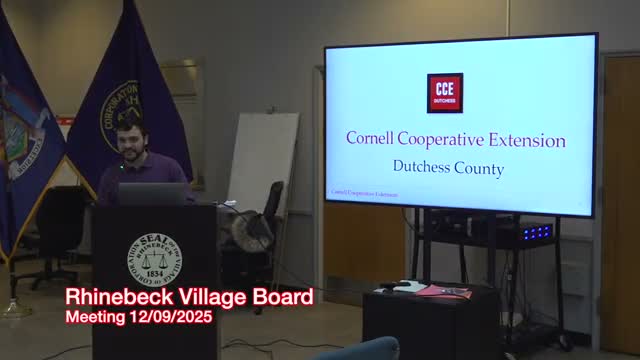
Summary
Cornell Cooperative Extension summarized a 2025 resilience assessment for Rhinebeck, noted the village’s Silver Climate Smart Communities certification and recommended actions including stormwater planning, mapping vulnerable populations, training staff on risk-mapping tools, and pursuing FEMA and NYSERDA grants.
Scott Kleinberg, a climate and environment educator with Cornell Cooperative Extension (CCE), presented the results of a 2025 resilience-planning assessment carried out for the village. Kleinberg described the planning tool as a checklist aligned with New York State’s Climate Smart Communities program that evaluates planning integration, vulnerability assessment, public outreach, disaster preparedness, hazard mitigation and implementation.
Kleinberg said the village has several strengths: a completed greenhouse-gas inventory, an established climate-adaptation plan and a climate-smart task force. He noted Rhinebeck recently achieved a Silver Climate Smart Communities certification and recommended the village pursue additional state grant funding, develop a stormwater-management plan, integrate risk-mapping into the comprehensive plan and prioritize updating zoning and capital-improvement plans to reflect flood risk and other climate projections.
The presentation included practical recommendations: train municipal staff in mapping and flood-projection tools (for example FEMA’s HAZUS and flood-insurance mapping), mark high-water lines at flood-prone parks, conduct storm-preparedness outreach (including translated materials for residents without internet access), and coordinate timing with the Dutchess County hazard-mitigation-plan update scheduled for 2026.
During a board Q&A, members asked whether some actions were realistic for a small village and discussed collaborating with nearby towns and Dutchess County to pool resources. Kleinberg said mutual approaches are common and that shared watershed planning can reduce duplicated efforts.
Kleinberg closed by pointing to the resiliency tool as a way to identify low-cost, high-impact actions and to position the village for state funding that rewards certified communities.