
Springfield Township committee backs allowing 18-year-olds to opt out of instruction while limiting 'moral' exemptions
Get AI-powered insights, summaries, and transcripts
Subscribe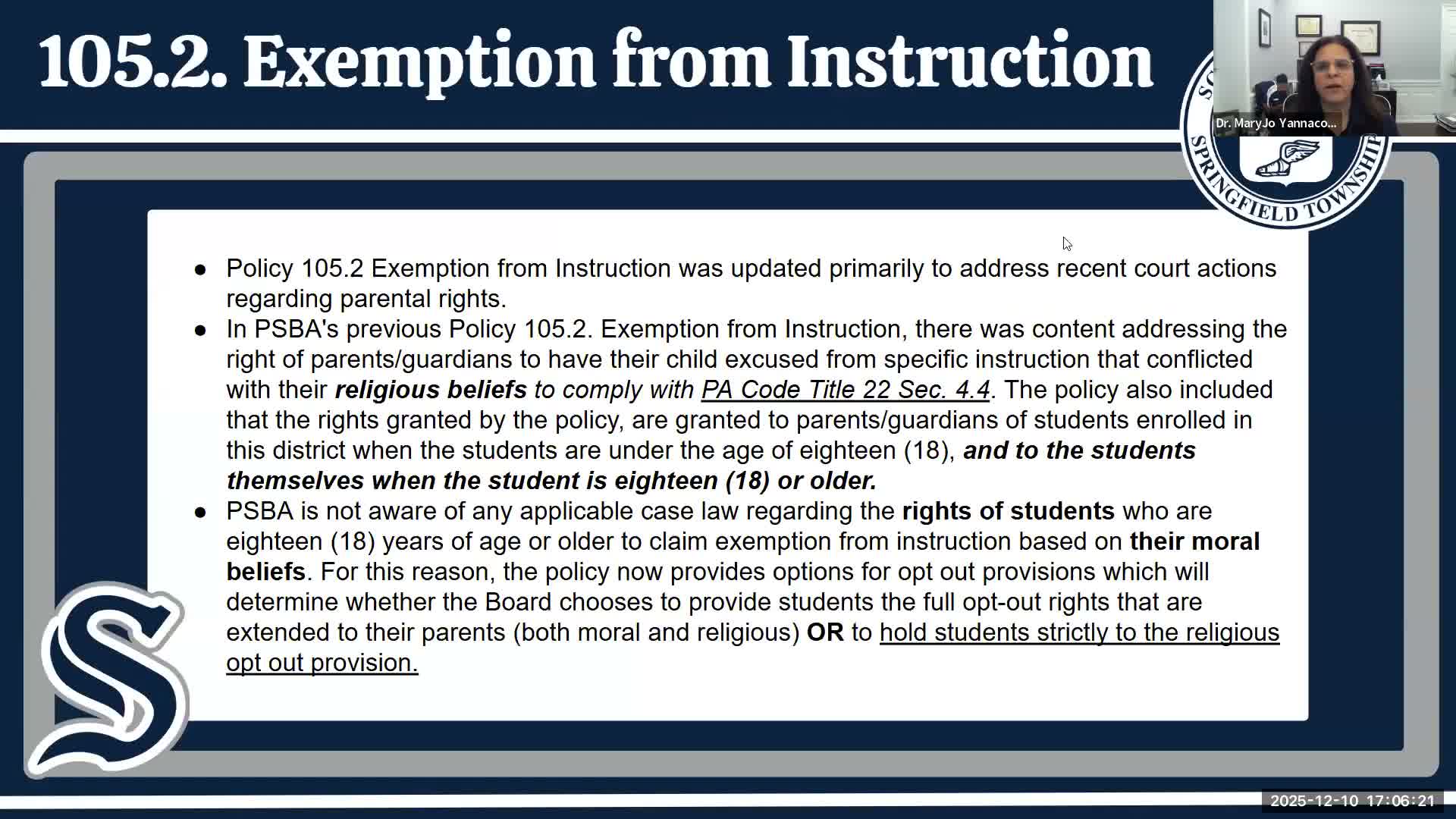
Summary
The policy committee advanced revisions to policy 105.2 to explicitly let students aged 18 and older opt out of instruction that conflicts with religious beliefs; members recommended excluding broad 'moral' grounds and clarified dissection exemptions, IEP handling and notification timing.
The Springfield Township School District policy committee on Dec. 10 reviewed changes to policy 105.2 on exemptions from instruction and signaled support for letting students aged 18 and older request opt-outs without parental agreement in cases tied to religious beliefs.
Administrators told the committee that recent court actions had given students who are 18 and older the same opt-out rights as their parents and proposed updating the policy language accordingly. "The new policy includes the option for students 18 and older to do the same for themselves," the superintendent said.
Committee members debated whether to broaden opt-outs to include "moral" grounds in addition to religious ones. Administrators recommended against adding moral language, arguing it is "too broad and vague" and could allow opt-outs from essential instructional content. "We try to use the term religious grounds to be broadly enough where we're not judging what somebody's faith is," the superintendent said.
The draft also clarifies a process for exemption from dissection activities: teachers must provide notice at least three weeks before a dissection, and administrators said only a high-school elective (zoology) currently includes dissection. The superintendent said the district would mark dissection as an essential component of that elective and work with Dr. Johnson and the science department on implementation.
Questions from committee members focused on frequency and logistics. Dr. Johnson said opt-outs are infrequent—"one to two requests on average" per year—and typically apply to a lesson or specific content rather than an entire subject, and that building principals, families and teachers generally negotiate alternative activities.
The committee also asked how students who remain enrolled until age 21 or who have guardians or powers of attorney would be handled. Administrators said those cases would be coordinated through the IEP process and case managers on an individualized basis rather than by a blanket policy.
Administrators recommended placing the revised policy on the full board agenda for Jan. 20 and indicated it could be a one-reading item because the changes were not considered substantive. They will post slides and the finalized draft with the minutes and make administrative regulations available to help implement exceptions and processes.
What happens next: the committee referred policy 105.2 to the full board for consideration on Jan. 20; minutes, slides and the draft policy will be posted online before then.