
Red Hook board adopts resubmitted zoning laws tied to boat‑club acquisition after heated public hearing
Get AI-powered insights, summaries, and transcripts
Subscribe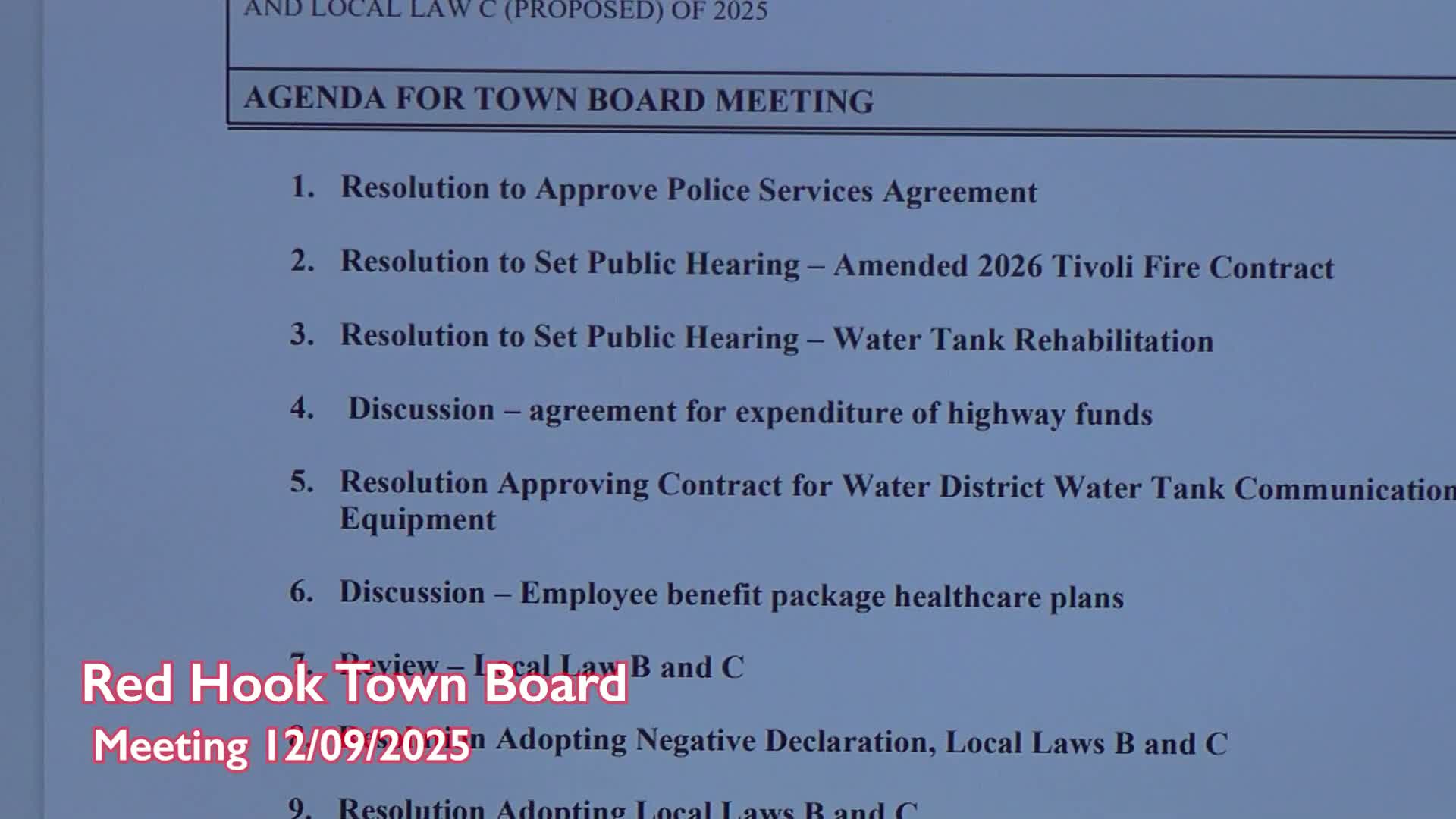
Summary
After a three‑hour public hearing with dozens of residents criticizing the town’s process and possible use of eminent domain, the Red Hook Town Board adopted resubmitted Local Laws B and C (zoning changes and a streamlined LWRP/SEQR review). The board also adopted a SEQR negative declaration and set follow‑up hearings for related projects.
Red Hook — The Red Hook Town Board on Dec. 9 adopted two resubmitted zoning laws that the board says comply with a court ruling and consolidate environmental review of a planned acquisition of the Red Hook Boat Club site. The moves followed more than two hours of public comment—much of it sharply critical—and a detailed presentation by the town’s planner on traffic, historic‑resource and waterfront consistency issues.
Why it matters: The zoning changes, labeled Local Law B and Local Law C (to be filed as Local Laws 3 and 4 of 2025), revise the town code on several issues, including time/place/manner rules for adult‑use cannabis retail, short‑term rental provisions and definitions for waterfront uses, docks and “boat club.” The board said it combined the zoning amendments with the acquisition analysis to comply with a court ruling that required the town to stop segmenting its environmental review. Opponents argued the resubmission is intended to enable a town acquisition (and eventual public park) at the Red Hook Boat Club site and asked elected officials to pause pending further review.
Public opposition and main claims: Dozens of residents urged the board not to proceed. Linda Cassidy, who identified her address in the record, told the board the action “is a ploy designed to sidestep Judge Rosa’s ruling” and called the process “unethical.” Others raised financial and legal concerns: Susan Wacha, citing FOILed invoices, told the board its legal bills tied to the acquisition approach about $275,000 so far and warned more costs would follow. Multiple speakers asked for written legal opinions about whether the Community Preservation Fund (CPF) can be used for acquisition or debt service and flagged potential deed restrictions and CSX property issues that could block riverfront uses.
Planner’s summary of the environmental review: Ted Fink of GreenPlan, the town’s planner, told the board the consolidated full EAF (Parts 2 and 3) now addresses three linked actions: the two zoning laws and the acquisition action. He said almost all Part 2 thresholds were answered as “no or small impact” except the question about possible effects on historic and archaeological resources—an expected flag in a town with many mapped historic areas. Fink also described new traffic counts (a short December count showed 666 vehicles on a local road during the sampling interval) and projected an illustrative scenario in which a public park at the boat‑club site could generate roughly 7 additional vehicle trips per hour on the nearby road when spread across the day. He emphasized the board could adopt measures (parking limits, managed access) to address capacity and safety concerns.
Board action and votes: After discussion, the board adopted a determination of non‑significance under SEQR (a negative declaration) and voted to adopt Local Laws B and C as resubmitted. The board recorded a unanimous vote (5–0) on Local Law B and a recorded outcome of 4–1 in favor of Local Law C in the meeting minutes. Town officials said the resubmission responds to the court’s direction and is intended to reduce future legal exposure by consolidating reviews.
What supporters said: Board supporters characterized the changes as technical and the product of long public and committee input. A board member who chairs the comprehensive‑plan steering committee said many of the zoning updates are needed in the interim while the town’s comprehensive plan update continues into 2026.
Next steps and procedural notes: The board directed the town clerk to file the adopted local laws with the state and to make required SEQR and LWRP filings. Opponents urged the board to leave public hearings open into January, request written legal opinions about CPF use and provide more documentation about deed restrictions and safety/ADA assessments for riverside access. The town scheduled related public hearings and administrative steps (see “Votes at a glance” for hearing dates and other actions). The town also noted ongoing court proceedings (the prior Article 78 challenge and federal filings) that may continue to affect the acquisition process.
The meeting record: The public hearing record, the planner’s EAF/CAF materials, county referral comments and the town’s LWRP consistency sheets were discussed at length in public and will be part of the administrative record the town clerk maintains. The Board moved into an attorney‑client executive session after the public meeting concluded.