
County’s Latino health assessment and gun‑violence cost study show steep disparities in East San Jose
Get AI-powered insights, summaries, and transcripts
Subscribe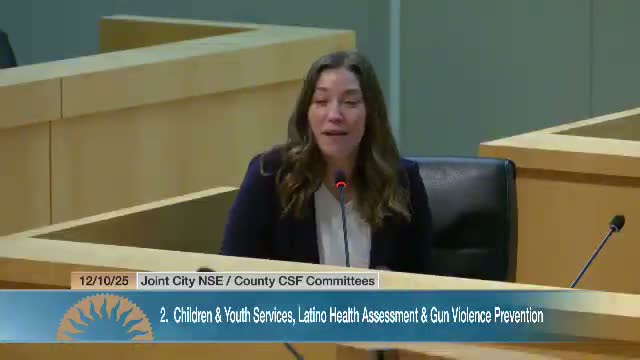
Summary
Santa Clara County public health officials summarized a Latino health assessment and a cost‑of‑gun‑violence study finding disproportionate burdens in East and South County — higher absenteeism, behavioral‑health indicators and juvenile justice representation among Latino youth, and rising community costs from firearm injury.
Dr. Sarah Redmond, Santa Clara County health officer, presented key findings from two county studies — a Latino Health Assessment and a cost‑of‑gun‑violence analysis — and called for place‑based, community‑centered interventions.
Redmond told the joint city–county committee the assessment combines quantitative surveillance, county service‑utilization data and extensive community voice. She said Latinos compose a large share of the county’s young population and that disparities concentrate in places like East San Jose and South County. "Latinos make up 34% of children and youth," she said, and the county found higher rates of chronic absenteeism, behavioral‑health indicators and juvenile justice involvement among Latino youth.
The presentation highlighted several data points the county says need targeted action: 37% of Latino high‑school students reported feeling depressed in the past 12 months; Latino youth represented roughly 70% of juvenile justice cases in the county (with the highest numbers in South County and elevated rates in East San Jose); and neighborhood safety perceptions and retail density (tobacco and alcohol outlets) varied by area. Redmond said the county has begun follow‑up actions, including declaring Latino health a public‑health priority and relaunching community prevention campaigns.
On the county’s cost‑of‑gun‑violence study, Redmond summarized that direct and indirect costs are rising and disproportionately affect San Jose. She said the study’s pre‑2020 data shows the per‑capita cost of firearm harms in San Jose is almost double the county average and that the study found totals exceeding $1 billion in negative impact for San Jose and roughly $1.2 billion for Santa Clara County when considering direct, indirect and lost productivity costs.
Redmond emphasized that both studies recommend dismantling historical barriers, prioritizing mental‑health and violence‑prevention strategies, and centering community partners and youth in implementation. She urged officials to use the assessment to inform pilot selection and program design across city and county partners.
Committee members and community speakers echoed the need for culturally responsive, place‑based interventions and for data sharing to ensure pilots serve neighborhoods with demonstrated need. The county committed to follow‑up reports and recommended actions that align with the master plan implementation work the city presented earlier.
The presentation and discussion concluded with an invitation to review the full reports and to integrate the assessment’s recommendations into the pilot evaluation and expansion process.