
Timberlane committee trims $3.8M from proposed $92M FY27 budget after hour-long review
Get AI-powered insights, summaries, and transcripts
Subscribe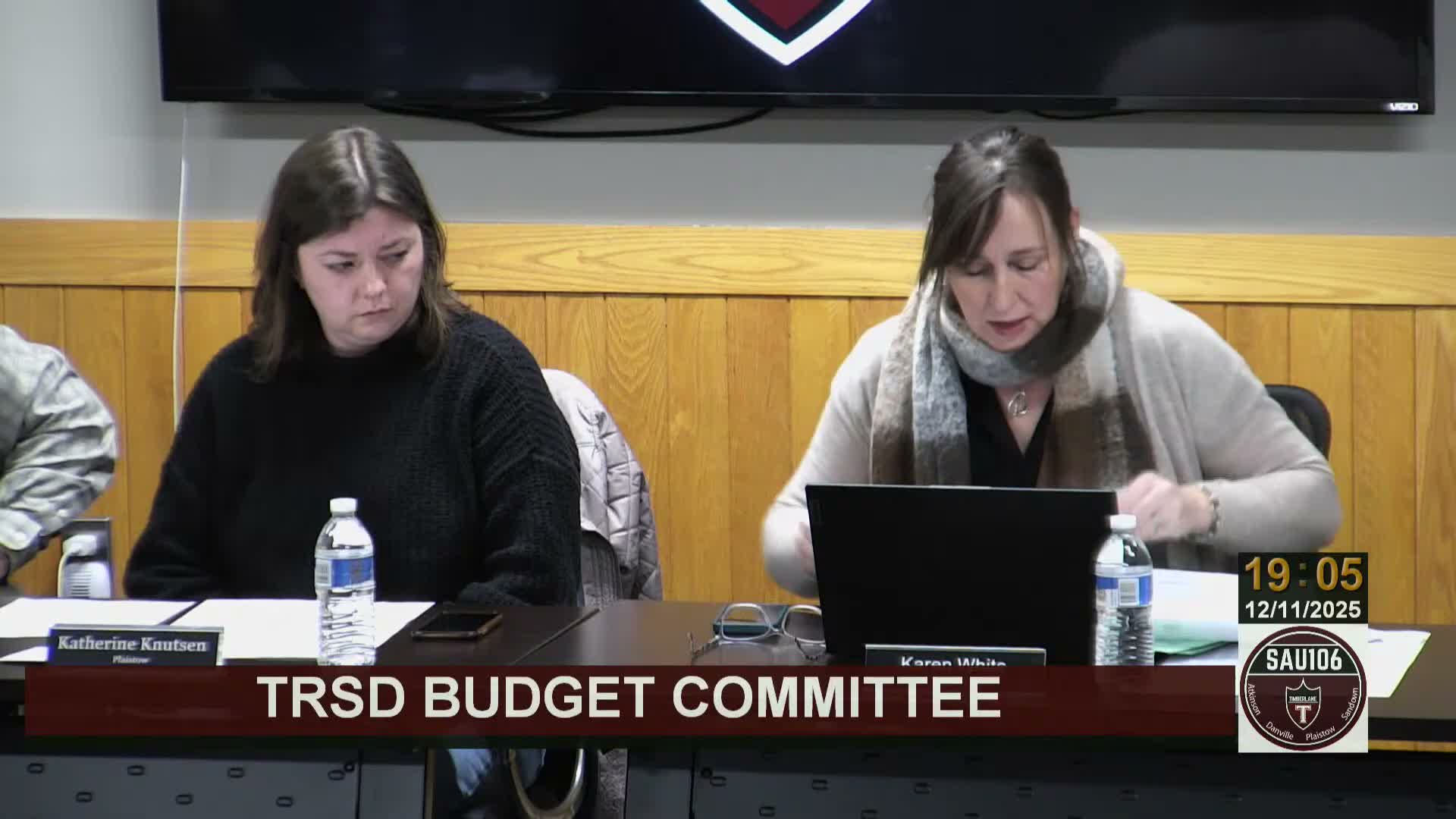
Summary
The Timberlane joint budget committee and school board on Dec. 11 approved several targeted reductions — including two bus routes, district administrative cuts, staff attrition and capital deferrals — lowering the district's proposed FY27 budget by roughly $2.8'$3.0 million to about $89.2 million. Officials said itemized cuts are intended to balance fiscal restraint with protecting core instructional programs.
The Timberlane Regional School District's budget committee and school board voted Dec. 11 on a package of line-item reductions and a short-term deferral that together trimmed the district's proposed fiscal 2027 operating budget from roughly $92 million to approximately $89.18 million.
After more than three hours of public comment and detailed presentations from district administrators, the committee approved measures that include eliminating two regular bus routes (estimated savings presented as $194,980), reducing administrative staffing lines (a motion to cut one administrator and one administrative assistant totaling about $205,000), removing a $650,000 Sandown North sprinkler project from the capital improvement plan, and taking savings from open and vacant positions and other specialist reductions.
Superintendent Justin Krieger framed the discussion by warning the group that the proposed $92 million figure "doesn't have a snowball's chance" without public appetite and asked the committee to present specific, itemized changes. He also described the underlying cost drivers, saying special-education needs and contracted services have grown substantially: "Our out-of-district students in fiscal '23 were 25; this year we have 29," and the district is conducting far more psychological evaluations and delivering more related services, he said.
Board and committee members repeatedly urged that cuts be justified and should preserve direct student services. Mark Sherwood, a school board member, said targeted capital savings such as delaying the sprinkler project could be less harmful to instruction than reducing classroom staff: "If it comes down to student to teacher ratios, that's a place I wouldn't touch; I'd rather look at capital and operational inefficiencies."
Transportation was one of the largest single savings items debated. The committee approved a motion to remove two regular bus routes while preserving late buses that support after-school academic help, after members discussed safety, parking and the uneven availability of sidewalks near schools.
On lease payments, members voted to defer the phase-4 lease payment of about $844,000 so the first payment for that phase would be due July 1, 2027, rather than charging the expense to FY27. Maria (district finance staff) explained the deferral shifts, but does not remove, the obligation: "The engagement of the phase doesn't change; the work starts as planned; we can request Bank of America to move the first payment out a year."
Several staffing reductions were approved, largely using attrition or removing vacant positions. The committee voted to reduce the elementary bucket by a package described in the presentation (10 paraprofessional positions and 3 teacher attrition slots yielding roughly $498,000 in savings) while signaling reluctance among some members to raise elementary class sizes because of potential impacts on early-grade instruction.
Committee members voiced repeated concern about special-education needs. Public commenter Larry Bledel, who identified himself as a parent of a child with special needs, warned against cuts that would harm students on IEPs: "These kids need help. Twenty-two percent of this district are on IEPs, and you're asking for that reduction." Board members asked administration to map impacts of proposed cuts so voters and the board could weigh trade-offs.
The revised proposed budget figure shown at the meeting after the motions and votes was approximately $89,176,996, reflecting the approved reductions. Administrators and the board said additional work remains to finalize warrant-article language and to present a transparent, itemized budget for the public ahead of deliberative sessions.
What happens next: the school board and budget committee will translate approved reductions into updated warrant articles and continue negotiations on remaining items at upcoming meetings; administrators said they will provide additional impact analyses to show how each cut would affect programs and compliance obligations.