Springfield council directs staff to develop payroll tax after large public hearing
Summary
After an extensive public hearing dominated by residents urging full library funding, the Springfield City Council voted 6–0 to direct staff to develop a payroll tax proposal for council review; staff will return with details and updated revenue forecasts early next year.
The Springfield City Council voted unanimously Tuesday to direct staff to develop a payroll tax proposal for council review after a large public hearing where dozens of residents urged the council to use the tax to prevent library cuts.
Finance Director Nathan Bell told the council the resolution before them would not itself implement a payroll tax or set a rate but would start the process of preparing materials and options for council review in a late-January or early-February work session. "This resolution does not implement a payroll tax, nor does it contain any of the details of what that payroll tax would look like," Bell said.
The hearing drew more than a dozen in-person commenters and remote speakers, many representing library users, nonprofit groups, families and library staff. Callie Ackland, a community organizer with Save Springfield Library, told councilors: "The payroll tax is a solution right in front of you" and urged them to set a rate that would fully fund the library.
Several speakers described the library as an essential social and educational resource. Elliot Harwell, a newly appointed budget committee member speaking for himself, highlighted revenue math: "Increasing the payroll tax by point 01% would result in the payroll projected tax revenue increase of $400,000," he said, arguing the council could close the roughly $500,000 shortfall with a small rate change.
Not all testimony pressed for a larger rate. Bonnie Mickelson, representing the Springfield Chamber of Commerce, said the chamber was "open to the shared payroll tax at the rate currently proposed at 0.1% for employers and 0.1% for employees" but urged guardrails including 12 months' notice before implementation, a three-year rate lock, independent oversight and transparent public reporting.
After the public testimony, Mayor Van Gordon told the council staff should reforecast projected revenues before finalizing rate choices: a recent change in the revenue methodology "probably" added an estimated $300,000–$500,000 to projections, the mayor said. Councilors agreed to send the direction to staff and to consider the payroll tax as part of the budget committee process, which provides additional public review.
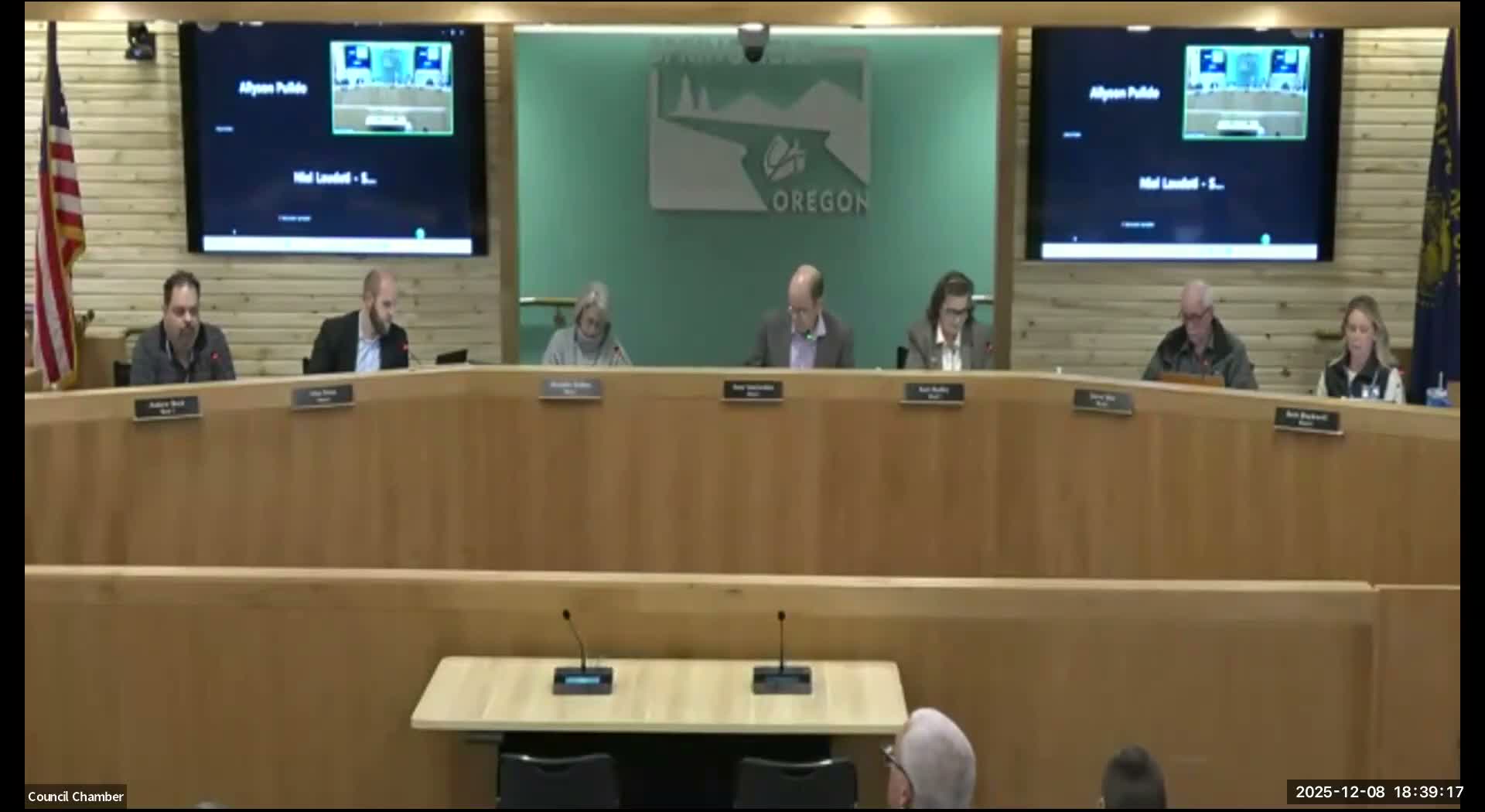
Councilor Weber moved and Councilor Buck seconded the resolution directing staff to develop a payroll tax for council review and deliberation. The motion passed on roll call, 6–0 (Weber, Moe, Rodley, Blackwell, Buck, Stout). The council did not adopt a rate or ordinance at Tuesday's meeting; staff will return with specific proposals, implementation schedules and further opportunities for public input.
Next steps: staff will reforecast revenue assumptions, prepare the municipal code and ordinance options for council review, and bring a work session on details in late January or early February, with implementation—if adopted—targeted no earlier than Jan. 1, 2027.