
Kane County committee hears state food-scrap bill and weighs local support
Get AI-powered insights, summaries, and transcripts
Subscribe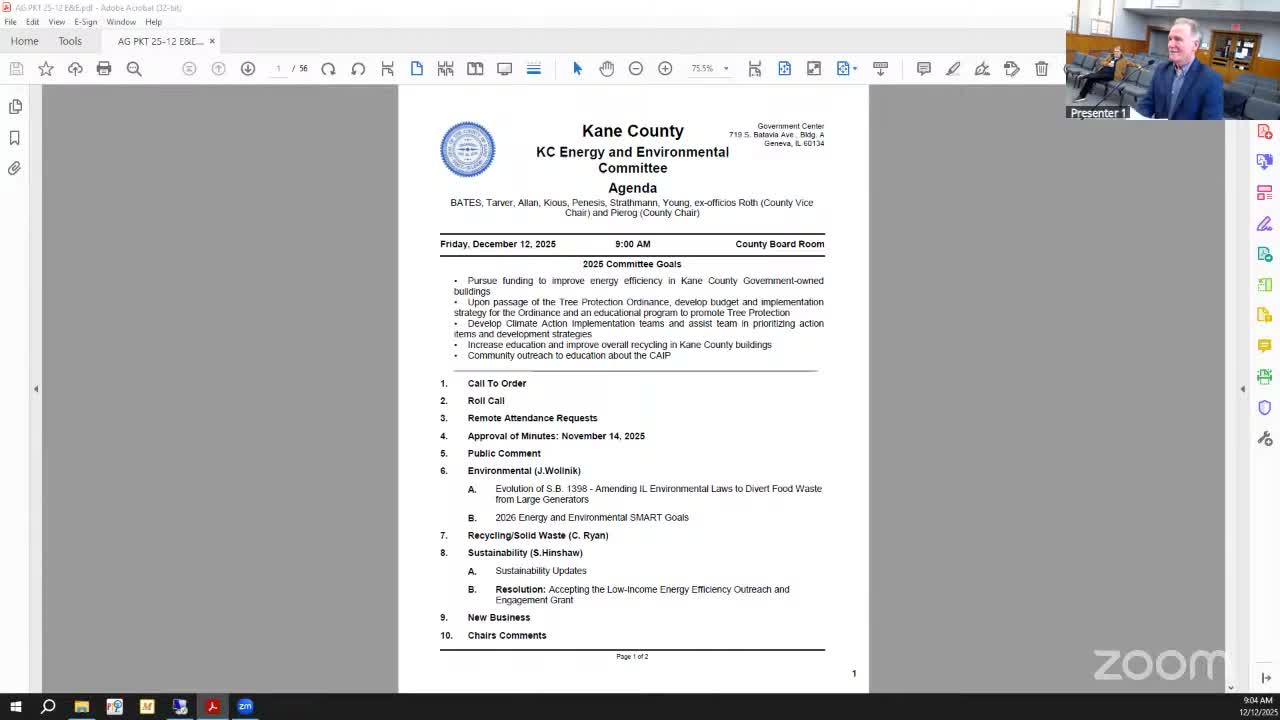
Summary
Walter Willis of the Solid Waste Agency of Lake County briefed the Kane County Energy & Environmental Committee on Illinois Senate Bill 1398, which would phase in commercial food-scrap diversion. Committee members raised cost and implementation questions and agreed to consider a resolution of support after amended language is available.
Walter Willis, executive director of the Solid Waste Agency of Lake County, told the Kane County Energy & Environmental Committee on Dec. 12 that Illinois Senate Bill 1398 would require covered commercial generators to divert food and food scraps from landfills and follow a hierarchy of responses — reduce, donate, feed animals, then compost or send to anaerobic digesters.
"This bill would require that food and food scraps as they're defined in Illinois be diverted from the landfill in certain areas," Willis said, adding the law would phase in by county population and by establishment size so infrastructure could develop before more stringent requirements apply.
Willis said the bill would begin in 2028 for counties with 240,000 or more people and initially target large grocery stores (establishments of about 40,000 square feet), then ratchet down to smaller establishments over time. He also urged local governments to consider formal support: "I guess I'm here today to have this committee and ultimately the county board of Kane decide whether or not they can formally support this piece of legislation," Willis said.
Committee members pressed on details. David Young said he was worried about cost and private-sector burden, calling the bill "just a total government overreach" and questioning whether smaller retailers and restaurants could absorb collection and training costs. Willis acknowledged cost concerns but said some private and nonprofit actors already operate programs and that, in other states, diverting food scraps has produced jobs and new economic activity. "We do see a lot of pre-consumer materials ... go into cattle and pig feed," he said, adding that the bill also includes grants and market-development provisions to help build capacity.
Members asked whether states piloted the approach; Willis said few jurisdictions ran discrete pilots and that many states implemented full diversion laws. He described alternatives used elsewhere — measuring by tons or by facility characteristics — and defended square-footage thresholds as easier to verify: "We went with an approach that New York City uses, which is mainly define the establishments you're focusing on and then do it by square footage because it's easier to see if people are in compliance or not."
The committee did not take a formal position at the meeting. Chair Mavis Bates said staff would work with the legislative committee once amended bill language is available and would coordinate with the county's state senators. Willis said he would provide updated language to county staff when amendments are filed. Several members volunteered to help with stakeholder outreach to retail and manufacturing groups cited in the presentation.
Next steps: staff will circulate the bill amendment language when available and return to the committee with a draft resolution if members wish to pursue formal county support.