
Kalamazoo reveals FY2026 budget with $1 million planned gap and major street, water and housing investments
Get AI-powered insights, summaries, and transcripts
Subscribe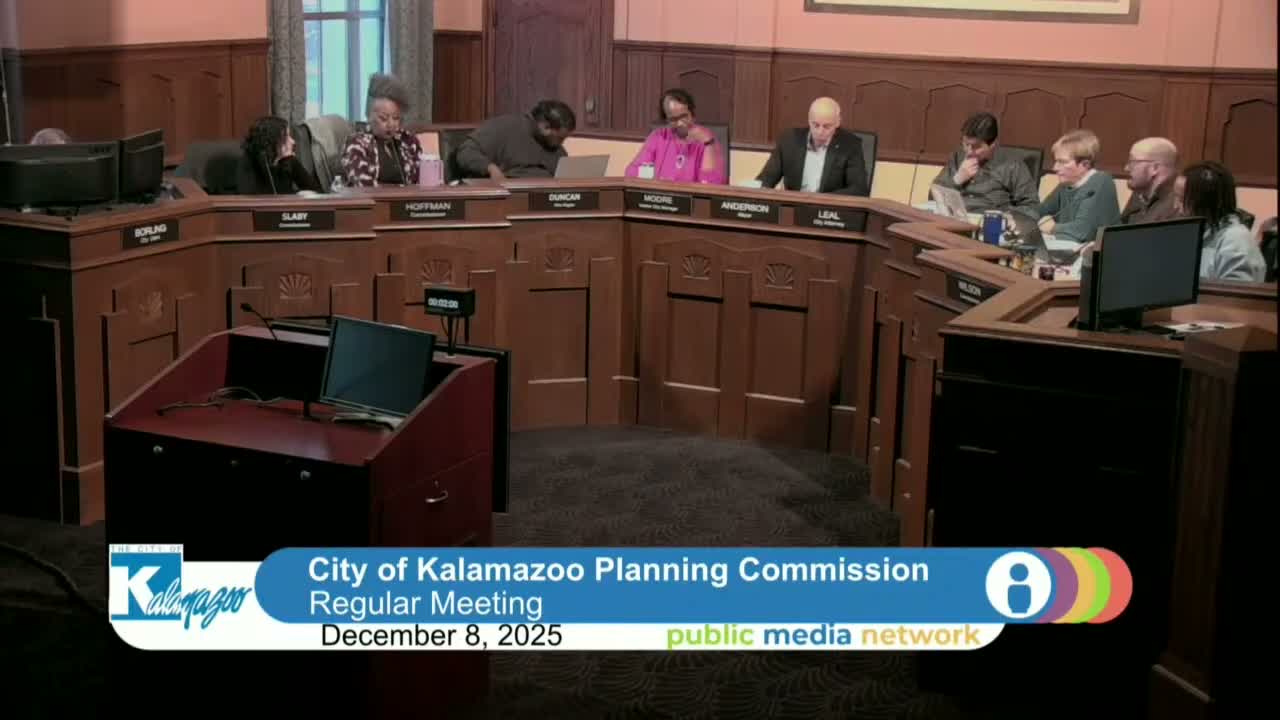
Summary
City staff presented a proposed FY2026 budget that keeps the city’s 12-mill operating levy, anticipates a $1 million planned general-fund shortfall, and funds large street and water projects along with $500,000 for emergency shelter supports; staff and commissioners debated metrics, staffing and website accessibility during the informational session.
Kalamazoo City staff on Monday presented the proposed FY2026 budget to the City Commission Committee of the Whole, outlining major spending on streets, water infrastructure and housing supports while noting a planned $1 million general-fund shortfall that staff say is part of a five-year smoothing plan.
City Manager Moore opened the informational session and noted the budget has been available on the city website since Dec. 1 and that the Commission will hold a public hearing Dec. 15 before final consideration Jan. 5. “This is really an informational and input session,” Moore said, asking residents and commissioners to review details and submit questions.
Chief Operating Officer Lam described the policy inputs used to shape the proposal — the Imagine Kalamazoo vision and a National Community Survey — and highlighted areas where resident priorities outpace perceived service quality, notably safety, the economy and utilities. Lam also outlined program-level proposals including an ongoing home-share feasibility launch and a $500,000 continuation of emergency shelter support for extreme weather funded from the Foundation for Excellence.
“Those inputs then help inform departments’ proposed budgets and their special requests,” Lam said, adding staff will continue outreach and data visualization work to show context for resident perceptions.
CFO Steve Vicencio said the FY2026 budget is 11.4% lower than FY2025 — largely because a one-time $110 million drinking-water project in the prior year does not recur — and that the city expects roughly $86 million in general-fund revenue against about $87 million in expenditures. Vicencio described the $1 million deficit as planned and linked to two bond maturities in 2026 that will reduce debt service in 2027, restoring balance in the five-year outlook.
“We plan to have revenues catch up to expenditures over the five years,” Vicencio said.
Major investments called out in the presentation include a roughly $56.3 million plan for local and major streets (about $46 million expected from state and federal grants), approximately $43 million toward the water system and $26.2 million in wastewater projects, and a $38 million federal PROTECT grant for Arcadia Creek stormwater work intended to remove about 60 acres from the floodplain and remove roughly 70 structures from flood-prone areas. The budget also proposes $6 million for lead service-line replacement in FY2026 — staff estimate that will address about 1,200 service lines.
On housing and homelessness, Deputy City Manager Rebecca Kick said the Housing Development Fund now consolidates several housing initiatives including mixed-income gap financing, rehabilitation and rental subsidies; Kick noted home share funding is included inside that HDF line and therefore may not appear as a separate line in the summary sheet. The budget proposes $500,000 for emergency shelter and extreme-weather supports, funded from Foundation for Excellence resources, and staff said roughly $2.5 million of the $5 million FFE request is intended for housing-related activities in 2026.
Public safety drew sustained attention from commissioners: the Police Chief noted public-safety programs make up the largest share of the general fund — about 47% — and reported year-to-date responses to 128,057 calls for service and declines in violent and property crime compared with recent years. “Our shots-fired caller in-progress call is about 203 seconds, which is 3.4 minutes on average,” the chief said, giving the metric as an example of operational performance tied to the department’s investment.
Commissioners pressed staff on a range of implementation questions. Commissioner Slaby flagged accessibility problems with several special-revenue fund pages on the city’s budget website and urged clearer messaging so residents understand slow-loading data; staff said the pages are active and that device or browser reloads sometimes are required, and they committed to investigate and add explanatory notes. Slaby also asked why some strategic goals lack numeric targets; staff said measures can be difficult to establish before a program launch (for example, the capital consortium) but agreed to return with more specific metrics.
Several operational and funding clarifications emerged in Q&A: the budget creates a separate building inspection special-revenue fund to make inspection operations self-sustaining; the request includes 14 new positions across funds (two of them funded by the general fund for labor-relations and administrative support); the city will buy a Vactor machine and add stormwater crew positions to clean and inspect roughly 13,000 storm structures over a planned three-year cycle; and parking operations are projected to run a roughly $1 million loss in FY2026, prompting staff to pursue a short-term parking strategy with consultants.
On sustainability, staff said a contract with Consumers Energy to source renewable energy for city operations starts producing material savings in 2027 and that most of those savings will accrue to the water and wastewater enterprise funds (ratepayer-funded), limiting direct use for general-fund sustainability projects without confirming rate impacts. Staff also said grant and small-dollar funding continues to support discrete sustainability initiatives.
Residents used the public-comment period to press for more shelter and housing investments. “I didn’t see the amount for the shelter program, which is concerning,” one speaker said during the comment period; staff responded in the presentation by pointing to the $500,000 FFE allocation and the HDF consolidation.
Next steps: the Commission will accept public comment at its Dec. 15 public hearing and is scheduled to take final action on the budget Jan. 5. Staff invited commissioners and residents to submit follow-up questions to the city manager’s office and said they will post clarifying materials and outreach information as the process continues.
What’s next: staff will report back on website accessibility for the budget book pages, return with more specific GOSM performance metrics for programs where practicable, and continue outreach on housing and homelessness services.