
Coffey County commissioners approve routine abatements, contracts and purchases
Get AI-powered insights, summaries, and transcripts
Subscribe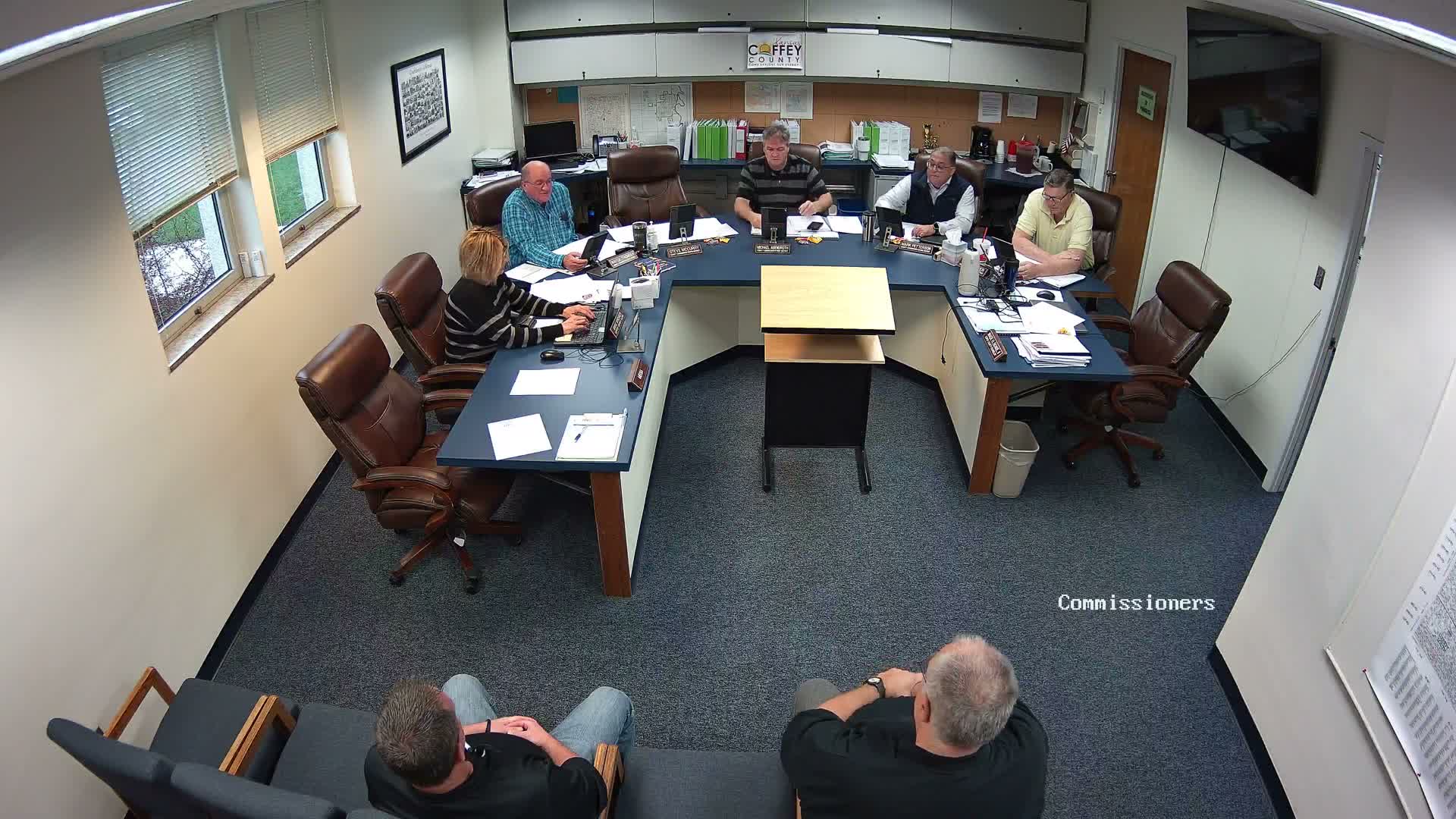
Summary
At its Nov. 17 meeting commissioners approved 12 tax abatements totaling $5,880.68, a $128,002.74 payout to Kilo Construction, a payroll reclassification for Chris Lawson, a one-year service agreement for the county fiber network, the Lake Region Solid Waste Plan resolution, and a $6,570 paper purchase; all motions passed by voice vote.
The Coffey County Board of Commissioners approved a slate of routine fiscal and administrative items during its Nov. 17 meeting.
Key actions recorded in the meeting transcript include:
- Authorization for the chairman to sign 12 tax abatements totaling $5,880.68; motion approved by voice vote.
- Approval of a payout described in the minutes as 'pay up number 3' to Kilo Construction for an economic development access route in the amount reported during the meeting as $128,002.74; staff said Garrett Nordstrom recommended paying now and discussing future work later. Motion moved and approved by voice vote (moved by Abidaros; seconded by Barker).
- Authorization for the chairman to sign a payroll notice adjusting Chris Lawson's reassignment and wage classification; motion approved by voice vote.
- Approval of a one-year service agreement with Shared Technology Team LLC to manage services related to the Coffee County Fiber Network (as recommended by the IT director); motion approved by voice vote.
- Adoption of the Lake Region Solid Waste Management Plan via Resolution Number 20205964 after an annual review presented by Lake Region Solid Waste Authority representative Shea Hainesach; motion moved and approved by voice vote.
- Approval of the IT director's recommended bid for 120 cases of copy paper at a total cost of $6,570 to be paid from the 2025 County General Fund (courthouse commodities line); motion approved by voice vote.
Each of these items was approved by voice vote with 'Aye' recorded in the transcript; the meeting record in the transcript does not contain roll-call tallies for each item. Several items included brief discussion or clarifications (for example, staff discussed which general-fund line would pay the paper purchase and noted lower paper prices than recent years).