
Department of Family Services asks legislature to replace federal SNAP education funds and fund program expansions
Get AI-powered insights, summaries, and transcripts
Subscribe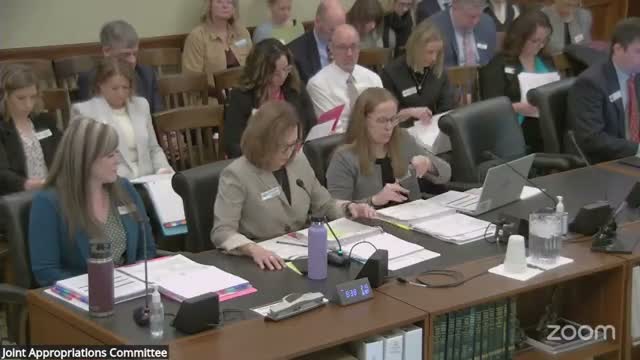
Summary
Director Corinne Schmidt told the Joint Appropriations Committee that federal changes require the state to replace SNAP education dollars and increase administrative general-fund support; DFS also requested funding for IT modernization, adult protective services, foster-youth transition services and a summer EBT pilot.
The Wyoming Department of Family Services told the Joint Appropriations Committee on Dec. 16 that federal changes to the Supplemental Nutrition Assistance Program require the state to replace lost education funding and to raise its administrative share.
Director Corinne Schmidt said the agency requests $3,000,473 to continue SNAP education operated by Sensible Nutrition through University of Wyoming extension offices, a program that served 887 adults and 2,112 youth in fiscal 2025. Schmidt said the federal statute change eliminated the federal SNAP education grant and the department must bridge the gap to keep classes that teach recipients how to make benefits stretch and improve diet quality.
The department also asked for $6,805,564 in general fund to change the SNAP administration match from a 50/50 federal–state split to one that reflects the new federal rules. Schmidt said the governor’s recommendation covers seven of eight quarters of the 2027 biennium; her request shows the full biennial impact. She warned that states with payment-error rates above 6% could be required to pay a share of benefits and said Wyoming’s error rate is below that threshold today.
In addition to SNAP-related requests, DFS outlined an ongoing $3.7 million biennial IT operations request to support its platform-based case-management systems (the agency uses a Salesforce-based approach), and sought funding for adult protective services ($1,583,948) to provide short-term emergency housing, cleanup and guardianship legal services for vulnerable adults. The department asked for $975,820 to expand independent-living supports for youth aging out of foster care, including one-time rental assistance and education or training vouchers.
Schmidt said DFS piloted a revamped foster-care training program with kinship emphasis and reported promising early feedback but said it is too soon for definitive impact numbers. She described a University of Wyoming ECHO partnership to train school personnel about mandatory reporting nuances after noting roughly half of school-originated reports during COVID were not actionable.
On summer child nutrition, DFS presented a Summer EBT ("Sun Bucks") pilot that would place grocery EBT benefits on cards for children who qualify for free or reduced lunch. The department requested approximately $3.53 million, including a startup tranche, and said the program differs from Department of Education site-based summer meals because benefits are redeemable at grocery stores.
Lawmakers pressed DFS for metrics: Schmidt provided household SNAP counts (about 28,000–29,000 households in FY25) and said Sensible Nutrition reports outcome measures (about 95% improved diet quality, 92% improved food-resource management). Committee members asked for follow-up data on pre/post COVID service levels and administrative workload impacts; DFS agreed to supply further breakdowns.
The committee paused consideration for markup and asked staff for additional cost and penetration-rate details before final decisions in January.