
Wyoming Stable Token Commission seeks $8.13M for launch, drawing questions on risk and public role
Get AI-powered insights, summaries, and transcripts
Subscribe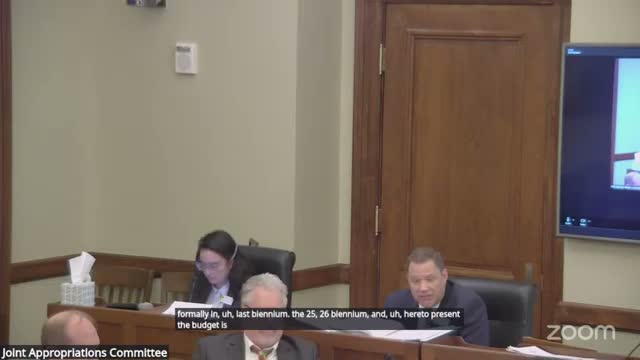
Summary
Executive Director Anthony Apollo asked the Joint Appropriations Committee for roughly $8.13 million in exception funding to finish the state-backed stablecoin rollout, citing conservative breakeven projections and vendor/market-maker costs; lawmakers probed advertising, constitutional and freeze/seize issues and asked for more fiscal detail.
The Wyoming Stable Token Commission told the Joint Appropriations Committee on Dec. 16 it is approaching public launch of the state-backed stable token and requested $8,134,262 in exception funding for the next biennium to complete vendor work, marketing and liquidity arrangements.
Executive Director Anthony Apollo said the commission has built a tech and governance stack, published rules (reserve management and token management), and deployed pilot infrastructure on multiple blockchains. He described the token as fully reserved and backed by cash and U.S. Treasuries; interest generated on those reserves would, after obligations and required over-collateralization, flow to the state’s School Foundation Program.
Apollo presented conservative adoption scenarios that show breakeven between 2027 and early 2028 depending on demand and interest rates, and said statutory controls require up to 2% over-collateralization before returns are distributed. He told the committee the commission has expended an estimated $2 million of the initial $5.8 million appropriation and seeks additional operating and vendor funds to complete launch and pay for recurring services such as market makers and custody.
Lawmakers pressed multiple points: Representative Pendergraft asked why $22.4 million was listed for advertising in agency materials; Apollo said the large marketing line mostly reflected potential market-maker and liquidity arrangements but acknowledged the commission does not intend to spend unnecessary funds. Co-Chair Bear and others pressed timing: Apollo said the commission expects the token to be publicly purchasable by the end of the month and described ongoing testing of mint/redemption flows and reserve ladders.
Committee members raised constitutional and policy questions: Apollo said the commission’s legal analysis concludes the token is not currency because it is fully backed by fiat and that Wyoming will not mandate acceptance as legal tender. He emphasized that freezes or seizure of tokens would require lawful court orders and contrasted the commission’s transparency and rules with private issuers. Members asked whether federal stablecoin legislation or state CBDC prohibitions apply; Apollo said the Commission views itself as outside the federal "Genius Act" framework and not a central-bank digital currency.
Questions also touched on staffing (the commission uses AWEC-classified positions to recruit specialized personnel), travel and the potential for issuing tokens for other sovereigns or states — activity Apollo said could be explored but may require clear statutory authorization.
The committee asked for clarification on unspent funds and whether carryforward is intended; the commission stated it expects to carry forward remaining BFY25 funds and apply them in BFY27. Members signaled concern about pace, transparency of large line items and statutory authority for cross-jurisdictional issuance and requested additional fiscal detail before markup.