
Sebring CRA approves incentive package for 139 Ridgewood Drive, including splash pad and access ramp
Get AI-powered insights, summaries, and transcripts
Subscribe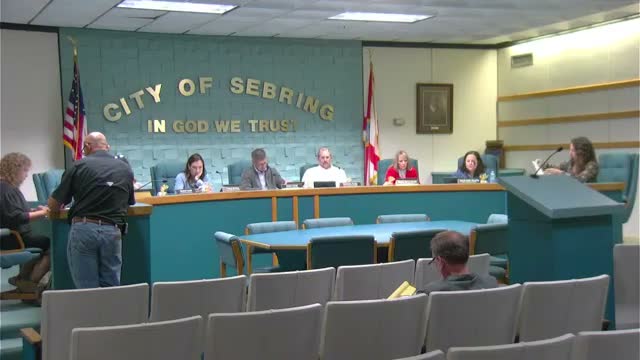
Summary
The Sebring Community Redevelopment Agency approved an incentive agreement with Kendall Blox Company for a $2.5 million development at 139 Ridgewood Drive, authorizing a 20% contribution (about $505,000) and additional local payments for a splash pad, handicap ramp, gravel pits and a nearby retention area.
The Sebring Community Redevelopment Agency board voted to approve an incentive agreement with Kendall Blox Company for a proposed $2.5 million development at 139 Ridgewood Drive, including a 20% incentive (approximately $505,000) and additional contributions for site features.
The board approved the agreement and a package that includes a splash pad (requested at $75,941), a handicap access ramp (about $21,000) and gravel pits beneath artificial turf to improve on-site retention and drainage. During board discussion, the applicant, Ken, said the splash pad is designed "as a system that you don't recirculate water" and that water would drain into the same underground system. Ken also confirmed that under the agreement the CRA will "pay the water bill for 5 years," while maintenance and repairs of the splash pad would be the developer's responsibility.
CRA staff member Christie Vasquez explained how the 20% figure is treated: $500,000 (the 20% escrow) would be held in escrow with the agency's attorney to demonstrate to lenders that funds are earmarked for the project; the funds remain in CRA possession and would be disbursed to the developer only upon project completion and as reimbursement requests are submitted. Vasquez cautioned that the eventual annual tax-reimbursement amount cannot be precisely stated now because it depends on future market valuations.
Board members pressed on stormwater and long-term infrastructure implications. Member 4 asked whether adding retention capacity now would help future downtown growth. Ken described a two-part approach: installing gravel pits under turf and on-site piping to retain water where feasible, and enlarging an off-site retention area nearby to accept excess discharge. He noted an exemption from "Swift Mud" that permits some discharge from the site, and said the retention work would be more cost-effective if completed as part of the site's construction rather than later as a standalone project.
Members also raised concern about the aggregate CRA exposure when the 20% contribution is combined with five years of tax reimbursement and the optional add-ons; one board member estimated the combined CRA commitment could surpass initial expectations and could push total assistance beyond $600,000–$700,000 depending on tax-year valuations.
The motion to approve the development agreement and the contribution package (including the splash pad, handicap ramp, gravel pits and the retention area) was moved by Member 4 and seconded by Member 2; the chair called the roll and the motion carried with affirmative responses from the board.
The agreement also anticipates five years of tax-reimbursement eligibility; staff said the exact annual reimbursement amount will be calculated when tax bills and property valuations are established after project completion.
The board did not adopt a separate long-term maintenance obligation for the CRA beyond the five-year water-bill arrangement for the splash pad; Ken said repairs and day-to-day maintenance would be his responsibility from the beginning.
The CRA now moves forward with the approved incentive agreement and the specified contribution package; the developer estimated construction would take about a year, with first full tax assessment years beginning after occupancy (projected for 2027).