
Gadsden Council Hears Strong Local Opposition to Proposed C&D Landfill Expansion; Vote Tabled
Get AI-powered insights, summaries, and transcripts
Subscribe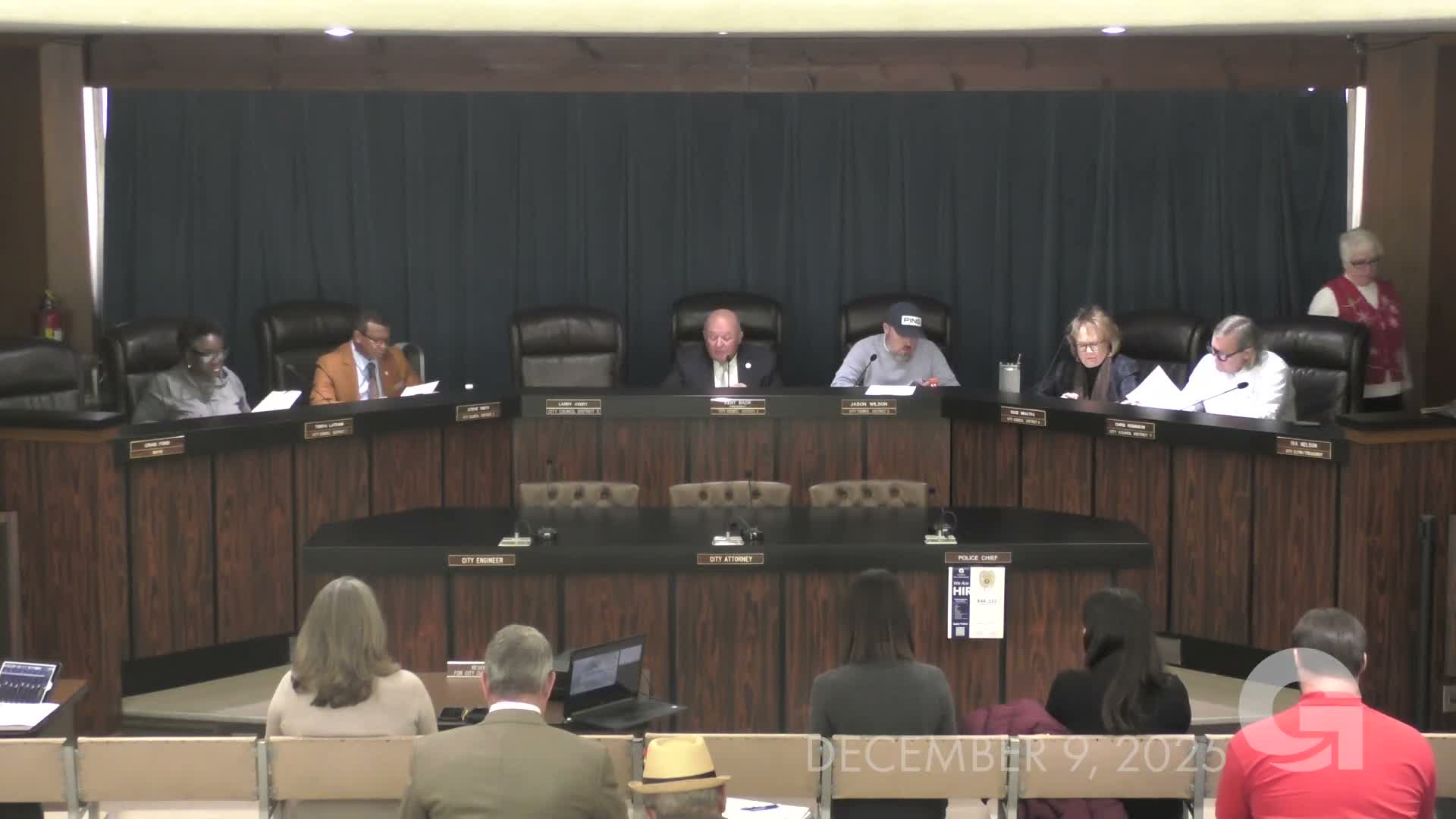
Summary
Residents from the Green Pastures area urged the council to deny a proposed expansion of the citys construction-and-demolition (C&D) landfill, citing health, property-value and environmental-justice concerns; an engineering consultant said the design follows ADEM criteria and the council voted to table action until next week so more public comments can be reviewed.
Gadsden City Council held a public hearing Dec. 9 on a proposed permit modification that would expand the footprint of the citys construction-and-demolition (C&D) landfill and open additional waste-disposal cells on city-owned property. After hours of public comment and technical briefing, the council voted to table the resolution until the next meeting to allow staff and the council more time to review comments submitted through the 4:30 p.m. public-comment deadline.
Residents from the nearby Green Pastures neighborhood described decades of industrial encroachment and said the expansion would threaten property values, quality of life and health. "This expansion threatens the value, safety, and integrity of those assets, and therefore, it is opposed," said an unidentified speaker representing the Shalindra Scott Estate. Charlie Jane Jenkins of 1603 Paradise Avenue described ongoing noise and pollution from existing nearby industrial sites and asked the council to "please reconsider" siting more landfill capacity adjacent to homes. Regina Henry (1014 Mallory Street) recounted years of neighborhood decline and urged that the location be reconsidered.
The council invited Charles Olgy, an environmental engineer with TTL, and City Engineer Heath Williamson to answer technical questions and respond to petition citations. Olgy said the design follows the Alabama Department of Environmental Management (ADEM) criteria for C&D landfills and emphasized differences between C&D sites and municipal or hazardous-waste sites cited by petitioners. "A C and D landfill is not required to be lined," Olgy said, "and the contamination and odor issues that you have with municipal solid waste landfills generally are not the same or applicable to C&D type landfill." He added that household garbage and hazardous materials are prohibited.
Olgy and council members discussed buffers, stormwater controls and oversight. He said the site design sought to exceed ADEMs 100-foot perimeter minimum in places and that the team tried to preserve existing tree buffers to help attenuate noise. On distances to homes, Olgy said the closest current residential property boundary is about 800 feet from the active cell and that construction of the proposed Cell 4 would bring the closest boundary to roughly 300 feet. He explained stormwater basins are control points used to settle sediment and to sample runoff; the landfill operates under a stormwater permit that requires quarterly sampling and reporting to ADEM.
On capacity and intake, Olgy said the current active disposal area is about 26 acres, the overall landfill property is roughly 132 acres, and the permit application includes about 130 acres of additional expansion area; he estimated the first phase of the expansion would add approximately eight acres to the active footprint. He also described long-run averages and thresholds: the landfill is a low-volume site with an estimated average intake of about 75 tons per day (well under a high-volume benchmark of 500 tons per day), and cover material is placed weekly with a six-inch soil cover requirement.
Residents repeatedly raised concerns about odors, pests, lower property values and fire risk, and several speakers framed the issue as one of environmental justice for a community with many long-term and senior residents. Olgy responded that the petition cited studies of municipal and Superfund sites not comparable to a low-volume C&D facility, and that ADEM is the regulatory authority conducting inspections and sampling.
After the public comment and technical discussion, Councilmember (speaker 5) moved to table the resolution so the council could review additional written comments and ensure all members had time to digest the supplemental material. The motion carried by voice vote. The council stated it will return to the item at the next council meeting.
Next steps: the public comment period remained open until 4:30 p.m. on Dec. 9; the council said newly received comments will be forwarded to the TTL consultant for response and shared with council members before the next meeting, when the council plans to vote.