
Salinas planning commission hears PlaceWorks plan for Phase 1 zoning updates tied to housing element, cancels Dec. 17 meeting
Get AI-powered insights, summaries, and transcripts
Subscribe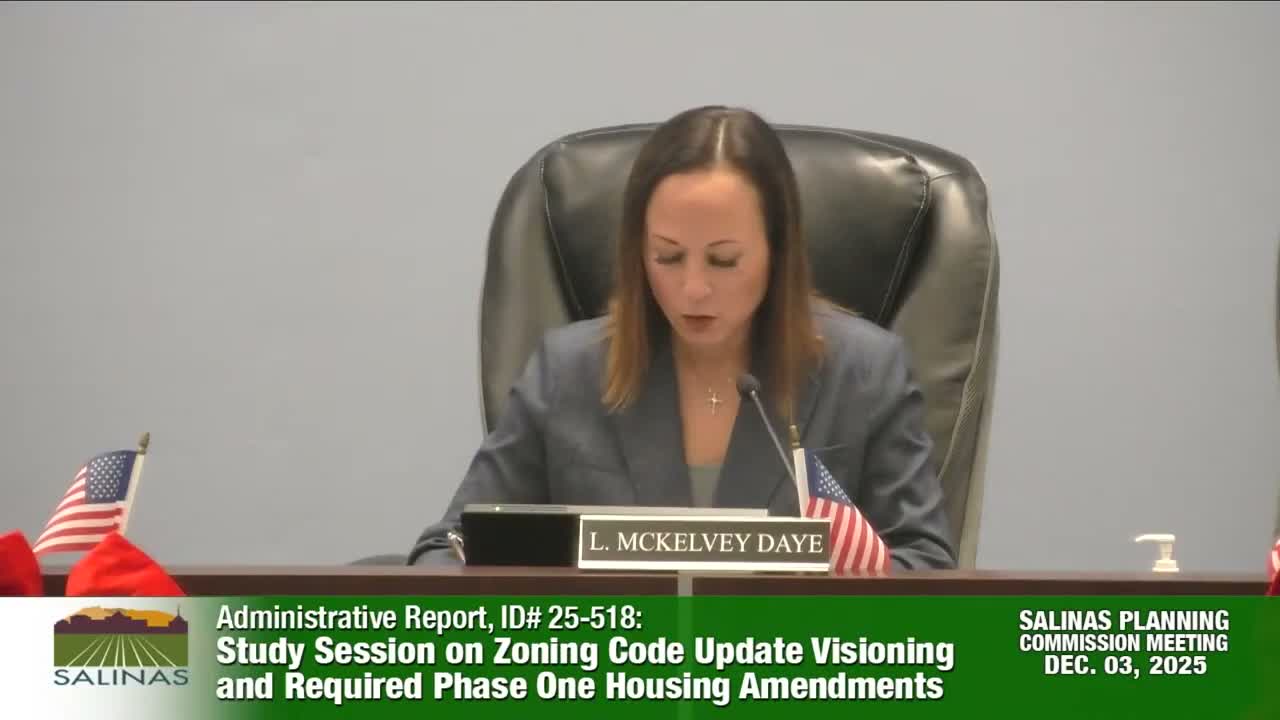
Summary
PlaceWorks presented Phase 1 of a multi-year zoning code update focused on implementing Salinas’s housing element and state laws; commissioners pressed for clearer public outreach, operational impacts and how state mandates (e.g., streamlined review and parking changes) will affect local control. The commission voted to cancel its Dec. 17 meeting.
PlaceWorks, the consulting firm hired to update Salinas’s zoning code, told the Planning Commission on Dec. 3 that Phase 1 will focus on changes required by the city’s housing element and state law, with later phases aligning the zoning map and development standards to a new general plan.
“We are starting with implementing your housing element, through some required changes to the zoning as one of the first phases of the work,” Amy Sintheimer of PlaceWorks said, summarizing the project structure and a three-phase schedule the consultant said is expected to wrap up in late 2027. She said much of Phase 1 is legally prescribed and will require fewer outreach steps than later phases.
The presentation listed concrete items that staff and consultants expect to address in Phase 1: updating accessory dwelling unit (ADU) rules to match current state law, replacing subjective conditional-use-permit findings with objective standards, revising the code’s definitions (including the term “family”), and modifying parking requirements to reduce barriers to housing—especially near transit.
Commissioners used the study session to press for detail on community engagement, implementation costs and where staff capacity might be strained. Commissioner Ruck asked, “What is this best practices jurisdiction? And where did it come from?” PlaceWorks replied that the list is an assemblage of existing municipal codes (Sacramento, Stockton, Rancho Cucamonga, Antioch, Pomona) the firm will mine for organization and measurable standards.
Several commissioners emphasized clarity and usability. Commissioner Ruck said the code should be organized so “Joe Blow off the street can come in and say, I have blah blah blah, and my zoning’s blah blah blah,” arguing the document must avoid sending users on repeated cross-references. Staff and the consultant agreed that reducing subjectivity and establishing clear, tiered pathways (administrative approval if objective standards are met; planning commission hearings if not) would be explored.
PlaceWorks and staff also summarized state-driven changes that will affect local rules: emergency-shelter and low-barrier navigation-center laws that broaden siting options and require objective standards; streamlining laws such as Senate Bill 35 (which the presenter said was extended and referred to in the presentation) that speed review for qualifying affordable projects; and other statutes (the presentation referenced AB 2097 and a Health & Safety Code section cited in the transcript) that change parking and employee-housing rules. The consultant said the city’s housing element (adopted in 2023) covers through 2031 and that many of the Phase 1 items are intended to bring Salinas into compliance with state review requirements.
Commissioners asked how the city will balance faster, administrative approvals with staff workload. Planning Manager Courtney Grossman and Community Development Director Lisa Brinton said staff is assessing process impacts; Brinton warned that failing to demonstrate progress toward compliance could jeopardize some state funding or pro-housing designations.
On procedural business, the commission voted to cancel the Dec. 17 meeting. Chairperson Natalyvdate moved that the commission skip the Dec. 17 meeting; the motion was seconded and, after a roll-call, the chair stated, “Motion passes.”
What’s next: PlaceWorks and city staff said broader public engagement will launch after Phase 1 work is complete or concurrent with Phase 2, with targeted interviews and focus groups for code users (designers, developers and other frequent applicants), larger public events (a general-plan event was planned for January) and repeated study sessions with the commission during the multi-phase process.
The commission adjourned after brief discussion about meeting frequency in 2026 and the importance of avoiding cancellations that result from lack of quorum.