
Board hears concerns as TELA first-time pass rate falls to 35%
Get AI-powered insights, summaries, and transcripts
Subscribe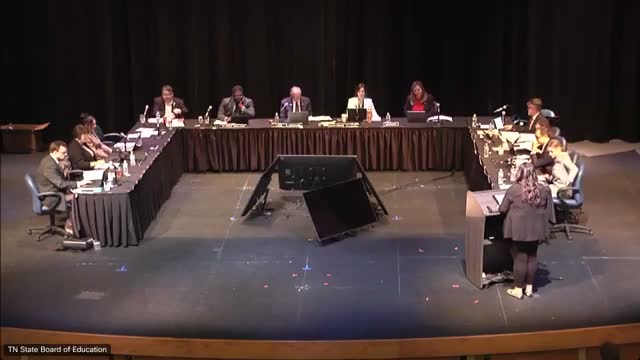
Summary
State education officials told the board that Tennessee's early-literacy assessment first-time pass rate declined to 35% in year two, prompting questions about test use, oversight of educator-preparation providers and supports to raise rates.
The State Board of Education was presented with early results from the Tennessee Early Literacy Assessment (TELA) and several board members questioned the low first-time pass rate.
Taylor Reed, senior director of licensure for the department, told the board the TELA was launched in 2023 as a 25-item assessment aligned with the Tennessee Literacy Success Act and that it is a pathway (but not a substitute) for licensure-related literacy requirements. "For overall pass time rate for year 2 was 35 percent down, from the 40.2 percent in year 1," Reed said while summarizing the department's report. Reed also said more than 11,000 educators have completed TELA and more than 65,000 completed the foundational literacy training course.
Board members pressed the department on why the first-time pass rate was low. Reed said candidates may treat the assessment as a practice opportunity because multiple attempts are permitted and oversight and monitoring differ across educator-preparation providers (EPPs). She told the board the department has action plans and is meeting with programs showing lower performance to identify supports. "Educators and candidates do have multiple attempts... that could potentially reduce some of the urgency on the first attempt," she said.
Board members asked whether there is a departmental goal for pass rates and what the expected proficiency threshold is. Department staff confirmed that licensure-related pass benchmarks vary by endorsement and that in some endorsement cases an 80% proficiency expectation is used; Reed emphasized that some endorsements require passage as a licensure condition and that pathway options remain available for candidates who do not pass TELA.
The board asked for continued monitoring and for department follow-up with EPPs to improve first-time outcomes. Department officials said they will continue to report participation and performance and to coordinate support and oversight for educator-preparation programs.
The board did not change policy at the meeting; members requested additional data and follow-up on monitoring plans and on how multiple assessment options affect pass rates and alignment to Tennessee standards.