Portland public hearing on Jefferson High boundaries turns into sharp debate as superintendent backs 'Scenario C'
December 09, 2025 | Portland SD 1J, School Districts, Oregon
This article was created by AI summarizing key points discussed. AI makes mistakes, so for full details and context, please refer to the video of the full meeting. Please report any errors so we can fix them. Report an error »
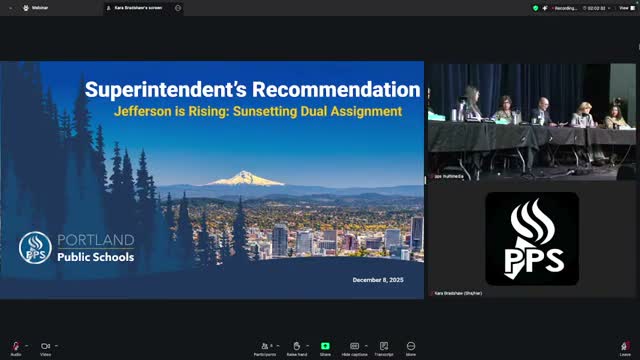
Board Chair Eddie Wong began the evening by acknowledging community concerns about the tone of a prior meeting and apologizing for conduct that left people feeling "dismissed, unheard, or undermined," saying in part, "We agreed that parts of the meeting did not reflect the level of respect, clarity, or care that our community expects from its elected leaders." The session then moved to a presentation of the recommended assignment area and an extended public-comment period.
Assistant Superintendent Margaret Calvert outlined the district’s outreach and analysis behind Scenario C, saying the district ran transit and proximity analyses, modeled capture rates and projection targets, and intends a phased implementation beginning with incoming freshmen in 2027 and full phase-in by 2030–31. Calvert said the district sought broad input (six formal engagement sessions with more than 400 families, 200+ form responses and mailed postcards to addresses in the dual-assignment area) and described Scenario C as balancing proximity, enrollment feasibility and long-range planning. "The superintendent recommends Scenario C," Calvert said, framing it as a path to bring Jefferson’s enrollment closer to the district target for a comprehensive high school.
Public commenters split into two broad camps. Many parents, students and community members argued Scenario B better protects existing feeder patterns, limits disruption to middle-school cohorts (especially Harriet Tubman), and gives Jefferson a stronger, more stable enrollment base to support comprehensive programming. Fifteen-year-old Grove Tollson, a Vernon student, told the board Jefferson needs 1,100 students to sustain a full comprehensive program and said he supported Scenario B so Jefferson could immediately offer robust electives and athletics. Several parents and community analysts disputed aspects of the district’s modeling; Laura Westwood and others said small differences in capture‑rate assumptions can swing Jefferson’s projected enrollment and urged board members to question the data.
Other speakers — including families from neighborhoods closer to Jefferson — supported Scenario C, arguing proximity and neighborhood alignment matter and saying Jefferson deserves the opportunity to be a vibrant, well‑resourced neighborhood high school. Supporters who favored Scenario C also urged the board and district to ensure a well‑funded launch so incoming cohorts do not face reduced programming while construction and staffing ramp up.
Multiple commenters pressed the board to include a clear, written amendment if Scenario C is adopted: not only a boundary change but an explicit guarantee of funding, staff hires and program parity "from day one," so that Jefferson students would have the same access to AP courses, arts, CTE pathways and athletics as peers at Grant, McDaniel and Roosevelt. Parent Gina Levine told the board that without explicit commitments "you can't build a comprehensive high school on uncertainty."
Equity and safety were recurring themes. Speakers from Sabin and other historically feeder communities argued that removing Sabin from Grant would reduce diversity at both high schools and force some children onto longer, less safe commutes across MLK and Prescott; Bina Patel said, "Pulling Sabin out of Grant significantly reduces diversity at both Grant and Jefferson." Several Jefferson alumni and long-term neighborhood residents framed the change as an opportunity to reverse decades of disinvestment in Jefferson and insisted that the district must accompany any boundary shift with investments that repair harms.
Board and district officials closed the meeting by announcing a teaching, learning and enrollment committee meeting later in the week, a board work session on Dec. 16, and a tentative vote scheduled for Jan. 13. No final board action occurred at the listening session; the public comment record and committee discussions will factor into the board’s January vote.
What’s next: the board is scheduled to review detailed implementation and program plans at upcoming committee meetings and to consider an assignment-area vote on Jan. 13. Several commenters urged an amendment guaranteeing funding and a staffing plan be adopted alongside any boundary decision to ensure program parity during the transition.
View the Full Meeting & All Its Details
This article offers just a summary. Unlock complete video, transcripts, and insights as a Founder Member.
30-day money-back guarantee
Sponsors
Proudly supported by sponsors who keep Oregon articles free in 2025

