
Multnomah County to cut services after CareOregon delegation ends; board approves $2.4M bridge to retain staff
Get AI-powered insights, summaries, and transcripts
Subscribe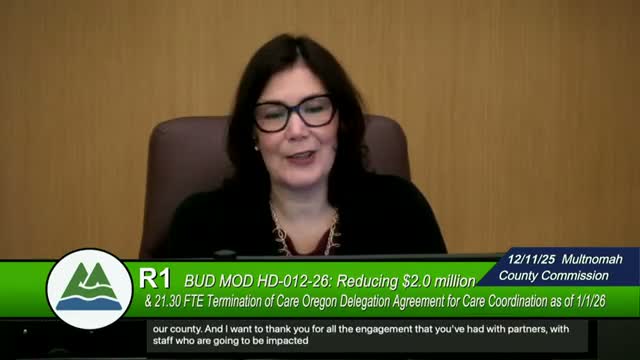
Summary
County health officials told commissioners HealthShare’s decision not to renew CareOregon delegation agreements will remove roughly $4.6 million in FY26 funding and eliminate programs funded by the CCO; the board approved one-time bridge funding of $2.4 million to retain about 17 FTE through June 2026 while staff design FY27 options.
Multnomah County commissioners on Monday approved emergency budget changes after HealthShare and CareOregon moved to end delegation agreements that had funded intensive care coordination programs.
Health department director Rachel Banks told the board the county faces two linked tasks: adopt a budget modification removing activities and revenue tied to the ending delegation agreement, and approve a separate one-time appropriation to preserve essential services while the county plans for fiscal year 2027. "The delegation agreements will end on December 31 of this year," Banks said, describing a shortfall that left the behavioral health benefit running at a deficit.
Jessica Jacobson, interim deputy director for clinical integrity, said the intensive care coordination services for youth and adults had been funded 100% by CareOregon and that the decision will remove programs the county previously performed under delegated duties. Finance manager Brady Estevez estimated the county would recognize about $4.6 million in lost revenue for FY26 tied to the terminated agreements and said Bud Mod 012 eliminates funding for roughly 20.5 FTE in certain care coordination roles effective Jan. 1, 2026.
Interim behavioral health director Anthony Jordan told the board the proposed package aims to retain core capacity while minimizing personal hardship for impacted staff: "We are looking to retain approximately 17 FTE for the next 6 months," he said, and emphasized the county would actively work with human resources to secure placements where possible.
Commissioners pressed staff on service impacts and alternatives. Commissioner Brent Medhors asked how the changes would translate to community services; Jacobson said the most intensive in-person outreach—teams providing long-term, hands-on coordination—would largely stop and be replaced by plan-based care coordination that is less intensive and less likely to be in-person. Multiple commissioners raised the possibility of using 1915 waivers or state mechanisms to fund intensive case management; staff said those were being explored but did not offer an immediate replacement.
After questions and discussion, the board approved Bud Mod 012 to remove the terminated activities and then adopted Bud Mod 013 to appropriate $2.4 million in one-time funds to sustain essential staffing and services through June 2026. The county plans to use the six-month period to develop FY27 budget solutions while preserving the Choice model and other required services where possible.
What’s next: the reductions are effective Jan. 1, 2026, and county staff said they will continue to seek alternative funding and partnerships to restore or replace lost functions during the FY27 budget process.
Votes and motions: Commissioner Jones Dixon moved approval of the initial modification; Commissioner Singleton seconded. The board approved the backfill appropriation (Bud Mod 013) by roll-call vote.