
Louisiana parole board denies multiple parole requests after contested hearings on Dec. 11, 2025
Get AI-powered insights, summaries, and transcripts
Subscribe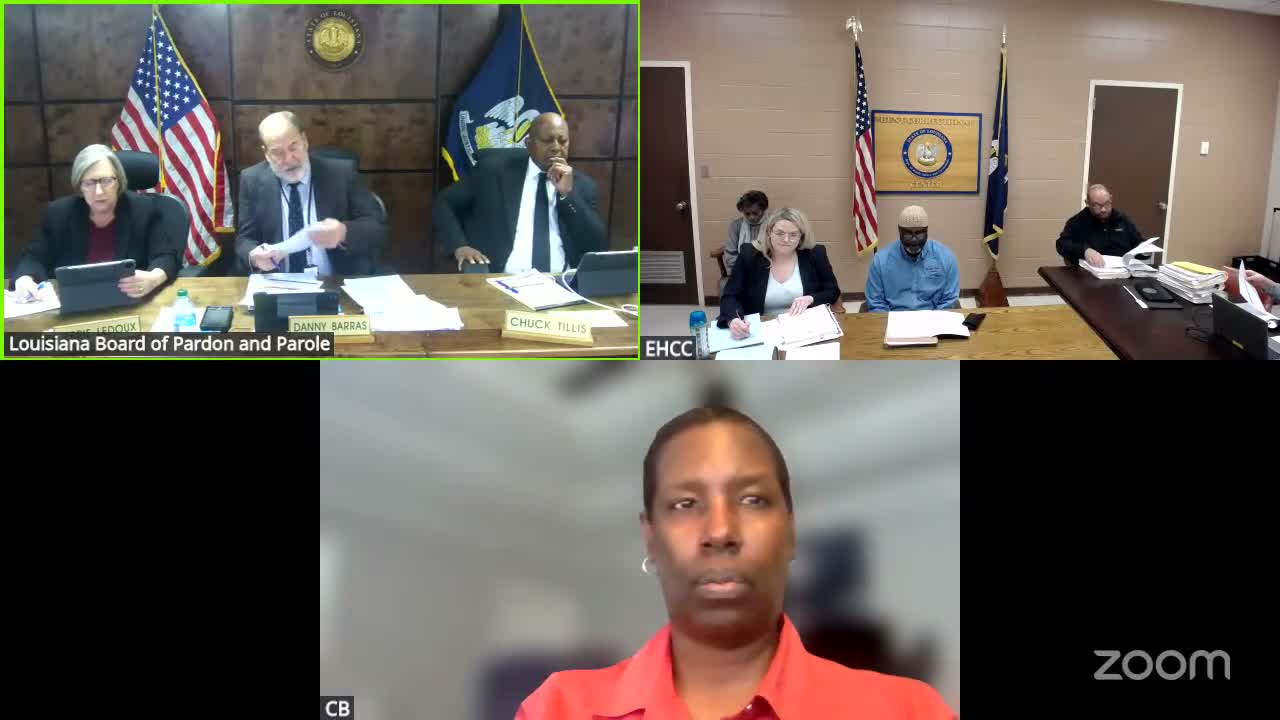
Summary
On Dec. 11, 2025, the Louisiana Committee on Parole heard several cases at DOC headquarters in Baton Rouge and remote sites. The board denied parole for multiple applicants after testimony from inmates, supporters, wardens and district attorneys; denials cited public‑safety concerns, disciplinary records or incomplete programming.
The Louisiana Committee on Parole met Dec. 11, 2025, at DOC headquarters in Baton Rouge and remote correctional facilities and denied parole in a series of contested cases.
The panel opened the morning session by outlining procedures for inmate statements, warden reports, supporters and opponents, and district attorney input (SEG 001–035). Over the day the board heard applicants who described rehabilitation steps, vocational training and reentry plans; supporters described family and nonprofit reentry support; prosecutors and law‑enforcement officials urged denials in several cases.
In the earliest hearing, Larry Joseph McClinton (DOC 315102) told the board he killed two people and injured another and apologized to the victims’ families, describing decades of education, tutoring and religious leadership during 33 years in custody. His mother, Betty Spears, and representatives of the Pearl Project urged release, citing McClinton’s programs and the Supreme Court’s Miller/Montgomery framework for juvenile‑era offenders (SEG 036–1287). The Rapides and Grant parish district attorneys and local law enforcement opposed parole; Assistant District Attorney Philip Terrell summarized investigative reports and argued that the record and forensic evidence undercut McClinton’s account, saying, “It’s the state’s position that what we have is here is 2 cold blooded murderers” (SEG 747). After board discussion the panel voted to deny parole for McClinton by a 2–1 margin; the board cited the seriousness of the offenses and law‑enforcement opposition.
The board next considered Jake Mike Ortega (DOC 446422). Ortega described a late‑night fight, accepted responsibility and laid out a Colorado‑based reentry plan and employment prospects. Supporters and local reentry groups offered housing and intensive outpatient therapy; the warden summarized a recent custody record and programs completed. Prosecutors and sheriffs objected to release on public‑safety grounds and asked the board to weigh institutional history against the proposed plan. The panel denied parole after examining residency and program compliance (SEG 1314–2276).
Other applicants included Henry Fagan (a mental‑health case), Troy Jordan (who has more than 40 certificates but a problematic disciplinary window between 2018 and 2022), Alan Reed (a violent multi‑offense case prosecuted in Orleans and Jefferson parishes), Michael Alexander (a drug‑distribution case), Lloyd Knott (workplace threats and repeated violent incidents), Billy Perkins (extensive disciplinary history) and Emmanuel Walton (a domestic‑abuse conviction producing serious injury). In each instance prosecutors or local law enforcement cited the severity of the original crimes, the applicant’s disciplinary record or gaps in long‑term treatment and opposed immediate release (see timeline for each case’s record and board findings). The board uniformly urged further programming where it deemed it necessary — for example, long‑term substance‑abuse treatment, victim‑impact work, anger management and GED or vocational completion — and denied parole in each of the cited cases (SEGs 2301–5343).
The hearings included direct appeals to the panel from family members and reentry organizations. Carrie Myers of the Pearl Project told the board that the organization had accepted McClinton for transition housing and support and that the nonprofit would “keep [him] in our program, in our housing as long as he needs it” (SEG 446–481). Innocence & Justice Louisiana’s Caitlin Newswanger described the wrap‑around reentry plan for Troy Jordan and noted his multiple certificates: “He sits before you having over 40 certificates” (SEG 3343–3345). Prosecutors repeatedly emphasized the gravity of underlying offenses and the lasting harm to victims; Edward McGowan of the Orleans Parish DA’s office described one case as “truly horrific” and urged the board to weigh community safety alongside any rehabilitation claims (SEG 4178–4184).
What changed procedurally after the hearings: in each case where the board denied parole, members recommended specific programming or a stronger residence plan before an applicant should return for reconsideration. The board recorded denials by vote and closed each case according to standard procedure; several members noted that applicants who complete additional, targeted programming and maintain discipline could be reconsidered later.
The committee adjourned after hearing the scheduled cases for the day; each denied applicant was informed of the board’s decision and the additional steps the board recommended prior to any future hearing.
Sources: Committee on Parole hearing transcript, Dec. 11, 2025 (committee proceedings and witness statements as recorded in the hearing record).