
Martin Arts pitch for Stuart High School campus raises questions over alcohol rules and property options
Get AI-powered insights, summaries, and transcripts
Subscribe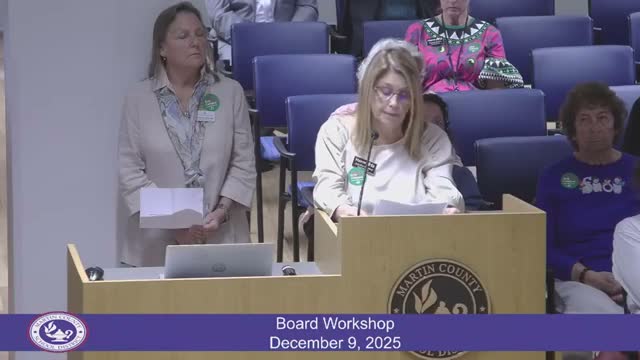
Summary
Martin Arts and local arts leaders urged the Martin County School Board to approve a lease of the former Stuart High School to create an arts campus, saying limited evening alcohol service is integral to the project’s revenue model; the board and its attorney flagged board policies and city rules that could bar on‑site alcohol and directed staff to update appraisals and property inventories.
An organization backing a plan to convert the vacant Stuart High School into an arts and culture campus told the Martin County School Board on Monday that limited alcohol service outside school hours is key to making the project financially viable, while the board’s attorney said district policies and local rules raise legal obstacles that the board must resolve before approving a lease.
Martin Arts representatives, artists and local arts leaders appealed to the board during public comment, describing the proposed campus as a multiuse destination for students and the community that would support arts education, downtown businesses and local employment. "Martin Arts will not serve alcohol during school hours or school related functions," one representative said, adding that service would be "strictly limited to evening or weekend" events with "proper licensing, training staff, and strong safety protocols." The speakers said the group has raised more than $500,000 in cash and in-kind support to date and hopes lead gifts this season would allow construction of phase one—work on two 1950s classroom buildings—to begin by late next year.
But Terry Harmon, an attorney for the school board, told trustees the board must follow existing board policies and local rules that could restrict alcohol on district property. Harmon said the district’s student drug‑prevention policy defines "drug" to include alcoholic beverages and establishes a drug‑free zone within 1,000 feet of district facilities used for educational purposes. He also pointed to a board policy that generally bars alcoholic beverages at functions occurring on district premises. "There is nothing in Florida law that absolutely prohibits a school board from engaging in this type of activity," Harmon said, "but there are a number of . . . concerns" that would have to be addressed, including proximity to Stuart Middle School and how classrooms or student learning in the building could trigger other workplace or student‑safety rules.
Board members acknowledged the project’s community benefits but repeatedly raised fiduciary and logistical questions. Several trustees said holding the property indefinitely is a financial burden on the district and noted that roughly $500,000 raised over several years falls short of the millions the full renovation would require. One board member urged staff to update appraisals, surveys and an inventory of underutilized properties so the board can consider sale or lease options. "I would like you to direct Dr. Miller to start the process of getting the value of the property," the board chair said; trustees agreed to begin appraisals for properties of immediate community interest, including the Stewart campus and others previously evaluated.
Martin Arts representatives said the inability to serve alcohol as envisioned in the business plan is a "deal breaker" for their fundraising model, but they also expressed willingness to seek compromises. Trustees discussed a path that would remove the district from ownership—selling the property to a private owner or arts organization—so decisions about liquor licensing would rest with the new owner and with municipal permitting. Harmon noted that city ordinances on distance from schools (roughly a 500‑foot rule cited by a speaker) and the city’s waiver/permit process would govern any license application.
The board did not vote on the lease or a sale. Harmon clarified that an "intent to lease" document in 2022 memorializes shared goals but is not itself a lease; it sets deadlines for delivering a formal lease, including a notice‑of‑intent deadline and a 30‑day window for negotiating a proposed lease after that notice. Any enforceable lease must be drafted and mutually agreed by both parties before coming back to the board for a vote.
The board moved later in the meeting to policy reviews and other agenda items and adjourned without acting on a final lease. Next steps: staff were directed to update appraisals and property surveys and to report back so trustees can weigh sale versus lease options and any policy changes required to allow limited alcohol service under narrow conditions.