
Mississippi community colleges ask Legislature for salary boosts, $150M for repairs and $5M for career tech
Get AI-powered insights, summaries, and transcripts
Subscribe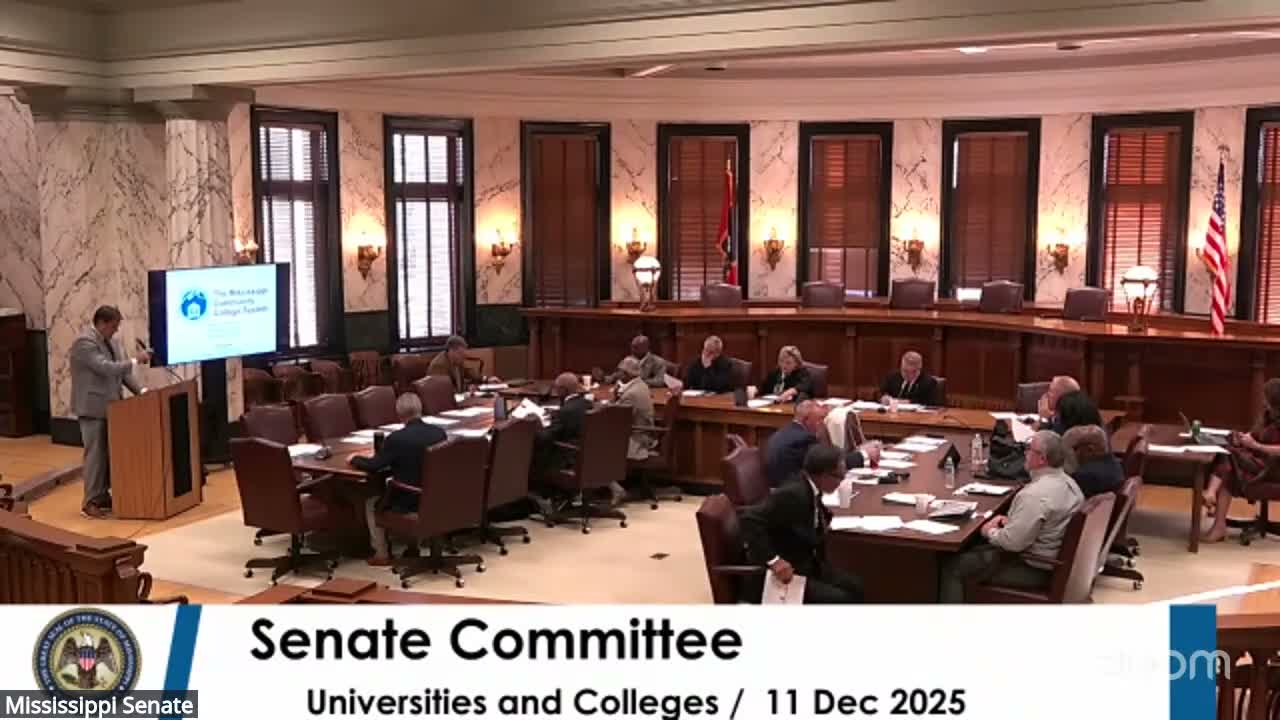
Summary
The Mississippi Community College Board told legislators the system serves 88,685 students and is requesting $28M for salaries, roughly $28.5M for operations, $5M to expand career-technical programs, $150M for repair/renovation and $2M for adult education in FY27.
Kale, executive director of the Mississippi Community College Board, told a legislative committee the system serves 88,685 students across 15 locally governed colleges and asked the Legislature for multiple budget increases to sustain operations and workforce training.
"We are the number 1 FAFSA completer in the country," Kale said in opening remarks, and he highlighted the colleges'role as a statewide workforce engine during a presentation that summarized enrollment, awards and costs. The system reported 20,075 degrees and certificates awarded in the most recent year and an average annual tuition and required fees of $4,068.
Kale explained the state's funding formula: 15% of appropriations is a uniform base and 85% is distributed by full-time-equivalent (FTE) enrollment with weights for program type. He told the committee the model has been in place since FY2004 and that an FY25 FTE equaled $3,560.96, with higher weights for associate-degree nursing and allied health.
On budget requests, Kale said the board's FY27 priorities include: $28,000,000 for salary improvements (described as a 6% increase), roughly $28.5M for basic operations, a $5,000,000 increase to the Career Tech Advantage program, a $150,000,000 request for capital repair and renovation (R&R) and $2,000,000 for the state's adult education office. He framed those asks as responses to rising operating costs and to the high expense of delivering technical and health programs.
Legislators asked how R&R funds would be distributed and whether the formula accounts for older facilities and uneven local capacity. Kale said capital distributions for bonds or capital projects are shared "half enrollment and half evenly" with the R&R formula split "half enrollment and half square footage maintained." He also noted local millage contributions and other nonstate revenue sources help fund projects.
Committee members raised salary parity concerns with K-12 pay, the need for a transparent five-year capital plan, and requests for campus-level breakdowns of local millage and R&R needs. Kale agreed to provide detailed county and campus reports to committee members.
The presentation concluded with an economic impact summary Kale attributed to a statewide study: he said 84% of community college graduates remain in Mississippi within a year and that community college activity generates roughly $2 billion in wages and $243 million in tax revenue annually. The committee scheduled follow-up requests for detailed breakdowns of local contributions and five-year capital plans.