
187th District Court opens morning docket, reminds attendees of procedures and schedules jury trial
Get AI-powered insights, summaries, and transcripts
Subscribe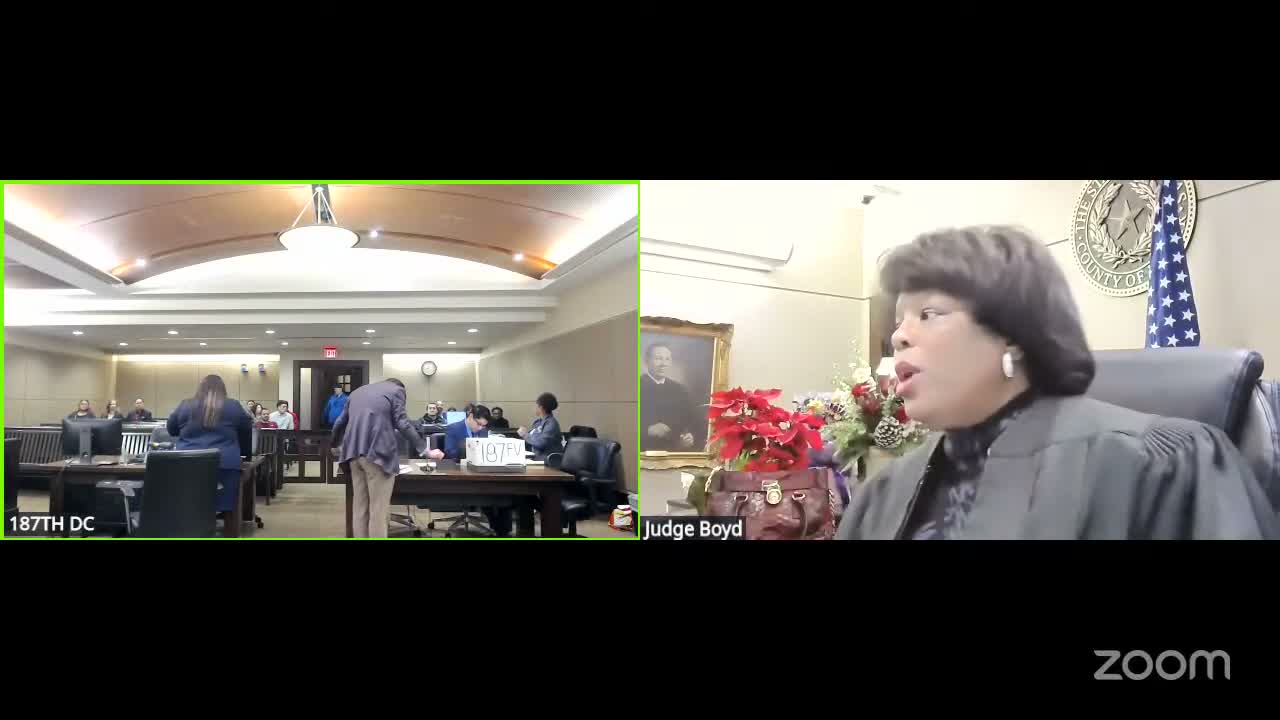
Summary
Judge Stephanie Boyd opened the morning docket, reviewed courtroom rules including interpreter and custody procedures, announced a 1:30 p.m. jury trial start and a noon staff break, and set numerous plea-deadline and trial dates across the docket.
Judge Stephanie Boyd convened the 187th District Court morning docket and instructed everyone called to stand and confirm presence when their name was read, warning that failure to respond could result in a warrant. She reviewed courtroom procedures for attorneys — including requirements to confer with the state and clients before approaching the bench, how to request custody defendants from deputies, and the requirement to arrange an interpreter if a non-English language will be used.
The court identified probation officer "Miss Abrams" as a participant the bench will consult on cases involving probation and reminded parties that the court reporter’s area is off-limits while the record is open. "If your client is in custody, request them from the deputy," the judge said, instructing counsel and deputies on logistics. She also told the courtroom staff would take a break at 12:00 p.m. and that a jury trial would begin at 1:30 p.m.
Why this matters: the court’s opening sets the procedural baseline for dozens of cases on the calendar, establishes scheduling expectations for attorneys and defendants, and flags immediate operational constraints — including custody logistics and interpreter needs — that affect case timing and access to counsel.
The court then proceeded through the docket, calling dozens of names and noting custody status, who appeared by Zoom and which matters were set for plea deadlines or jury trials. For many matters the judge set short timelines for plea deadlines or disposition (commonly in January), required the state to produce discovery and to tender any offers by the date set, and directed probation to prepare or review TAP/PSI recommendations where applicable. Several matters were continued or reset so the court could hear additional records, competency reports or contested motions.
Among procedural notes the judge said she will consult probation when appropriate, may require defendants to provide proof of employment within specific windows when ordering probation conditions, and emphasized that communication with probation is critical to avoid collateral sanctions. The court also reminded attorneys to file formal motions — for example, an attorney who needs a record sealed will have to file a motion to unseal and obtain any necessary permissions.
The court recessed mid-morning to allow staff preparation for the afternoon jury trial and to complete administrivia for the remainder of the docket. The morning record shows multiple plea-deadline dates and scheduling resets for January and March, reflecting a busy calendar of pretrial windows and upcoming trials.