
Philomath council favors mixed-use plan for city'owned former gas station, asks staff to draft RFQ
Get AI-powered insights, summaries, and transcripts
Subscribe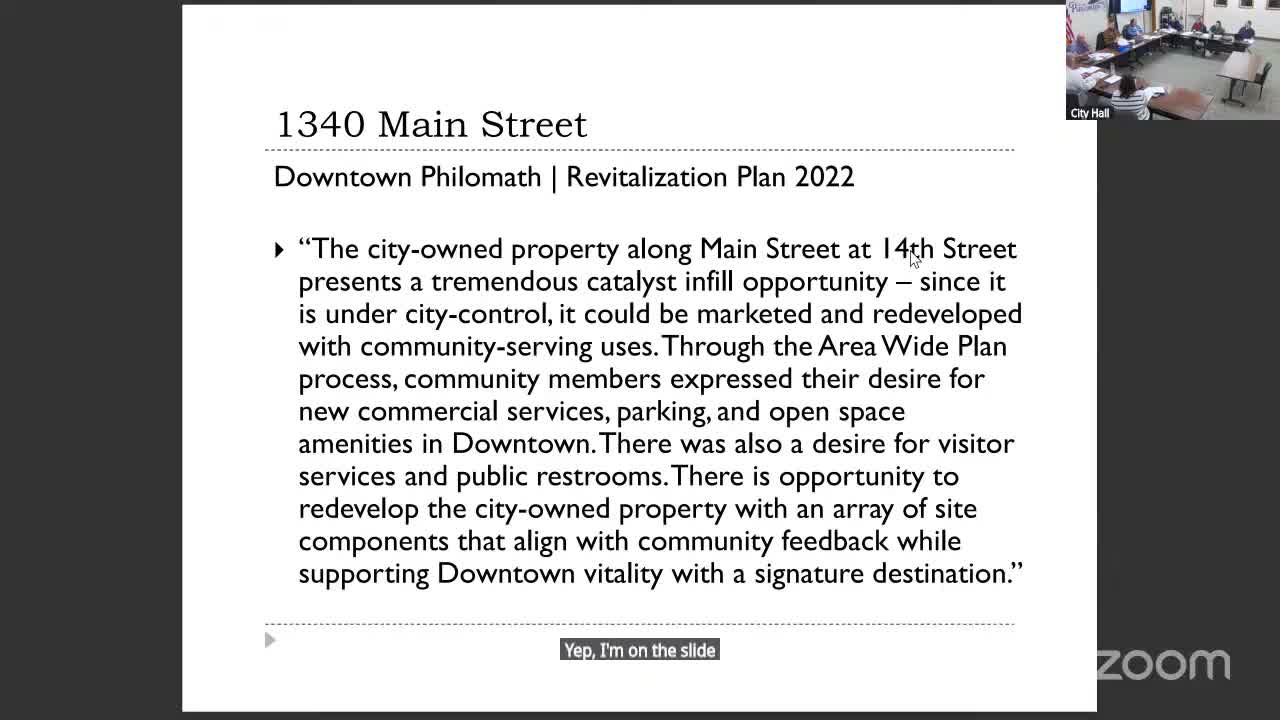
Summary
At a Dec. 8 work session the Philomath City Council reviewed an area-wide downtown plan and three options for the city-owned property at 14th and Main (1340 Main). Council members generally favored a mixed-use development with ground-floor commercial space and a public restroom; staff will draft an RFQ/RFP and return with details.
PHILOMATH, Ore. ' At a Dec. 8 work session, the Philomath City Council reviewed an area-wide downtown revitalization report and discussed redevelopment options for a city-owned former gas station at 14th and Main (1340 Main).
City manager and urban renewal manager Tiff, who presented the history and options, traced the city's urban renewal work from the 1990 plan through later expansions and infrastructure projects. Tiff said the city has used renewal funds for College Street improvements and later to address chronic downtown flooding by extending storm drains down 13th Street. She told council the city recently completed an underground-tank removal and environmental cleanup at the 14th and Main site under DEQ oversight.
Why it matters: the site is a visible gateway into downtown and sits inside the urban renewal area, so how the city disposes of or develops the property will shape downtown character and private investment. Stantec's area-wide plan offered three options for the parcel: a mixed-use building with ground-floor commercial and visitor amenities; a public plaza/event space with parking and restrooms; or a larger block-scale redevelopment that would require assembling multiple parcels.
Council discussion focused on fit and feasibility. Multiple council members said the site's location at the highway edge and as a gateway corner makes it better suited for a mixed-use project than for a standalone plaza. "My preference is the multi use," Councilor Cromer said, arguing taller units would create more housing supply above street-level businesses. Other members pointed to 13th Street as the natural hub for block parties and festivals and suggested investing in that area for public gathering spaces rather than converting the 14th & Main parcel into a plaza.
Parking was a recurring concern. Staff reported a parking inventory done by the Council of Governments and said the city plans to add striped parking and an electric-vehicle charging station on nearby side streets rather than pursue expensive multi-level parking. Tiff noted that structured parking costs were prohibitively high in the consultant's analysis and that market-driven on-site parking is typical for private developers.
Accessibility and visitor services also figured in the conversation. Several councilors pressed for an accessible visitor amenity and for at least one public restroom in any redevelopment. "I think having a public restroom has its benefits," one councilor said, noting downtown visitors and festival-goers would use the facility.
Process, procurement and constraints: staff presented a sample RFQ/RFP used by the City of Dallas as a template and asked whether council wanted an open solicitation or a targeted negotiation (the latter had been used previously with the Commonwealth project). Council signaled support for an open call for proposals but wanted staff to craft clear design parameters (timber-town guidelines, ground-floor commercial, restroom requirement) and selection criteria.
Budget limits were noted. Tiff said the urban renewal agency has a limited remaining capacity (about $340,000'$360,000) that could be consumed if the agency acquires additional adjacent parcels; that constraint will factor into whether the city markets the parcel alone or packages it with neighboring land.
What happens next: council asked staff to prepare a draft RFQ/RFP and to return with refined design parameters, renderings, and public-engagement options. Staff said it could prepare an 80% draft for council review, then open a public hearing and solicit community input before final selection.
Quotations in context: on cleanup and regulatory process, Tiff described the DEQ interaction: "If we could show that they were decommissioned before 1974, then we were excluded," a discovery that helped the city avoid additional registration requirements and stay on schedule for tank removal. On capacity limits, staff said the agency's remaining indebtedness is small, estimating roughly $340,000'$360,000 in available urban renewal funds.
The work session ended without a formal vote; the council adjourned at 6:42 p.m. and planned to take further action after staff returns with RFQ/RFP materials and public-input options.