
Monroe-Woodbury superintendent briefs board on eight district goals, from curriculum to bus electrification planning
Get AI-powered insights, summaries, and transcripts
Subscribe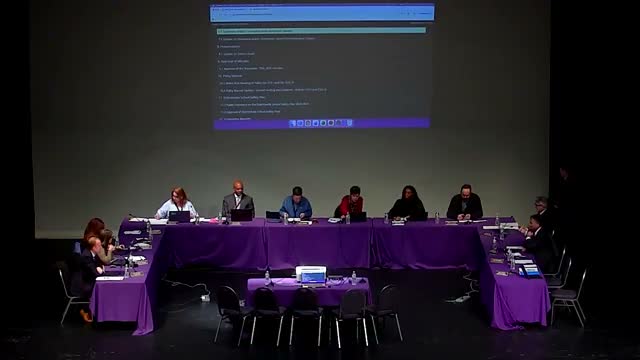
Summary
Superintendent Dr. Tracy Norman presented progress on eight district goals, including curriculum and attendance tracking, a new curriculum council, MTSS and special-education compliance, cybersecurity audits, strategic-planning outreach and capital projects that include planning for zero-emission buses. Board members pressed for clearer metrics and timelines.
Dr. Tracy Norman, superintendent of schools, told the Monroe-Woodbury Board of Education on Dec. 10 that the district is advancing eight strategic goals that cover instruction, human resources, technology and facilities.
"We have 8 goals, and each goal, one of our cabinet members takes responsibility for that goal as it falls under his or her purview," Dr. Norman said as she introduced the update and the cabinet presenters.
Goal 1 focuses on academic content and measurement. Dr. Morales and Dr. Hasler said the district is monitoring attendance and student achievement data (grades, state exams, AP and dual-enrollment outcomes) and has begun a curriculum council and learning walks to improve vertical alignment. They reported about 25% completion on several tasks and roughly 50% on monitoring student achievement activities.
Board members pressed for clearer progress metrics. One trustee asked for “prior and current” percentage columns to show movement over reporting periods; Dr. Norman said the prior value for the last report was 0 and agreed to provide side-by-side visuals going forward.
Goal 2, presented by the HR office, addresses recruitment and retention. Mr. Berger said the district formed a recruitment task force that meets monthly, and described partnerships with Mount Saint Mary College, Manhattanville and SUNY New Paltz to create teacher and administrator pipelines. A regional teacher recruitment day at SUNY New Paltz in March was cited as a recruitment opportunity.
The HR update also listed an updated hiring handbook and interviewing protocols due by June, a mentoring program for non‑tenured administrators (50% complete), and efforts to monitor and adjust substitute and bus-driver pay to remain regionally competitive.
Goal 3 covers cybersecurity. Technology staff reported a second year of a three‑year review of CIS (NIST-aligned) controls: the district audits six control areas each year and has completed reviews of controls 1–6 with no significant findings. The outside auditing firm is reviewing documentation for controls 7–12; staff estimated roughly 70–75% completion on that work and planned follow-up reviews in March or April.
The presentations also addressed instructional technology planning, an ongoing inventory of devices and resources, training for staff and a new ‘‘technology tip of the month’’ for administrators.
Facilities and capital projects featured prominently. Mr. Cahill updated trustees on the capital program (Phase 1 punch‑list work and Phase 2 design), noting approvals from the New York State Education Department Facilities Planning Unit and that the district expects to ask the board to approve several Phase 2 contracts. He said the district spent roughly $115 million with no tax impact because of capital reserves and anticipated building aid, and described work such as Central Valley and Pine Tree upgrades, auditorium reconstruction at the education center, window and roof work, and installation of classroom air conditioners.
On zero‑emission buses, Cahill summarized the practical constraints districts face: a possible state requirement that new buses purchased after 2027 be zero emissions, a 2035 full-fleet deadline, the need for charging infrastructure and electrical upgrades at bus yards, and mechanics training. He noted typical diesel buses cost about $150,000 and comparable electric buses roughly $425,000, and that NYSERDA is funding 75% of a statewide feasibility study. Cahill said the district is likely to include one or more electric buses in next year’s general fund budget "to dip our toe in," while acknowledging utility-capacity and contractor‑market challenges.
Board members asked substantive questions about how the presentation percentages were computed and about timing and metrics; administration acknowledged that some district-level goals are intentionally broad and that some work will not be tangible until later in the school year. The superintendent committed to clearer side‑by‑side progress indicators in future reports.
The district also reported safety work including vestibule procedures, a districtwide remote panic alarm rollout with vendor Syntegix (weekly coordination meetings), and a pilot that has outfitted 160 high-school classrooms with lockdown kits; staff estimated those safety tasks to be between 25% and 75% complete depending on the item.
What’s next: the board asked administration to come back with clearer progress metrics and timelines in upcoming reports; the superintendent said the next update would aim to be more concise and visually comparative.
Sources: Presentation to the Monroe‑Woodbury Board of Education by Dr. Tracy Norman and cabinet members (Dec. 10, 2025).