
PPS superintendent backs 'Scenario C' to end Jefferson dual assignment; neighborhood parents split over equity, safety and enrollment
Get AI-powered insights, summaries, and transcripts
Subscribe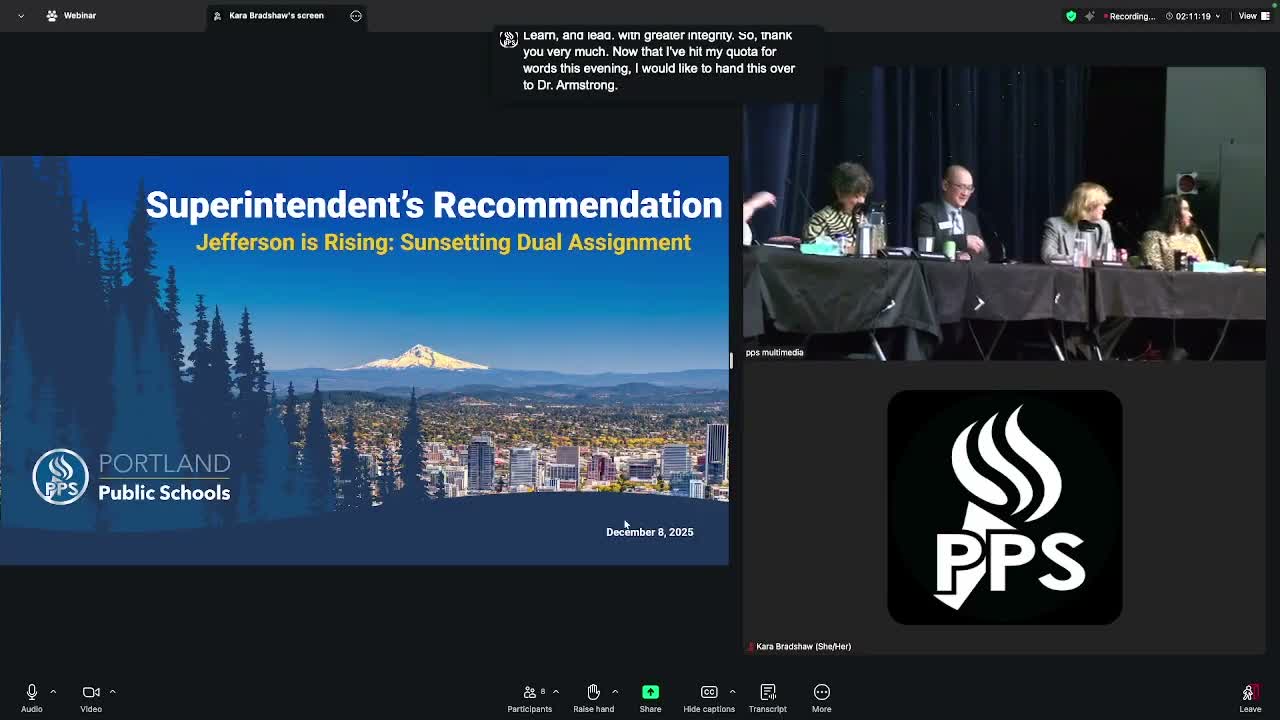
Summary
Superintendent Kimberly Armstrong recommended 'Scenario C' to sunset Jefferson High School's dual assignment, projecting a phased implementation beginning with 2027 ninth-graders and full phase-in by 2030–31; public commenters split—many parents press for Scenario B or explicit guarantees that Jefferson will have programming parity from day one.
Superintendent Kimberly Armstrong on Monday urged the Portland Public Schools Board of Education to adopt a boundary plan known as Scenario C that would end Jefferson High School’s dual assignment and reassign feeder schools across Northeast Portland, with the first incoming ninth-graders under the new boundaries arriving in 2027 and full implementation expected by the 2030–31 school year.
Armstrong told the board and more than two hours of public commenters that Scenario C was chosen because it “balances proximity, enrollment feasibility, and long‑range planning,” and that the district’s bond modernization program will return Jefferson to a “vibrant neighborhood school.” Assistant Superintendent Margaret Calvert presented the analysis behind that recommendation, including engagement outreach, transit-proximity mapping (concentric one-mile and 1.5-mile radii), and enrollment projections intended to bring each Northeast Portland comprehensive high school closer to a district target of about 1,100 students needed to sustain broad electives and extracurricular programming.
Why it matters: The recommendation would redraw neighborhoods’ high-school pathways and directly affect thousands of students across Sabin, Irvington, Vernon, Fabian and other elementary and middle schools. Supporters say moving students into Jefferson is necessary to restore its capacity to offer a full set of courses and activities. Opponents worry the plan either undercounts likely opt‑outs or fractures middle‑school cohorts, risking loss of programs, longer commutes and declines in diversity at particular campuses.
Public comments at the listening session were sharply divided. Parents and students from Vernon, Fabian and Oakley Green urged the board to adopt Scenario B — which, they said, better protects feeder cohesion and more reliably reaches Jefferson’s enrollment targets. “A comprehensive high school offers a wide range of electives… Jefferson needs 1,100 students and it currently only has 459,” Vernon student Grove Tollson said, urging Scenario B. Several commenters said Scenario C would split Tubman Middle School and “divide students along racial and economic lines.”
Other speakers — including Sabin and Jefferson families — urged adoption of Scenario C or, at minimum, strict guarantees of program parity. “This is about love, dignity and basic safety,” Sabin parent Bina Patel said, arguing that shifting Sabin away from Grant would reduce diversity and force children onto more dangerous walking routes across MLK and Prescott. Multiple parents asked the board to attach an explicit amendment requiring district commitments (funding, staffing and program offerings) so that Jefferson would offer the same electives, athletics and advanced coursework available at Grant, McDaniel and Roosevelt from day one of the transition.
Data and dissent: Several commenters challenged the district’s capture‑rate assumptions and projections. Laura Westwood, an Irvington parent, said the district’s own formulas produced different numbers when run with alternative assumptions and urged the board to consider Scenario F, a community‑developed alternative. Assistant Superintendent Calvert said the district engaged more than 400 families in multiple sessions, posted materials online and reviewed transit and feeder‑pattern tradeoffs; she emphasized the proposed timeline gives the district time for staffing and budget alignment before students arrive in 2027.
Safety and logistics: Sabin families highlighted pedestrian safety concerns and longer bus commutes under Scenario C; some parents asked the board to prioritize safe walking and biking routes or keep Sabin with Grant if safer routes exist. Others countered that historical feeder patterns can preserve privilege and that prioritizing neighborhood proximity can advance equity and local school revitalization.
Next steps: The board will discuss the proposal again at the teaching, learning and enrollment committee and at a work session on Dec. 16. The board is scheduled to vote on an assignment area for Jefferson High School on Jan. 13, 2026. At Monday’s listening session, no formal board action was taken; the district invited further written comments and public testimony ahead of the committee and vote.
A note on sources: Reporting is based on the district presentation and two hours of public comment at the Dec. 8, 2025 Jefferson listening session, where speakers named above spoke on the record.