
Portsmouth High outlines 2026–27 program of studies; highlights AP gains and new credit proposals
Get AI-powered insights, summaries, and transcripts
Subscribe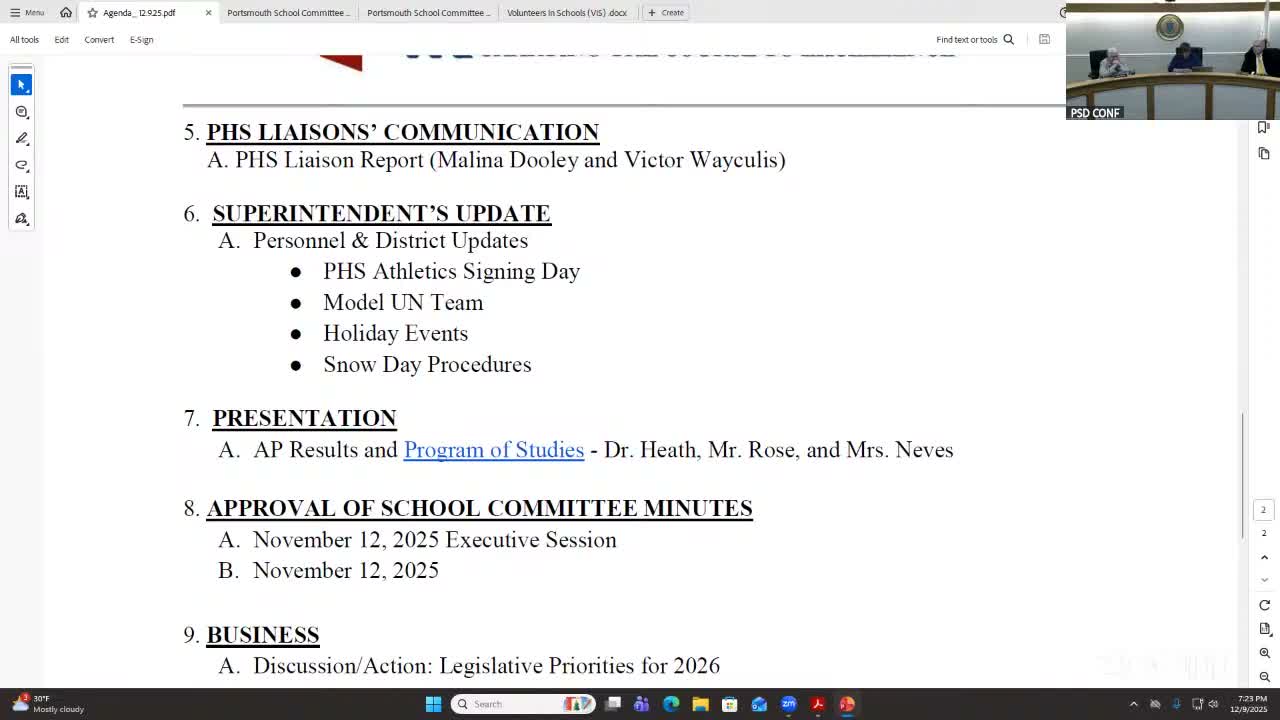
Summary
School leaders presented proposed course changes for 2026–27 — including eighth-grade credit for several subjects, a shift to digital portfolios, and proposed AP micro- and macroeconomics — and reported three consecutive College Board gold recognitions and growth in AP participation and scores.
Portsmouth School Committee heard detailed proposals on Dec. 9 for changes to Portsmouth High School's 2026–27 program of studies and a report on Advanced Placement results that officials said have grown substantially in recent years.
"We're going to predominantly cover the different changes that we're proposing to the program of studies," said Dr. Heath, who led the presentation on course changes and scheduling. He said the high school plans to award high-school credit for some eighth-grade coursework in Algebra I, Spanish I, civics and computer science to create more schedule flexibility and higher-level options later in high school.
The leadership team proposed several other shifts: replacing the culminating student exhibition with a year-long digital portfolio aligned to the district's "vision of a graduate," moving the digital video course back to a semester format, and adding semester-based AP options including AP microeconomics and AP macroeconomics to expand upper-level offerings. "If we're looking to grow our AP programming, if I was picking one spot for this school year, this would be the one," Dr. Heath said.
Assistant Principal of Teaching and Learning Miss Neves described a plan to award eighth-grade credit only when curriculum alignment and placement assessments ensure equity for transfer students. She also said a new semester-based civics course would be offered as a catch-up option for students who lack the state-required civics proficiency. "It is a state mandate at this time that we do have something that captures and catches those kids," Neves said, adding the proficiency is student-led and likely requires teacher support.
Administrators proposed changes to the district's early-enrollment program (EEP) partnerships. Presenters said the existing college-algebra EEP through Southern Maine Community College would be dropped because local colleges do not reliably accept that credit. Instead, the district is negotiating a memorandum of agreement with Roger Williams University to provide EEP credit for business-pathway courses; district staff said that arrangement could be funded through Perkins and categorical federal funds so students would not pay out of pocket for those EEP credits. Dr. Heath said some EEPs historically required a $288 student fee and the district must ensure it does not create inequitable requirements across courses.
Mr. Rose, who presented AP results, said Portsmouth High earned its third consecutive College Board gold recognition. He reported that 67% of the most recent graduating class took at least one AP exam and 54% of seniors earned a score of 3 or better on at least one exam. This year the school expects to administer over 500 AP exams to nearly 300 students. "Our AP students do a lot of great work," Rose said. Presenters estimated that, using a simplified calculation (three credits per course at roughly $900 per credit), AP credit earned by students potentially represented more than $1,031,000 in avoided college tuition costs; Rose and the committee characterized that estimate as an illustrative figure rather than a precise accounting.
Committee members pressed for clarifications. Miss McDade asked whether Roger Williams EEP credits would be accepted by other local institutions; administrators said MOAs and acceptance details were under review. Members also sought assurances that students would not be required to pay EEP fees when district funding could cover them and that proposed new offerings only run when minimum enrollment thresholds are met; Chair noted Portuguese 1 would require a minimum of about 15 students to run.
The presenters displayed a scheduling timeline showing course-selection windows in February and March and said staff would return with finalized memoranda of agreement before bringing any program-of-studies items to the committee for formal approval.
The committee did not vote on the program of studies that evening; administrators said they will continue negotiations, refine MOAs and bring the package back when financial and acceptance details are resolved.