
Advocates urge cleaner, quieter emergency cooling and compensation for student climate projects
Get AI-powered insights, summaries, and transcripts
Subscribe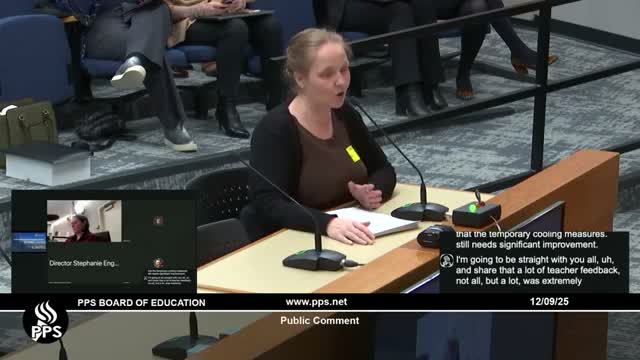
Summary
Speakers urged Portland Public Schools to use less diesel-dependent emergency cooling, prioritize classroom air conditioning placement, compensate staff for student-led climate projects funded by Portland Clean Energy Fund, and provide clearer processes for facilities approvals.
Several public commenters told the Facilities Improvement and Oversight Committee that emergency cooling responses should align with the district's climate goals and be safer for students.
Effie Greathouse of Safe Indoor Air for Oregon Schools presented survey results from teachers at 15 schools after the fall heat wave: only 7% of teachers said hallway fans were effective and many reported "extreme noise, safety concerns, and student distraction." She said classrooms that received portable air conditioners reported better outcomes and urged more thoughtful placement and permanent cooling strategies.
Sasha Pollock, a Robert Gray parent with climate-policy experience, praised PPS's climate policy and asked the operations team to "explore less fossil fuel intensive options to address extreme heat, including plug in portable heat pumps as opposed to air conditioners," noting those pumps can be "less than $300 each" and that diesel generators led to reports that teachers "could smell diesel exhaust in their classrooms." Pollock said the district should prioritize responses that both protect students during heat events and align with its climate commitments.
Teacher Shannon Kittrick urged prioritizing student-led green infrastructure projects funded through the Portland Clean Energy Fund (which she described as $36,000,000 total, with $2,000,000 for student projects and $10,000 per middle/high school per year for five years). Kittrick said students face barriers getting projects approved through facilities and requested clearer pathways and appropriate compensation for staff who facilitate those projects.
What happens next: Commenters said they will share reports and follow up by email; staff heard requests to investigate lower-emission cooling approaches and to clarify processes for advancing student-led projects.