Assistant commissioner briefs board on teacher-evaluation landscape and advisory work
Summary
Assistant Commissioner Brooke Amos told the board the department is preparing a landscape report on educator evaluation to the legislature in January 2026, described advisory-committee work and cited data showing most teachers rate evaluations as improving practice; committee recommendations are not final.
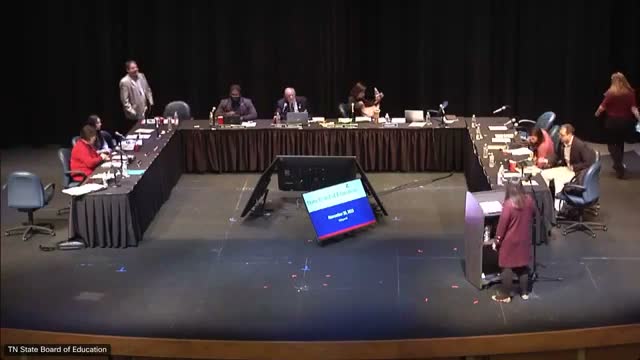
Brooke Amos, Assistant Commissioner of Human Capital, briefed the State Board of Education on the department's teacher-evaluation landscape analysis and advisory-committee findings required by recent legislation (Tennessee Code Annotated, Title 49). "Educators are the single most important lever in driving student achievement," Amos said, and the department's work aims to refine evaluation practice and supports for teachers.
Amos described three statutorily required activities: a landscape analysis of evaluation practices in Tennessee and other states, convening an advisory committee of experienced educators, and producing a final report to the legislature in January 2026. She said the advisory committee agreed the statewide system is "robust" and helpful for novice teachers but identified areas for refinement. Amos cited department survey data and internal metrics: she said roughly 80% of teachers report the evaluation process has led to improvements in their teaching, about 75% of educators receive an overall effectiveness rating of 4 or 5, and in early-career cohorts about 96% achieve at least a level-3 observation expectation.
Board members raised questions about announced and unannounced observations, rubric complexity, weighting differences for tested versus non-tested teachers, and how to preserve constructive coaching while ensuring reliable evaluative measures. Several board members advocated more formative, coaching-focused observations and simplifying rubrics to reduce administrative burden and better target feedback.
Amos said the department is still refining recommendations and expected a committee recommendation report in late January, with a final report to the legislature in January 2026. No policy changes were finalized at the workshop; the item was presented for discussion and stakeholder input.