
Monterey County board accepts year-end budget report, sets aside $20M for reserves and funding priorities
Get AI-powered insights, summaries, and transcripts
Subscribe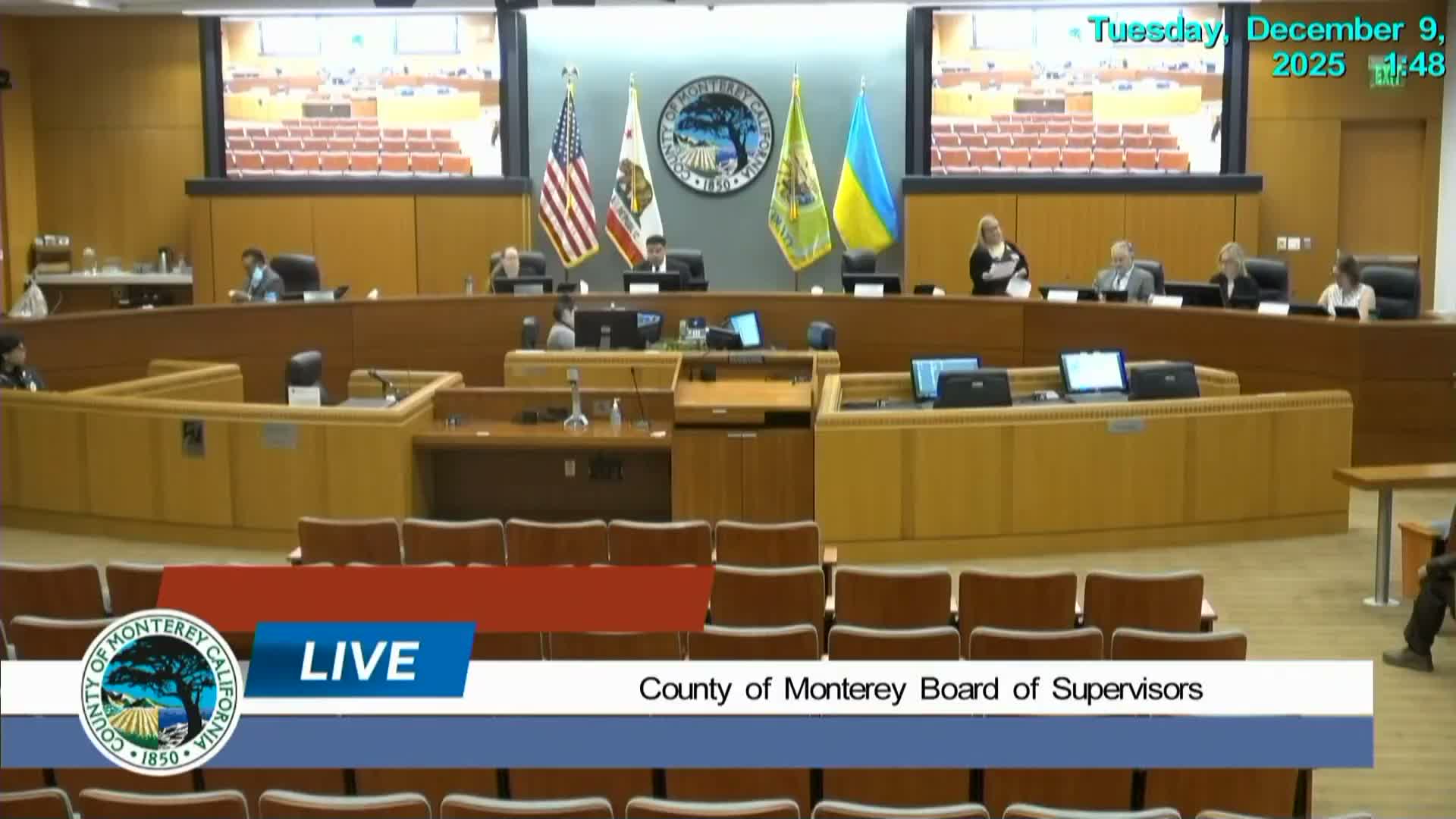
Summary
The Monterey County Board of Supervisors accepted the fiscal year-end budget report and approved staff recommendations to reserve $20 million of the $39.9 million unassigned fund balance, add to contingency and strategic reserves, and set aside funds for a building acquisition as it faces a projected structural shortfall for FY 2026–27.
The Monterey County Board of Supervisors voted Tuesday to accept the county'''s Budget End of Year Report (BEAR) and to adopt staff recommendations allocating a portion of a roughly $39.9 million unassigned fund balance.
Assistant County Administrative Officer Michael Beaton told the board the county began the fiscal year with about $32 million in unassigned fund balance and closed the year with about $39.9 million, in part because of one-time revenue and reimbursements. "We actually ended with 39,900,000.0," Beaton said during the presentation, which focused on the general fund component of county operations.
The board approved staff'''s proposal to hold $20 million in unassigned fund balance, set $8 million aside for a building acquisition, increase the contingency reserve by $2 million and place $4.8 million into the strategic reserve. That package of allocations was presented by staff as a way to smooth an expected shortfall next fiscal year and to provide a limited cushion for known, near-term costs.
Beaton said reimbursements from state and federal disaster-response programs (Cal OES and FEMA) are expected to cover much of the county'''s outstanding disaster-related expenses and would support returning the strategic reserve toward the county'''s policy target.
The county faces a projected structural shortfall going into fiscal 2026–27. Using the board'''s current allocations and assumptions, staff'''s forecast shows the county would need roughly $360 million in general fund contribution to maintain operations next year, while projected discretionary resources available were in the low $333 million range, producing a gap in the mid to high tens of millions of dollars. Beaton estimated an approximate shortfall of about $26.7 million without additional actions.
Supervisors used the presentation and discussion to press staff on assumptions, including the county'''s conservative property-tax projections, potential volatility in transient-occupancy tax receipts, and the possibility that FEMA or state reimbursements might be delayed or reduced. Supervisor Daniels highlighted the need to treat FEMA and Cal OES reimbursements as uncertain when planning long-term finances.
Board members also discussed the effect of unfilled positions and salary savings on year-end balances. Supervisors asked staff to refine three-year forecasts using actual workforce assumptions rather than full staffing models and to work with departments on options to control long-term costs while protecting front-line services.
The board added two friendly amendments before approving the BEAR: direction to schedule a strategic budget workshop to examine long-term structural issues and a clarification that small amounts of supervisors''' discretionary office funds that were expected to be carried over would be handled as noted by CAO staff. The motion to accept staff recommendations with the friendly amendments passed on a voice vote.
Beaton and CAO staff said the unassigned fund balance figures are preliminary pending the county'''s formal audit; staff said any minor adjustments would be reported following the controller'''s audit later in the calendar year.
The board directed staff to return in March with updated three-year forecasts, incorporating departmental input and refined revenue assumptions. The BEAR adoption comes as the county prepares a budget with rising retirement and wage costs, jail medical expenses and other multi-year obligations that staff said will require careful alignment of revenues and expenses.
The board'''s action leaves a limited unassigned balance for discretionary use and a directive to pursue budget policy changes, with the CAO and departments tasked to bring options for closing the structural gap in coming months.