
Judge denies motion to suppress evidence in Marquise Johnson DUI case
Get AI-powered insights, summaries, and transcripts
Subscribe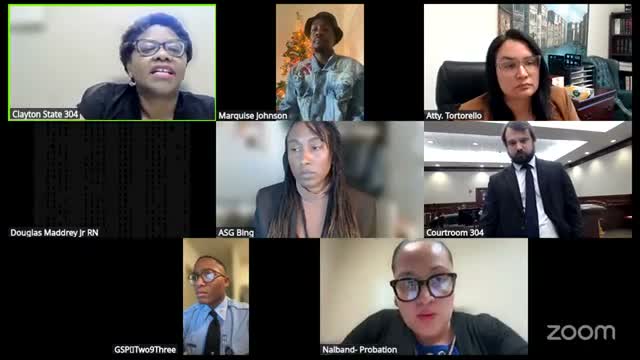
Summary
A Clayton County State Court judge denied a defense motion to suppress evidence in State v. Marquise Lamont Johnson, finding officers observed traffic violations and signs of impairment sufficient for probable cause to arrest for DUI; defense argued the stop was illegal.
A judge in Clayton County State Court denied a motion to suppress evidence at a hearing on Dec. 11 in the case State v. Marquise Lamont Johnson.
Defense attorney Susan Tortorello argued that Officer Christian lacked a lawful basis to stop Johnson and that evidence obtained after the stop should be excluded. "Officer Christian illegally stopped my client because he had no basis for the stop," Tortorello said during defense opening statements.
Assistant Solicitor General Stephanie Bing told the court the stop flowed from observed traffic violations and that officers discovered additional indicia of impairment. "The defendant was stopped because of a traffic violation," Bing said, adding that officers observed the defendant on the wrong side of the road, with glassy eyes and the smell of alcohol, and that the body-camera video showed erratic driving.
Officers who backed up the stop—whose testimony was presented through video and live examination—described the defendant's behavior at the scene, including belligerence, a later admission of drinking, and refusal to comply with field sobriety testing. Officer Descorbeth (backup) and former Officer Christian testified to seeing red, glossy eyes and an odor of alcohol. Defense counsel cross-examined witnesses about the sequence of statements and whether officers documented the traffic violations consistently on reports and dash-cam video.
The judge weighed the totality of the officers' observations, including driving behavior, admission of alcohol use, observable physical signs and the defendant's conduct when officers tried to conduct sobriety testing. The court concluded those combined facts supported probable cause for a DUI arrest and denied the motion to suppress. The court announced, "Motion to suppress, deny."
The ruling preserves evidence the state intends to use at trial. The court did not order any other remedies; the case will proceed under the court's standard scheduling and pretrial rules.