Multnomah County holds work session on deflection program; officials urge clearer success metrics, more services and data tracking
Get AI-powered insights, summaries, and transcripts
Subscribe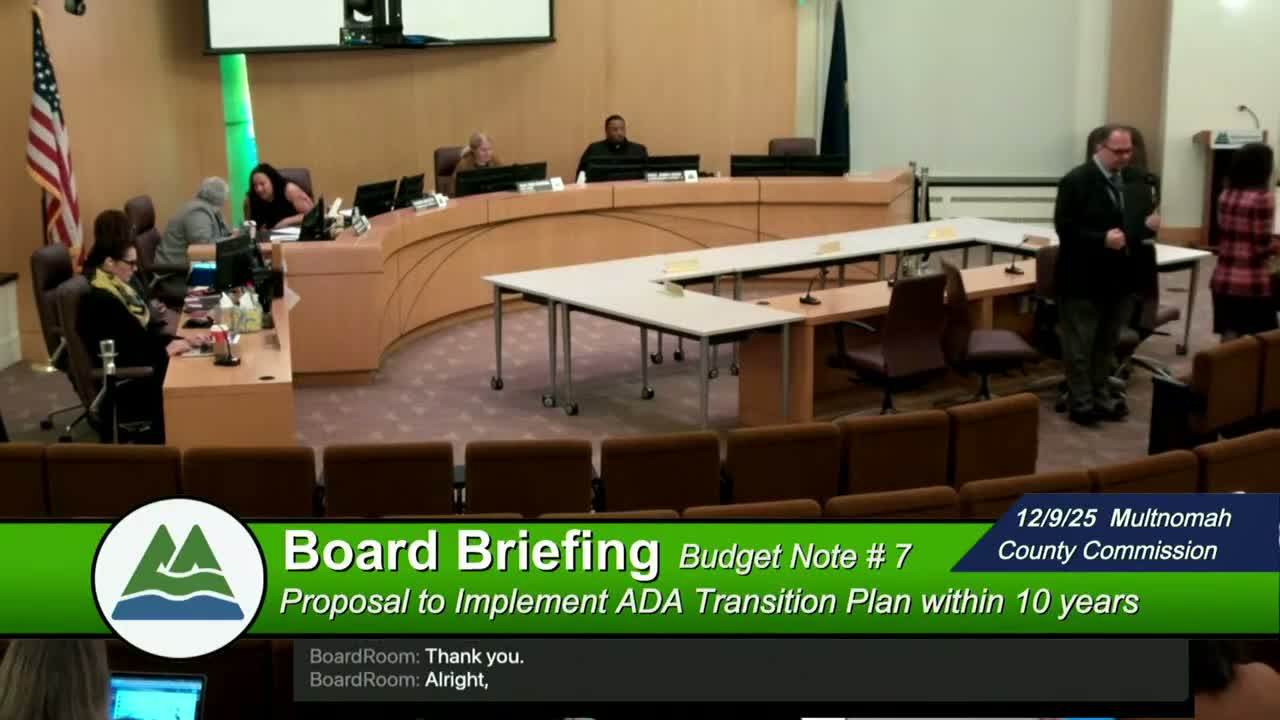
Summary
At a work session the Board and county, public safety and health partners reviewed first‑year deflection data, debated eligibility and accountability, and identified next steps including defining success, mapping services, and tracking rearrest outcomes before any expansion of charges.
Multnomah County commissioners on Tuesday held a work session on the county’s deflection program, hearing data and recommendations from public defenders, health researchers, the district attorney and service providers about how to increase treatment connections and improve outcomes.
Grant Hartley, director for Metropolitan Public Defenders in Multnomah County, told commissioners deflection should be judged against criminal‑justice alternatives and that measures of success should include incremental steps such as engagement with peers, acquiring identification, participating in detox or connecting to housing. "Progress is...merely progress," Hartley said, urging relationship‑based accountability rather than punishment.
Dr. Dan Hoover of OHSU presented early statewide findings: roughly 2,100 deflection events with about 1,700 individuals eligible and about 1,300 enrolled in the first year (data through August). He said about 31 percent of officer‑initiated deflections converted to locally defined "successes," and cautioned that co‑charges (trespass, warrants, failure to appear) complicate eligibility and limit scale if programs restrict entry to possession‑only cases.
District Attorney Vasquez emphasized that House Bill 4002 created an optional deflection pathway but did not transfer charging authority away from the DA. "Prosecutorial decision making remains entirely unchanged," he said, adding that his office will review cases coming through deflection and that expansion of eligibility or changes that affect charging will be his decision and contingent on demonstrably better program outcomes.
Panelists from providers and the health department described service gaps driving low engagement: the need for assertive outreach, same‑day clinical assessments, expanded access to detox and transitional recovery housing, and more case management to follow people through the system. Tony (4d recovery) and Anthony Jordan (interim behavioral health director) said same‑day assessments and assertive mobile outreach yield higher engagement, while available sobering services are time‑limited and transitional housing funding is scarce.
Law enforcement officials said the Pathway Center and related transports have kept hundreds of people out of jail but reported high walk‑away rates after initial referral; Assistant Chief Brian Hughes urged stronger front‑end transports and on‑site services so officers’ transports convert to treatment. Researchers and commissioners asked for clearer, progressive success metrics, warm handoffs, contingency incentives and a plan to compare outcomes for people who go through deflection versus the criminal legal system.
Commissioner Singleton summarized action items: define "success" and "accountability," create a landscape map of available treatment and housing resources, explore mobile assessment and transport teams, expand data collection to include rearrest outcomes, and solicit court data as a follow‑up. The session did not adopt formal policy; DA Vasquez said any change to eligibility or charging practice will require his office’s sign‑off and better measured outcomes before expansion.