
Salinas council approves pilot rental-assistance program to prevent evictions
Get AI-powered insights, summaries, and transcripts
Subscribe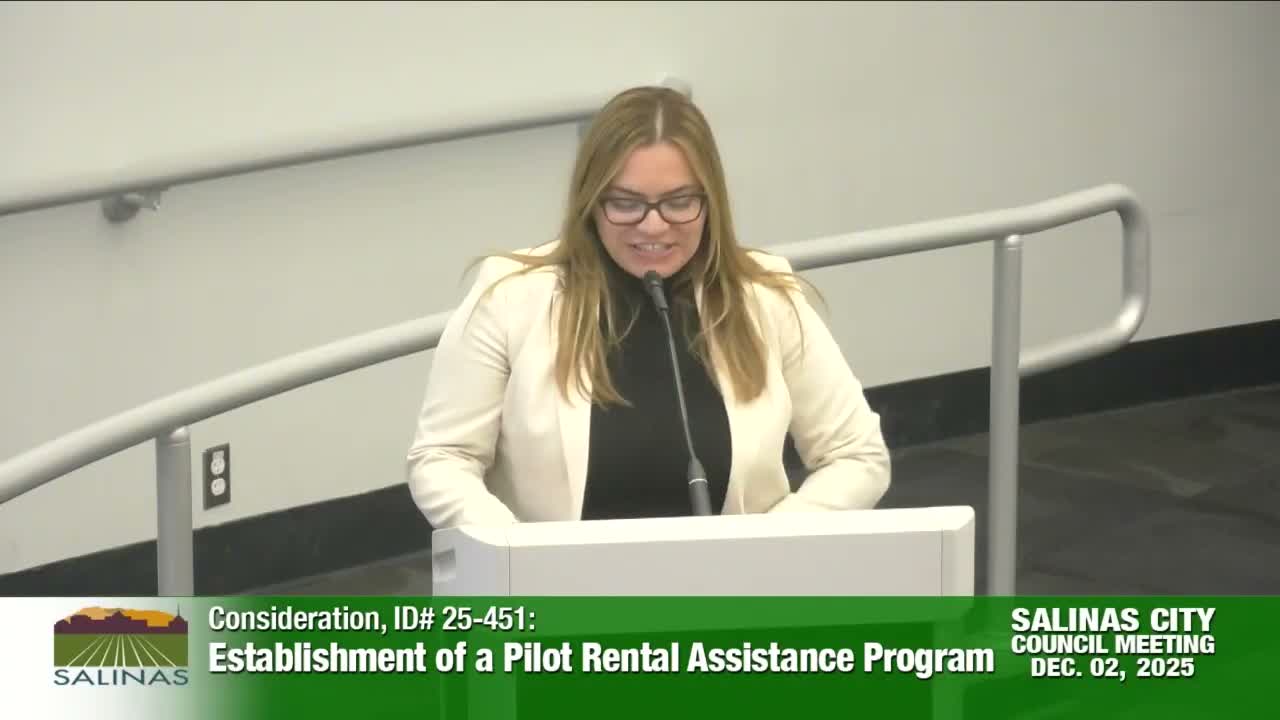
Summary
The Salinas City Council approved a pilot rental-assistance program using a mix of city and grant funds and a partnership with the Monterey County Office of Education to provide short-term aid and wraparound services for residents facing eviction.
The Salinas City Council voted unanimously Dec. 2 to establish a pilot rental-assistance program designed to prevent evictions by providing one-time rental-arrears payments and coordinated support services. Councilmember Andrew Sandoval moved the resolution and Mayor Donahue seconded; the motion passed on a roll-call vote with all members in favor.
City staff said the pilot targets City of Salinas residents who receive a three-day pay-or-quit eviction notice, have a valid 12-month lease, are no more than three months behind in rent and are not already receiving duplicative subsidized rental support. Keisha Lopez, the city's homeless services manager, told the council the program will pay landlords directly when eligible tenants are approved and will pair payments with referrals to legal aid, mediation and other wraparound services.
Lopez said the city will refer eligible school-age families to the Monterey County Office of Education (MCOE) via a subrecipient agreement to help scale intake and processing. The staff motion asked the council to appropriate $250,000 of Family Homeless Challenge grant funds for MCOE to distribute and to authorize the city manager to execute necessary subrecipient agreements. Staff said those funds will be part of a broader set of resources the city intends to use for eviction prevention this fiscal year.
Councilmembers pressed staff for operational details before the vote: expected processing time after a complete application (staff estimated two to four weeks depending on finance batching), whether the program will be first-come, first-served or shift to a lottery if demand exceeds capacity, and how eligibility and residency will be verified. Lopez said staff will accept applications by phone or in person and provide technical assistance during intake; approved cases would be processed within the stated two-to-four-week window.
Supporters at the meeting framed the program as a cost-effective prevention strategy that is cheaper than rehousing families after displacement; several councilmembers said they would pursue philanthropic and other local partnerships to expand funding if the pilot demonstrates measurable outcomes. Staff committed to returning in July 2026 with a report on program metrics including households assisted, total funds disbursed and an assessment of eviction-prevention outcomes.
The program was approved as a pilot with the expectation that staff will refine guidelines and return to the council for any material changes.