
Lane County hears shelter providers warn state funding cuts are reducing case management and housing exits
Get AI-powered insights, summaries, and transcripts
Subscribe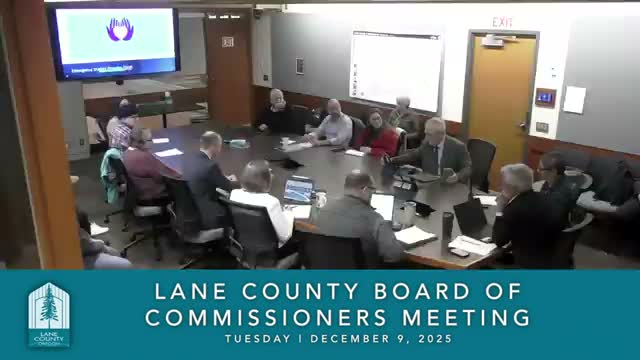
Summary
Shelter providers told Lane County commissioners that recent state and county funding reductions have cut case‑management capacity and client‑assistance funding, undermining progress on exits to permanent housing and forcing program changes; commissioners asked staff for a detailed fiscal follow‑up.
At a Dec. 9 work session, Lane County commissioners heard shelter providers describe a shelter system that serves roughly 1,200 beds across 48 sites and 18 providers, but said recent funding cuts have forced program changes and staffing losses that threaten housing outcomes.
James Ewell, the county's homeless and community action manager, opened the session and presented systemwide data, saying the county has "just shy of 1,200 shelter beds total as of last month, 2025." Providers from Everyone Village, St. Vincent de Paul, ShelterCare and Equitable Social Solutions detailed how different models — low‑barrier drop‑in shelters, medical respite, safe‑parking and tiny‑home villages — serve distinct populations and yield different exit rates to permanent housing.
Everyone Village described 70 tiny cottages and a recent addition of 10 medical recuperation tiny homes, plus on‑site workforce programs and a housing partner it identified as the Revelle Foundation, which leaders said helps stabilize participants before treatment. St. Vincent de Paul focused on continuity and staff experience. ShelterCare said its medical‑respite site has 19 beds and emphasized the benefit of private rooms for stabilization. Equitable Social Solutions said it now operates two low‑barrier shelters and has scaled back one medical‑respite site because of funding cuts.
Panelists said funding reductions at the state and county levels have led to concrete operational impacts. One presenter said the reductions eliminated funding for about 14 staff positions, including case managers, and another described the loss of client‑assistance money that previously helped move people into their first units. "Without the folks who are able to come alongside someone and walk them through that journey," a provider said, it is harder to convert shelter stays into permanent housing placements.
Providers described adaptive responses: greater reliance on partnerships with hospitals, nonprofits and universities; volunteer contributions; and internal innovations such as a shared self‑sufficiency outcome matrix adopted across the ecosystem to track engagement beyond direct housing outcomes. Several providers also said volunteer and resident‑led roles have temporarily filled some service gaps.
Commissioners pressed panelists on definitions of "low barrier" versus "high barrier" shelters and on the consequences of staffing losses for measurable housing outcomes. Chair and commissioners asked staff to return with a deeper financial analysis aimed at contract efficiency and the flow of funds to street‑level services.
The board did not take action during the session, but several commissioners signaled support for another follow‑up meeting focused on financial details and efficiency recommendations.
The county plans to reconvene the discussion with more detailed budget breakdowns and contract‑level figures in an upcoming session.