
State board hears committee findings on paperwork burdens and preview of new educator-preparation report card dashboard
Get AI-powered insights, summaries, and transcripts
Subscribe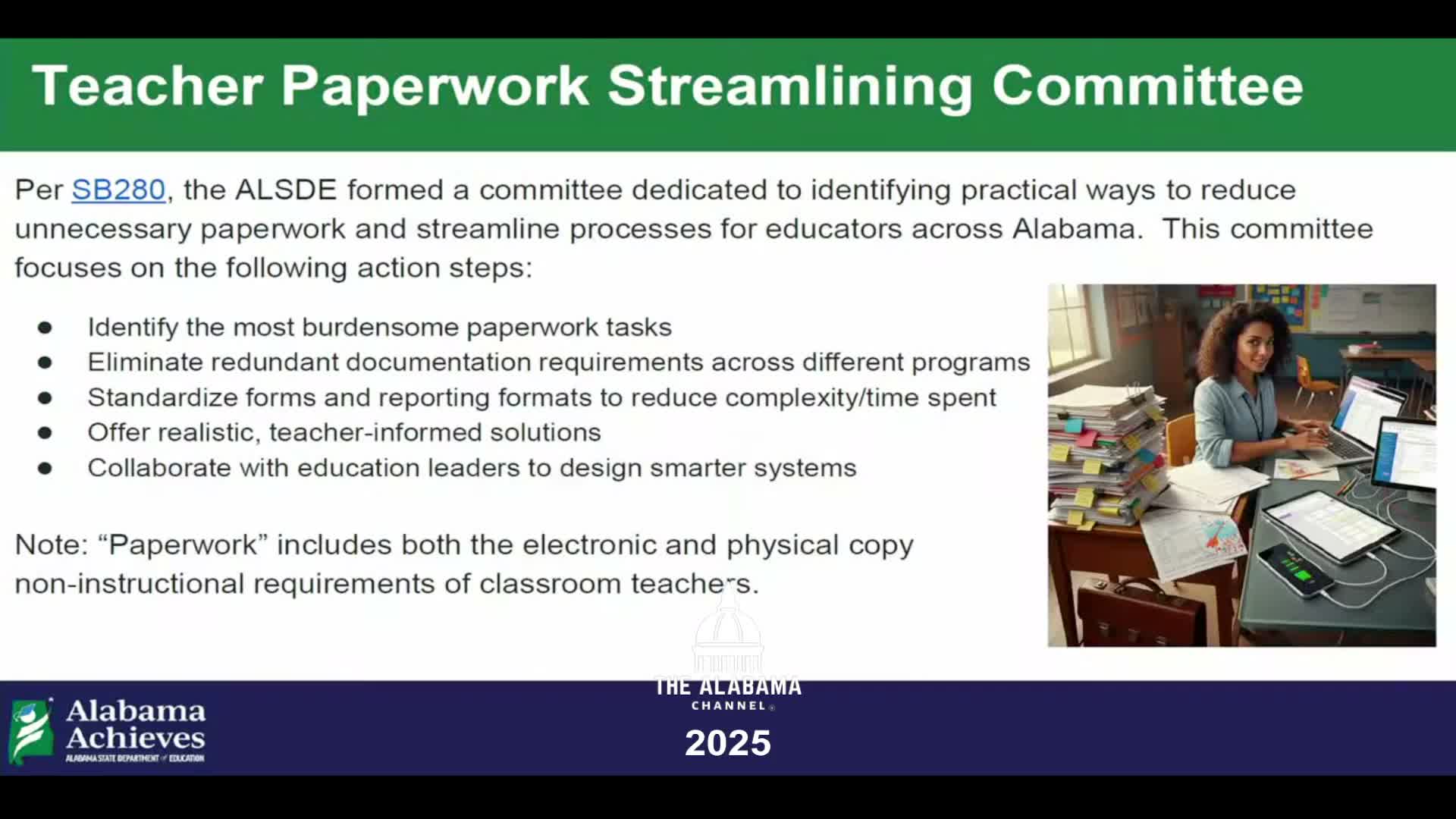
Summary
A teacher-led committee charged under SB 280 reported survey results (653 responses; 549 classroom teachers) and recommended templates, training and PowerSchool adoption to reduce duplicate paperwork. The State Department previewed a new filterable educator-preparation dashboard showing accreditation, pass rates and shortage data.
The Alabama State Board of Education heard two related presentations: a teacher-led paperwork-reduction committee summarized survey findings and next steps, and state department staff previewed a new dynamic educator-preparation institutional report card built on PowerSchool data.
Heather Hurt, a fifth-grade teacher and the committee chair, told the board the committee was formed after passage of SB 280 to identify and reduce unnecessary non-instructional paperwork for classroom teachers. "Over 75% of the committee is made up of classroom teachers," Hurt said, and the group identified five action steps including: cataloguing the most burdensome tasks, eliminating redundant documentation across programs, standardizing forms and reporting, offering teacher-informed solutions, and collaborating with state board sections to clarify legal and administrative requirements.
Hurt said the committee collected 653 survey responses: 549 classroom teachers, 82 support positions and 22 administrators. The committee found high time demands for student plans and stakeholder communication (about 7190% reported high time) and noted a mismatch for some tasks (for example, lengthy lesson-plan paperwork where time spent was high but perceived impact on student achievement was lower). The committee also documented local variance: some districts still require paper grade books in addition to PowerSchool entries.
Board members and state staff discussed PowerSchool Analytics and Insights as a potential unifying tool to reduce duplication, but members noted inconsistent local use and training. State staff present (including Stacy Royster from PowerSchool support) said analytics could auto-populate overlapping fields and help reduce multiple manual entries, though technical and policy work is needed to harmonize definitions across sections and districts.
As next steps, the committee proposed creating a template for state board sections to document each paperwork requirement92s origin (federal, legislative, state department, or local) and to offer consistent communication and training for classroom teachers on PowerSchool features. Hurt said the committee will continue monthly and semester work into spring and fall to analyze which requirements can be streamlined and which may require legislative change.
In a separate but related presentation, Dr. Olivia Hampton and Dr. Denise Peacock of the state department unveiled a new educator-preparation institutional report card: a filterable dashboard that shows accreditation status, educator-prep progress (admissions, completions, exits), first-time and subsequent pass rates on Praxis and the foundations-of-reading test, employer and novice-teacher survey results, and a teacher-shortage module that maps district-reported shortages.
State presenters said the 20239224 data show 5,422 unconditionally admitted candidates, 272 known exits without completion and 1,686 program completions (presenters cautioned that some EPPs did not previously collect exit data). Employer surveys produced 633 responses from 147 districts for 20249225; presenters are revising distribution to tie responses to individual teachers for greater specificity.
Presenters highlighted the foundations-of-reading first-attempt pass rate (about 56% statewide) as an area needing attention and said the dashboard will allow institutions and the board to filter by institution, certification class, gender and race to better target continuous-improvement efforts.
The board praised the committee92s work and asked staff to continue refining the report card and supporting teacher training on analytics tools. No formal policy votes were taken on the committee92s recommendations during this session.