
Oshkosh staff brief council on surge of small ‘class B’ licenses and attached gambling rooms
Get AI-powered insights, summaries, and transcripts
Subscribe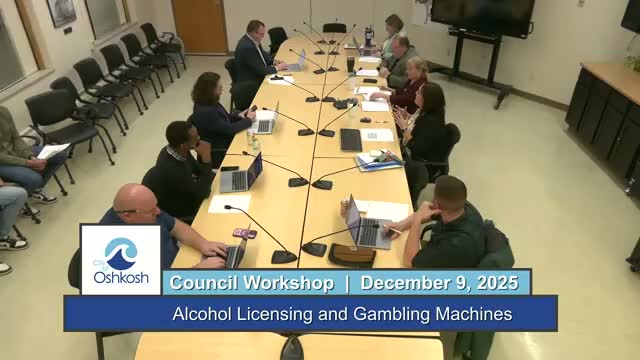
Summary
City staff and a Department of Revenue representative told the Oshkosh City Council at a workshop that they are seeing a statewide trend of tiny class B premises—often attached to convenience stores—with space for up to five mechanical amusement/video gambling devices; staff asked council what application detail and local rules it wants before formal license decisions are brought forward.
City staff and a Department of Revenue official on Wednesday told the Oshkosh City Council in a workshop that a statewide trend of very small class B liquor licenses — often designed as separate, small rooms attached to convenience stores — is appearing in the community and raising questions about how the city should review and regulate such applications.
“Gambling machines are illegal in Wisconsin,” attorney Lynn Laurenson told the council, explaining that state law treats gambling on non-class-B premises as a felony while imposing a reduced penalty — a forfeiture — for violations tied to class B establishments. Travis, a Division of Alcohol Beverages representative with the Wisconsin Department of Revenue, added that machines which redeem tickets or other items for value qualify as gambling: “If you are redeeming something for value, it is gambling.”
Staff walked council members through recent application examples. Darla Salinas, the city clerk, described a planned Quick Pantry Pub at 1212 Porter Avenue with a separate exterior entrance, a bar area and space for up to five mechanical amusement devices; staff later said that application was withdrawn and the fee refunded. Travis described a nearby municipality where a 125-square-foot room with seating for six had been licensed as a restaurant and operated with five machines, illustrating how local licensing categories and building use can produce unexpected outcomes.
Laurenson said municipalities have substantial discretion before issuing a license but considerably less authority to revoke or suspend a license once issued without concrete violations: “Once you do issue that license though, the opportunity to get that license back is very difficult to do.” Council members pressed staff for practical steps to reduce regulatory gaps, including pre-approval inspections, clearer application statements, and limits on multiple licenses on the same tax parcel.
Council members and staff discussed a range of local policy options used elsewhere, including ordinances that ban video gambling machines outright, square-footage minimums, or a rule preventing more than one license on a single tax parcel. Several members favored requiring a short staff summary for each application that highlights key facts (site plan, entrances/exits, whether the premise functions as a bar/restaurant/coffee shop, and whether an on-site licensed operator will be present) so elected officials do not have to parse full license forms to make an informed decision.
Travis and staff warned that enforcement capacity at the state level is limited; he said there are about 10 Division of Alcohol Beverage agents statewide for roughly 17,000 licensed establishments. That means local police and inspection processes are likely to be the primary mechanism for compliance checks and any complaints that could support suspension or revocation.
The council did not take formal action at the workshop. Members asked staff to return with one or two recently approved applications as examples, a short summary memo form staff could supply with future license packets, and recommended best practices from other municipalities. The workshop closed with staff committed to preparing sample applications and draft options for the council’s consideration at a future meeting.