
Baltimore County design panel approves recommendations for 1300 Walnut Hill Lane, sends plan to Planning with conditions
Get AI-powered insights, summaries, and transcripts
Subscribe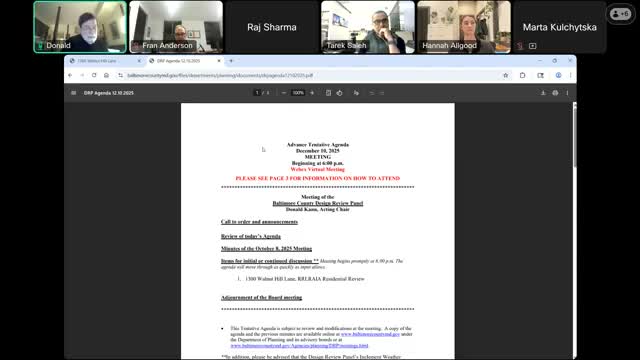
Summary
Baltimore County’s Design Review Panel approved a motion to return a proposed 3,000-square-foot replacement home at 1300 Walnut Hill Lane to Planning for administrative review, subject to conditions on landscaping, retaining-wall specifications, roof-edge/gutter detailing, window-type clarification and garage elevation treatment.
Baltimore County’s Design Review Panel voted Dec. 10 to approve recommendations that send a proposal to replace the existing house at 1300 Walnut Hill Lane back to the county Planning Department for administrative review with conditions.
Acting Chair Donald Kann opened the meeting and read the panel’s enabling provisions (Title 4, Subtitle 2, Part 1, Sections 32-4-203 and 32-4-204), then heard a presentation from Hannah Allgood of Elite Contracting Solutions, who said the applicant proposes to demolish the current nonconforming residence and build a new four-bedroom, five-bath, approximately 3,000-square-foot French/Tudor-style home centered on the lot to meet setbacks. Tierney Andrews of NW2 Engineers and Architecture was introduced as available for technical questions.
During her presentation, Allgood described site constraints: a long slope across the lot that required a tiered retaining-wall approach rather than a single tall wall, a lower roughly 5-foot wall around the parking area and a larger 8–10-foot wall farther back. She said the original single-wall concept would have been closer to 15–18 feet. She also described rear parking, plans to adjust but largely retain the existing driveway alignment, and proposed materials including brick cladding, limestone window headers and dark casement windows.
David Owens, speaking for the Brockston Ridderwood Community Association, said neighbors received the plans about three weeks earlier and held a meeting with nearby homeowners. Owens asked that the property lines be staked before construction and for the sewer/water easement along the east side of the lot to be identified; he said the sewer there has backed up repeatedly. Owens also asked that demolition not be permitted until the applicant files final building plans, expressed concern about the visual impact of a tall retaining wall and 42-inch aluminum fence, requested additional landscape screening and native plantings, and suggested the contractor reduce impervious area on the proposed parking pad.
Chair Kann noted several concerns Owens raised—stormwater, easements and driveway work—fall under other county agencies and not the panel’s purview but said the comments were entered into the record.
Panel members focused on design details the submission lacked. Mr. Anderson urged the applicant to provide retaining-wall specifications (Allgood said the wall would be compact modern block and that she would submit the product spec) and requested additional landscaping on the high side of the wall to screen the fence. Anderson also recommended adding windows to the left-side garage elevation to avoid a blank façade or, if windows are infeasible, augmenting foundation plantings. Mr. Sala supported added planting behind the fence, suggested a black fence would be less visually prominent, and urged consideration of aesthetic options for the concrete parking pad—such as coloring or patterned control joints—rather than full pervious pavers.
The chair asked whether major trees would be removed; Allgood said several trees adjacent to the existing house would be removed to accommodate the new layout and grading, and that a drawing showing tree removals was not included in the current submittal. Kann also asked about roof-wall junction and gutter details; Allgood said gutters will be incorporated and colors were under discussion.
Mr. Anderson offered a motion that the project be approved with conditions: submit a revised landscape plan showing additional planting to screen the retaining wall and identifying trees to be removed; provide specifications for the retaining-wall system; add roof-edge and gutter details; verify/clarify the window type (materials list vs. plan callouts); add windows to the left-side garage wall or provide enhanced foundation landscaping; and show the fence extent on the plan and address fence color at the Planning level. Staff clarified that these items could be handled by administrative review by Planning staff and the acting chair rather than returning the project to the panel.
The motion was seconded; the panel approved it by voice vote. The chair said the comments aim to ensure the project fits the neighborhood and works with adjacent properties. The panel then adjourned.
What happens next: the applicant will submit revised drawings and specifications to Planning for administrative review addressing the conditions the panel outlined. The transcript records the voice motion, conditions as stated, and that the action is advisory and subject to Planning’s administrative review; the transcript does not provide a roll-call vote tally or names attached to each affirmative voice vote.