
State health advisers back birth-dose hepatitis B policy as pediatricians report rising hesitancy
Get AI-powered insights, summaries, and transcripts
Subscribe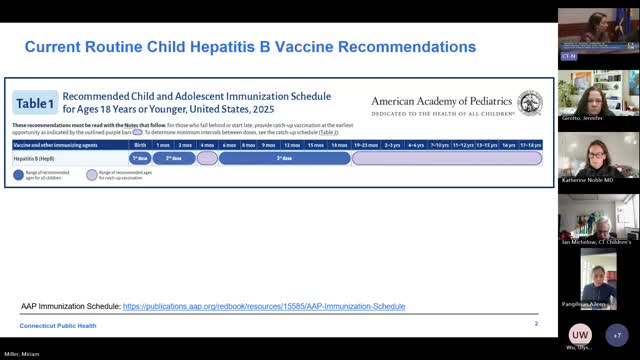
Summary
At an advisory committee debrief on recent ACIP actions, Connecticut public health officials reiterated support for the hepatitis B birth dose and described declining birth-dose uptake and growing parental hesitancy; clinicians requested clearer state resources and legal guidance.
The Department of Public Health’s advisory committee spent the majority of the meeting debriefing recent Advisory Committee on Immunization Practices (ACIP) votes that could alter aspects of the childhood vaccination schedule. Commissioner Jutani told the group that Connecticut’s DPH remains committed to recommending the hepatitis B birth dose: "the birth dose is still the right policy recommendation," she said, and emphasized that parental informed consent applies to all vaccines.
Presentations reviewed specific ACIP votes and implications. Slides summarized a vote recommending shared, individualized decision-making for the birth dose in infants born to HBsAg-negative mothers and a separate motion about post‑vaccination serology. Commissioner Jutani and clinicians expressed concerns about recommending routine serologic testing for newborns because there is limited evidence for long-term interpretation and practical follow-up challenges.
Jutani reported state data showing hepatitis B coverage among kindergarten entrants at about 98.7 percent, but the proportion of infants receiving a hepatitis B birth dose within one day of life declined to roughly 83.4 percent in 2024. She also cited distributed data that the United States misses 12–18 percent of pregnant women for HBsAg screening and that only about 35 percent of those who test positive receive recommended follow-up care, arguing these gaps make maternal-screening–only strategies vulnerable.
Clinicians urged DPH to expand provider-facing materials. Barbara Zayogas, immediate past president of the Connecticut chapter of the American Academy of Pediatrics, and other pediatricians said parents are increasingly uncertain and that ordering serologies, tracking results and recontacting families would be logistically difficult. Tom Murray of Yale New Haven Children’s said his system will continue to offer and promote the birth dose but has seen increased declinations.
Legal protections for clinicians who restrict practice to vaccinated patients were raised. Henry Salton, DPH chief counsel, said the department currently lacks tools to provide immunity from liability and that legislative action would be required to create such protections.
DPH said federal acceptance of ACIP votes by the CDC director had not yet occurred, and that the state would continue to order vaccines through federal contracts and work with partners to preserve access regardless of future federal policy changes. Commissioners and clinicians discussed developing clearer public webpages, provider packets and video resources to support shared decision-making and counter misinformation.
Next steps: DPH will review and expand immunization resources on its website, pursue communications work (focus groups and educational materials), and coordinate with providers to protect vaccine access.