
Santa Clara task force briefed on SB 79 and BART parking‑lot TOD options
Get AI-powered insights, summaries, and transcripts
Subscribe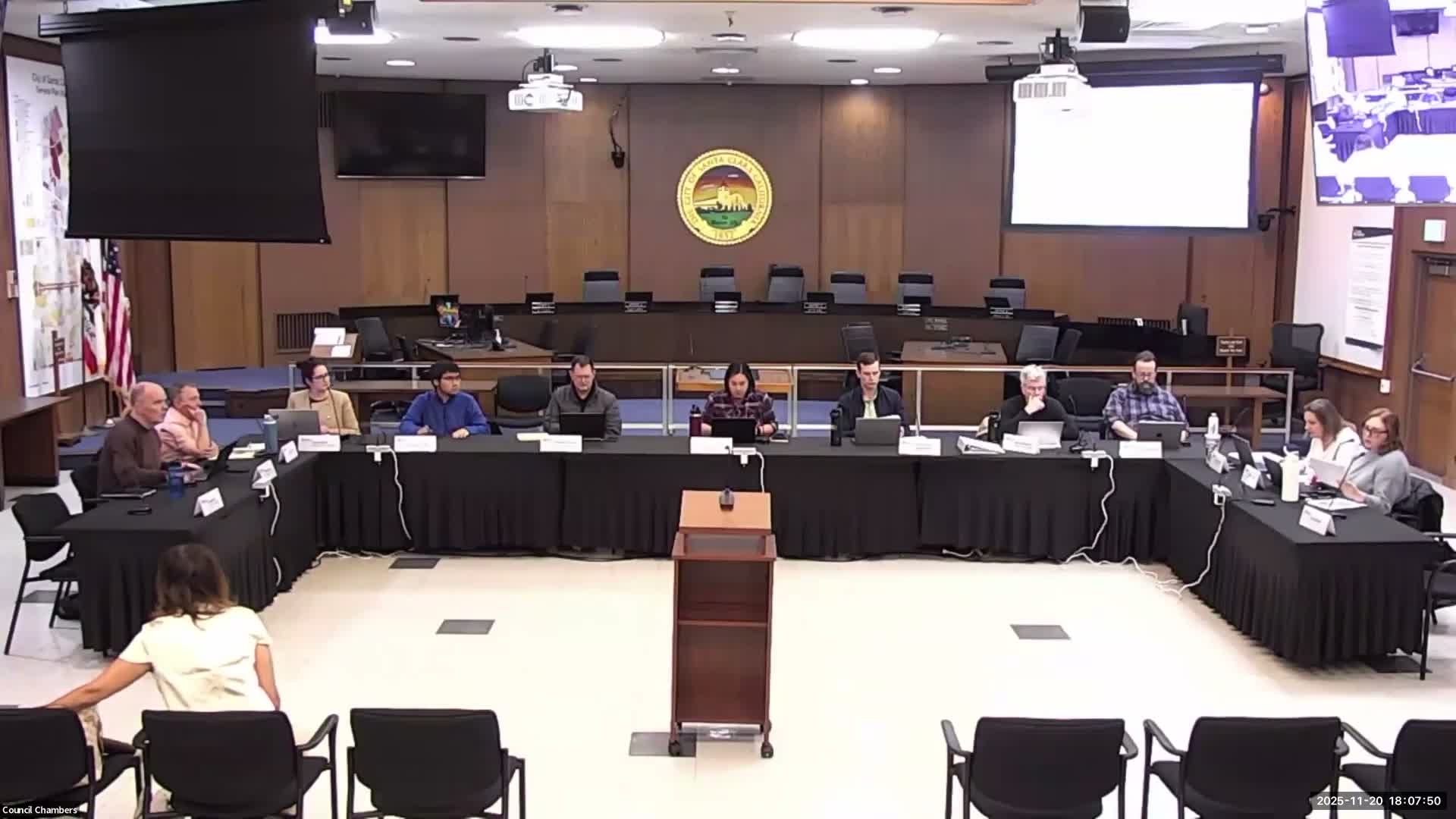
Summary
City staff and VTA/BTA presented how California's SB 79 would require upzoning near qualifying transit stations and reviewed conceptual transit‑oriented development scenarios for the BART parking lot that could add several hundred housing units while relying on shared parking and TDM measures. Council study session set for Dec. 16.
City staff and regional transit partners briefed the Station Area Task Force on Nov. 20 about the implications of California Senate Bill 79 and presented two conceptual transit‑oriented development (TOD) schemes for the BART parking lot adjacent to the station.
The briefing focused on SB 79's zoning requirements near qualifying transit stations and on conceptual fit‑tests by VTA/BTA and SiteLab showing how housing and office development could be accommodated on the BART parking‑lot parcels while maintaining BART patron parking in the short term.
City staff summarized SB 79 as intended "to increase the supply of affordable housing, specifically around train stations," and said the law requires mandatory upzoning near rail stations and rapid bus corridors with different requirements tied to distance from stations. Staff noted SB 79 does not change CEQA procedures, but that projects qualifying under SB 35 or SB 423 could use exemptions those laws provide. Staff also said the state Housing and Community Development (HCD) department will develop maps and guidance, and cities may propose an alternate TOD plan that HCD will review (staff said the HCD review period in the bill is 120 days). SB 79’s effective date was stated as July 1, 2026.
The presentation included specific figures that staff urged the task force to treat as preliminary: in some tiers the bill ties minimum heights and densities to proximity to stations (staff cited a 95‑foot minimum height for sites directly adjacent to a station, residential densities up to about 160 dwelling units per acre with bonus provisions, and floor‑area ratios up to about 4.5). Staff also said local inclusionary housing requirements remain applicable for projects with more than 10 units and that any city alternate plan must preserve the net zonal capacity designated by SB 79 and limit exceptions to a 10% cap.
VTA/BTA and SiteLab presented two conceptual schemes for roughly 2.5–3 acres of BART‑side parcels. Ugo of SiteLab described a mixed scheme (Scenario 1) and a more residential‑heavy scheme (Scenario 2). Scenario 1 showed roughly 800,000 square feet of development yielding about 425 new residential units plus roughly 200,000 square feet of office and an estimated total of about 720 parking spaces distributed across surface, podium and potentially one underground level. Scenario 2, which flips one building to residential, produced a higher residential yield (about 585 units) with similar parking assumptions. Ugo emphasized these are conceptual yields that stay within the height limits presented and that further study is required.
Task force members and the consultants focused substantial discussion on parking, shared‑use arrangements and legal requirements. Presenters stated they used a starting residential parking assumption of about 0.5 spaces per unit for the conceptual schemes and that VTA’s environmental clearance documents for the station referenced an initial requirement of roughly 500 BART parking spaces. VTA staff and SiteLab said parking needs would be refined with project‑level parking and access studies, and that shared or time‑shifted parking (residential parking freeing up during daytime commuting hours) is a commonly used approach. VTA staff also reviewed the agency’s TOC (Transit‑Oriented Communities) policy and a TDM (transportation demand management) toolbox that includes developer obligations such as smart transit passes for affordable housing residents and other measures used to reduce car dependence.
An online public commenter, James, urged caution about shared parking, telling the task force his "main concern is that the area will be severely under parked for BART ridership" and recommending a dedicated parking structure on BART land to serve transit riders. City and VTA staff responded that a range of shared‑use strategies, parking studies and TDM measures would be evaluated before final decisions and that project‑level studies are standard practice.
Staff also reported a grant from VTA’s Transit‑Oriented Communities grant program to support co‑creating a form‑based code for the station area has been executed; staff will issue an RFP to hire a consultant. City staff said they plan to bring a study session to the City Council on Dec. 16 to request expansion of the station plan boundary (to include the BART parking lot parcels and some adjoining blocks) so the city can transfer density away from small historic parcels and better meet SB 79 capacity requirements.
Next steps: staff will confer with legal counsel on interpretive questions (what counts as developable area or a 'site' for capacity calculations), continue WRT and consultant technical work on capacity and traffic analysis, provide the task force and council with VTA TOC and TDM materials, and present the proposed boundary expansion at the Dec. 16 council study session.
Quotes used in reporting are drawn directly from the public record at the Nov. 20 task force meeting.