
Lakeville sets residential factor at 1, keeps single tax rate; assessors project $9.74 per $1,000
Get AI-powered insights, summaries, and transcripts
Subscribe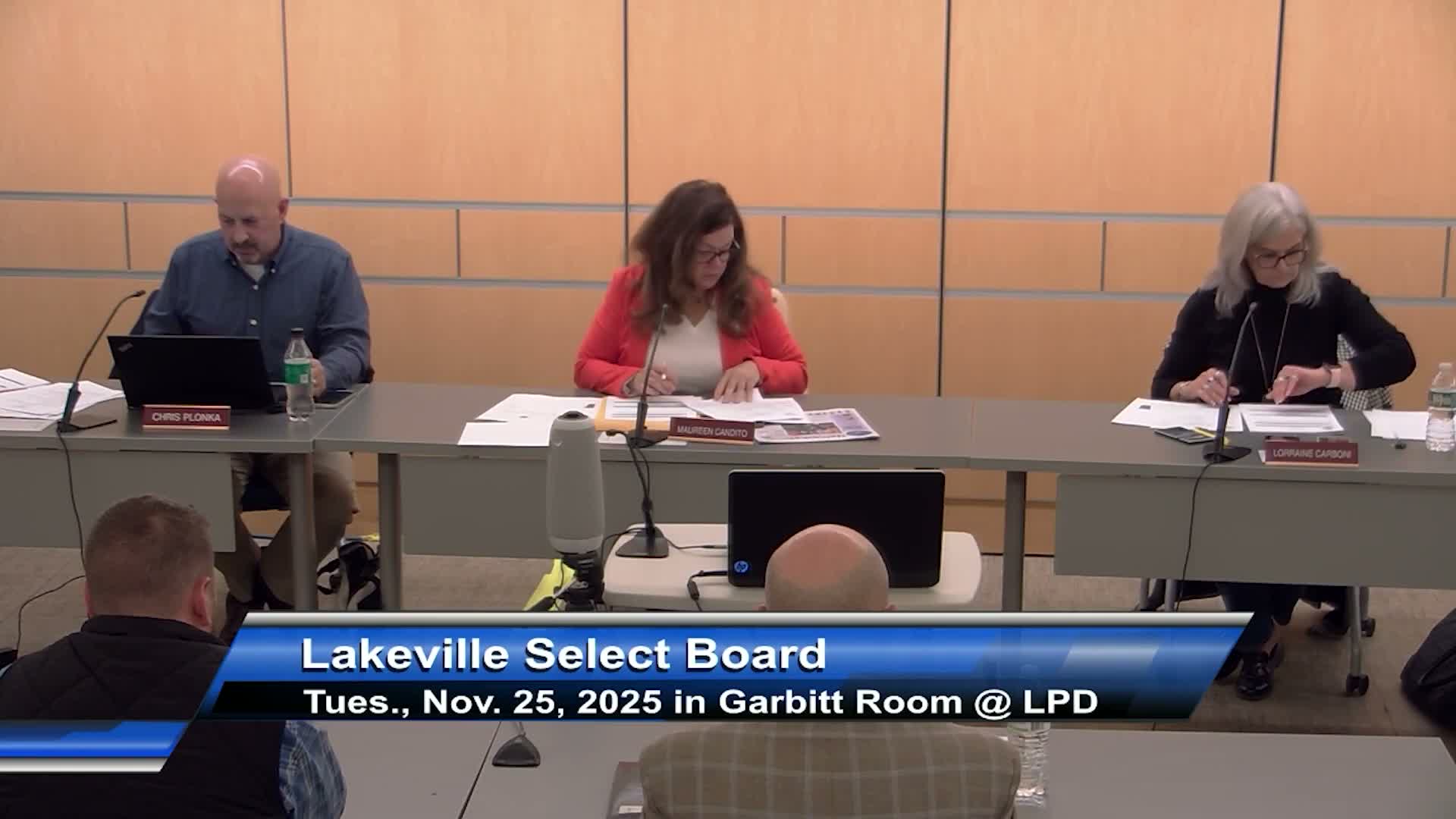
Summary
After a public hearing, the Lakeville Select Board adopted the assessors' recommendation to keep a single tax rate for fiscal 2026 and set the residential factor at 1; assessors projected a $9.74 per $1,000 rate and an average single‑family tax increase of about $170 (2.7%), pending Department of Revenue certification.
The Lakeville Select Board on Nov. 25 opened and closed the statutorily required fiscal 2026 tax classification hearing and voted to set the residential classification factor at 1, effectively maintaining a single tax rate for all property classes.
Assessors presented a preliminary levy and rate calculation showing the town would raise about $30,929,229 in tax revenue for fiscal 2026 and that the estimated tax rate would be approximately $9.74 per $1,000 of assessed value. "We are, this year for fiscal year 2026, raising $30,929,229 in tax revenue," the interim principal assessor said during the presentation, and later noted he was "projecting ... a lower tax rate, $9.74 per thousand." The Board of Assessors had recommended continuing a single rate because residential property accounts for the vast majority of the town's valuation, meaning a meaningful residential reduction would require a substantial commercial rate increase.
Board and staff walked through the numbers for average properties. Assessors said the average single‑family assessed value moved from about $572,600 to $625,900; applying the proposed rate yields an average annual tax increase of roughly $170, about a 2.7% change for the typical single‑family homeowner.
A late-day update from the state changed the new-growth number by $1,417, slightly altering totals staff had circulated earlier; assessor staff distributed an updated supplemental handout at the meeting and advised that the Department of Revenue's forthcoming certification could adjust the rate "a penny or two." Staff also said updated property record cards will be posted to the town GIS and encouraged residents to call the assessor's office for a property-specific calculation.
During public comment, resident Noelle Willow said the figures in the packet felt like a large increase for households on fixed incomes and said she read the packet as implying roughly "$353 per quarter" extra in taxes for her property. The assessor advised residents to obtain their updated valuation from the assessor's office and use that figure with the posted tax formula (assessed value ÷ 1,000 × tax rate) to estimate bills; he cautioned that final numbers depend on DOR certification.
The board voted, by unanimous roll call, to close the hearing and to set the residential factor at 1 with a corresponding CIP shift of 1, adopting the assessors' single-rate recommendation pending formal acceptance of the town's annual tax recap by the Massachusetts Department of Revenue. The decision directs staff to publish the calculation formula and updated property record cards and to notify residents by the town's email list.
Next steps: the Department of Revenue must certify the town's annual tax recap and the exact rate; once that occurs, the assessor's office will provide property-specific figures and the town will post the tax-calculation tools online.