
City attorneys recommend objections to six Columbus liquor permits citing violence, overdoses and code violations
Get AI-powered insights, summaries, and transcripts
Subscribe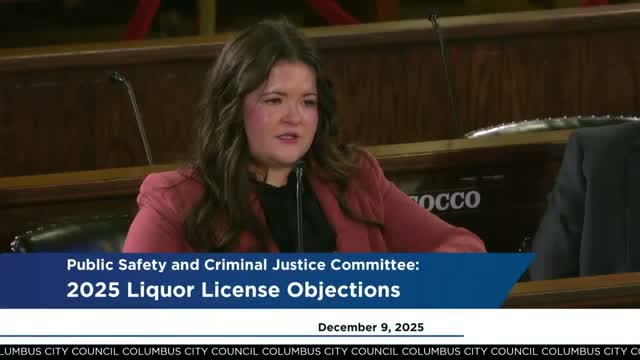
Summary
The city attorney's Property Action Team told the Public Safety Committee it recommends objecting to renewal of six liquor permits after investigations found high volumes of police calls, violent incidents, overdoses and outstanding health and fire-code violations; the council will consider the objections on Dec. 15.
Columbus City Council's Public Safety and Criminal Justice Committee on Wednesday heard a presentation from the City Attorney's Property Action Team recommending renewal objections for six liquor permits across the city, citing repeated violent incidents, overdoses, outstanding health and fire-code violations and sustained high volumes of police calls.
Assistant City Attorney Sophie Yano told the committee, "This year, we looked at over 200 properties that had come on to our watch list," and that investigators narrowed that list through multiagency reviews and records checks. The team recommended objections for six locations it says did not show sufficient improvement despite prior intervention.
The recommended objections and the chief concerns flagged by investigators are: - Speedway, 1165 S. High St.: repeat offender with C1, C2 and D6 permits; Yano said investigators recorded "over 560 calls for service to the property" between January 2024 and November 2025 and tied the address to multiple assaults, robberies and a drug-related offense. - Shell / True North Energy, 2441 Lockbourne Rd.: previously objected; calls for service rose by about 150 (from 228 to 366) in the most recent year-over-year comparison, with weapons offenses and other violent incidents. - BP, 2800 Sullivan Ave.: high call volume, citations for solicitation, underage sales, assaults, shots fired and outstanding Columbus Public Health violations for unsafe or unsanitary conditions. - Marathon, 2805 W. Broad St.: on the watch list about 18 months; investigators cited multiple assaults and robberies (Yano referenced eight events), intoxication incidents and three Narcan administrations indicating overdoses, plus Division of Fire violations. - Speedway, 2875 Stelzer Rd.: multiple assaults, robberies including armed robberies, shootings and drug overdoses; outstanding public-health and fire-code items were noted. - Buckeye Supermarket, 4432 Walford St.: investigators reported violent attacks allegedly by store representatives, numerous police reports (overdoses, felony assaults, liquor-law and weapons offenses) and police tips about narcotics sales; Yano said the property's alleged complicity posed "a substantial risk to the surrounding community."
Detective Mark Ryan, who works with the Property Action Team on liquor-permitted establishments, described repeated visits and outreach to owners and managers and said many family-owned carryouts cooperate after in-person engagement. "When you have 4 or 5 overdoses in your parking lot, when you have called the police 40 50 times, they know something's wrong," he said, describing the team's emphasis on practical remediation such as cameras, lighting, shared security and adjusted hours.
Yano explained the process that follows a council objection: the state Division of Liquor Control holds a public hearing where permit holders can present evidence of progress; the division may sustain an objection and remove a permit, overrule it and allow the permit to continue, accept negotiated operating provisions entered in environmental-court cases for monitoring, or the holder may forfeit a permit. Yano said most cases end with agreements intended to bring properties into compliance rather than immediate closure.
Committee Chair Councilmember Emanuel Remy thanked the Property Action Team for its work and said the committee expects to bring the objections to full council on Monday, Dec. 15. "We expect to see these liquor objections in front of council on this coming Monday, December 15," Remy said. He also noted there were no public speakers or written testimony submitted for the hearing.
The committee's recommendation to object does not itself change permit status. If the Division of Liquor Control sustains an objection after a full hearing, the permit can be revoked; if the division overrules the objection, the permit remains in force. Several presenters emphasized the office's preference for remediation and partnering with businesses to correct problems when possible.