
Judge Gatti Santana tells Security Council the Mechanism must retain core judicial oversight as it winds down
Get AI-powered insights, summaries, and transcripts
Subscribe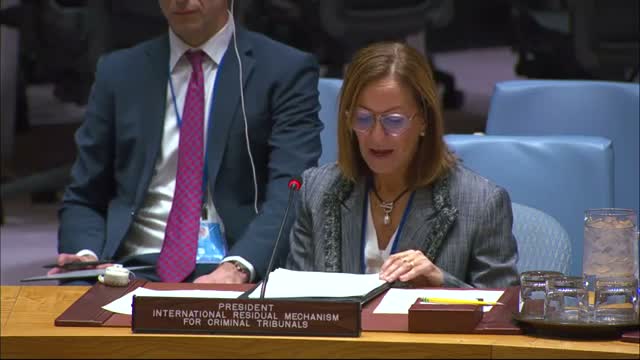
Summary
On Human Rights Day, Judge Graciela Gatti Santana presented the International Residual Mechanism for Criminal Tribunals' progress report, urging the Security Council to keep core judicial functions international while supporting transfer of certain technical tasks to the United Nations Secretariat and outlining staff and budget reductions.
Judge Graciela Gatti Santana, presenting to the United Nations Security Council on Human Rights Day, delivered the International Residual Mechanism for Criminal Tribunals' progress report and urged the Council to preserve international judicial oversight for core functions as the Mechanism prepares to conclude its mandate.
"Today is Human Rights Day," Judge Gatti Santana said, and she framed the Mechanism's work as rooted in restoring human dignity after mass atrocities. She told the Council that the Mechanism continues to perform substantial judicial functions: judges issued nearly 80 decisions and orders in the past six months, about nine in ten concerning continuous judicial functions, and she personally issued 26 decisions related to enforcement matters, including releases on humanitarian grounds and releases based on demonstrated rehabilitation.
The judge highlighted operational figures to explain the Mechanism's ongoing responsibilities: judicial oversight of protective measures for about 3,200 victims and witnesses, and continued responsibility for roughly 40 convicted persons incarcerated under the Mechanism's authority. She noted two convicted persons remain at the United Nations Detention Unit in The Hague until they can be transferred to states to serve their sentences.
The Secretary-Generalshared advance copies of reports requested under Security Council Resolution 2740 (2024) on possible transfer of the Mechanism's archives, assistance to national jurisdictions, and supervision of sentence enforcement. "First, the reports proposed that the technical functions of the prosecution's assistance [to] national jurisdictions and managing the archives can be transferred to the United Nations Secretariat," she said, and the Mechanism supports that assessment.
Judge Gatti Santana said transferring technical tasks to the Secretariat would reduce the Mechanism's activities and resource needs and that such functions need not be embedded in a court. The Mechanism, she added, will facilitate transfers "should the Council implement the recommendation."
At the same time, she argued core judicial powers must remain international. "The power to order the transfer of prisoners, designate enforcement states, and decide on applications for pardon, commutation of sentence, or early release involves core judicial functions that should stay at the international level," she said, urging the Council to retain judicial oversight involving the president, the roster of mechanism judges, and essential support staff. She cautioned that transferring authorities such as pardon and early release to states "presents credible risk of arbitrary, disparate, and unequal treatment of prisoners," given differing national practices.
On protective measures, Judge Gatti Santana invoked Article 20 of the Mechanism's statute, saying it "allows judges to order protective measures for victims and witnesses." She described the judicial balancing required when considering disclosure of confidential information to national prosecutors and said judges may vary protections only in limited circumstances, for example when a miscarriage of justice would otherwise occur.
The judge also updated the Council on selected case and procedural matters: a single-judge decision referred the last active contempt matter before the Mechanism to the United States and that decision has been appealed by the amicus curiae prosecutor; a case referred to Rwanda in 2012 has been narrowed so the trial chamber can adjudicate a final ground after receiving submissions from South Africa; and the trial chamber handling the case of F—acutelicien Kabuga determined he was not fit to fly to Rwanda, prompting requests that European states reconsider acceptance; the prosecution has appealed.
She said the Mechanism has sought efficiencies and amended rules of procedure and evidence to limit resource-intensive investigations and proceedings related to contempt, false testimony, and review matters. The 2026 budget proposal reflects an approximate 20% reduction in staff and a 15% reduction in overall resources compared with 2025. Over roughly the past six years, she described staffing declines and budget reductions that have amounted to steep cumulative decreases as the institution shrinks.
She closed by urging an "orderly transition" so that transfer and closure do not undermine more than three decades of international criminal justice progress and said the Mechanism will continue to adapt and to implement the Council's decisions; she thanked the Council and yielded the floor.
The Security Council will consider the reports and recommendations before deciding whether and how to implement transfers of functions and the scope of remaining international judicial oversight.