
Palo Alto planning commission backs 145‑unit Baylands townhome project, adds dark‑sky and tree conditions
Get AI-powered insights, summaries, and transcripts
Subscribe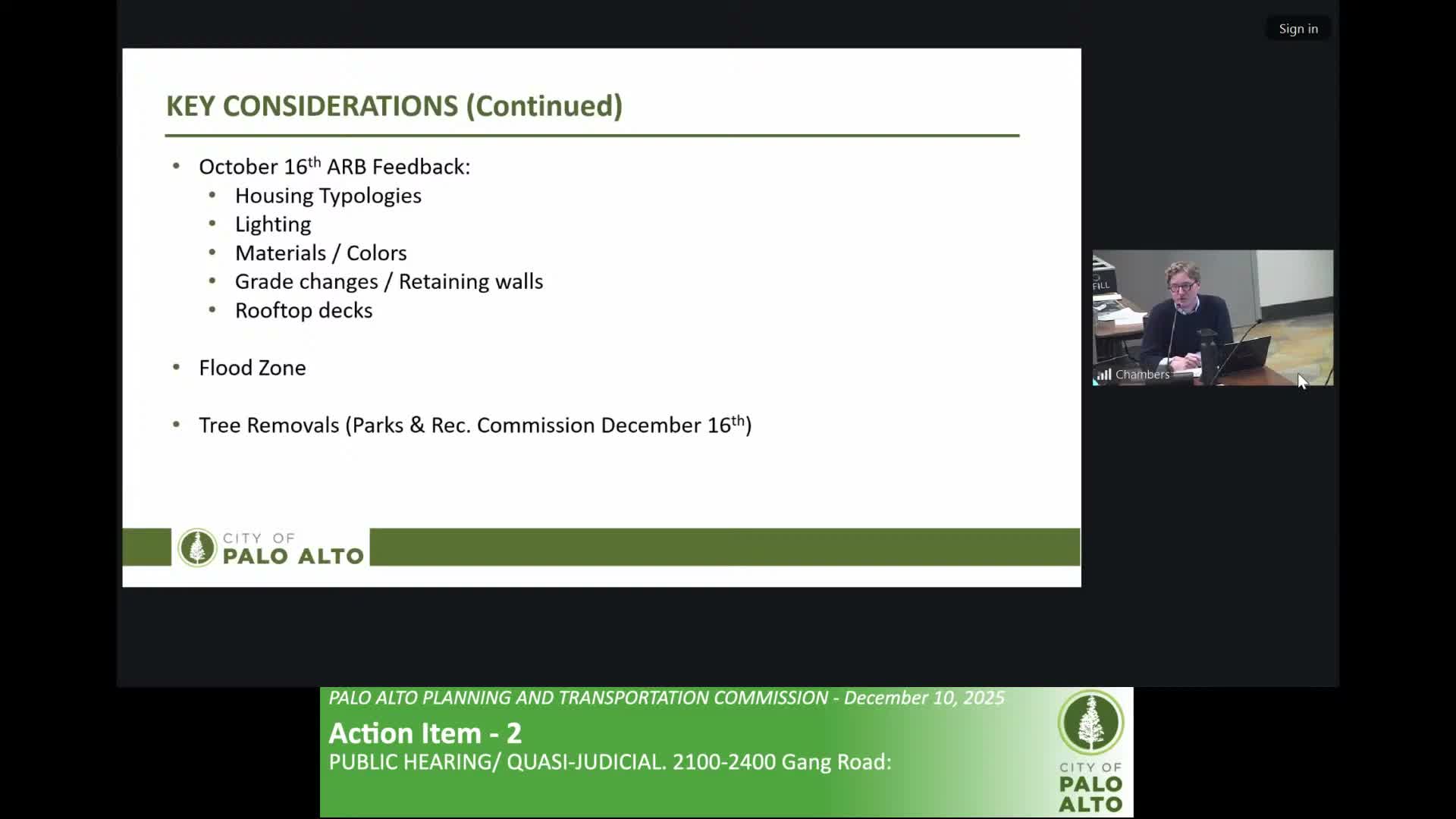
Summary
The Planning & Transportation Commission unanimously recommended the site‑and‑design approval of an 11‑acre Baylands conversion to 145 townhomes, asking staff to add a dark‑sky condition and to work with the developer to increase native tree planting while noting floodplain and tree‑removal issues.
The Palo Alto Planning & Transportation Commission voted 7–0 to recommend approval of a proposed 145‑unit townhome development on an 11‑acre former office park in the Baylands, with commissioners adding a condition to require compliance with the city’s new dark‑sky ordinance and asking staff to work with the developer to increase the percentage of native trees.
Planning staff opened the hearing by describing the proposal and the environmental review. Staff said the project is consistent with the comprehensive plan and recommended the commission find the project exempt under CEQA Guidelines §15183 and forward a site‑and‑design permit, vesting tentative map and related approvals to council. Staff also said the applicant is pursuing a CLOMAR and then a LOMAR with FEMA to document that the site has been raised out of the floodplain so buyers can obtain flood insurance.
Developer Michael Cohen of Strata Investment Group told commissioners the project converts the underused office park into a mix of 145 small‑lot single‑family and townhome units aimed at first‑time homebuyers. He described unit sizes ranging roughly from 1,600 to 3,000 square feet, said about half the homes include ground‑floor bedrooms to support multigenerational households, and said the homes will include roof decks and two‑car garages. Cohen added, “We’re gonna triple the number of trees on the site” and that the team “will not plant a single eucalyptus on the site.”
Commissioners pressed staff and the applicant on several site issues. Staff explained that raising the site in places by about 2 to 6 feet will require fill and retaining walls along the shared property line with city parkland; an arborist report identified roughly 50 city‑owned trees (characterized as blue gums/eucalyptus) that could be impacted and recommended removal in some cases. The applicant’s landscape team said the project proposes a 3:1 replacement ratio and about 648 new trees on the project property; potential new plantings on adjacent city property would be considered separately by the Parks & Recreation Commission at a December 16 hearing.
Public commenters were divided. Supporters said the conversion would add family‑sized for‑sale housing and community open space and could cut daily vehicle trips roughly in half compared with prior office uses. Opponents questioned the reduced BMR set‑aside under state builder’s‑remedy rules (13 percent under this project, which yields 19 below‑market units) and raised concerns about clustering of affordable units, floodplain and climate impacts, wildlife and light pollution. One public commenter said, “145 townhomes with a mere 13% BMR set aside … is the lowest in our town’s set‑aside history,” and urged the commission to resist concessions when possible.
Vice Chair Chang moved the staff recommendation with two additions: make the new dark‑sky ordinance a condition of approval and direct staff to work with the applicant to increase the percentage of native trees. Commissioner Heckman seconded. In explaining the tree request, commissioners and staff noted that native and climate‑adapted species are not only habitat‑friendly but also influence long‑term wildfire and maintenance considerations. The motion passed by roll call, 7–0.
What’s next: The commission’s recommendation will be transmitted to City Council with the record of land‑use action and the draft conditions. The Parks & Recreation Commission will separately consider any actions on city parkland where some trees are proposed for removal.
Authorities and approvals cited in today’s discussion included CEQA Guidelines §15183, the CLOMAR/LOMAR process with FEMA, and the city’s recently adopted dark‑sky ordinance. The Planning & Transportation Commission heard the item as the first major agenda item and concluded with formal minutes approvals and adjournment.