
Palo Alto commission forwards amended bird‑friendly design draft to council after extended debate
Get AI-powered insights, summaries, and transcripts
Subscribe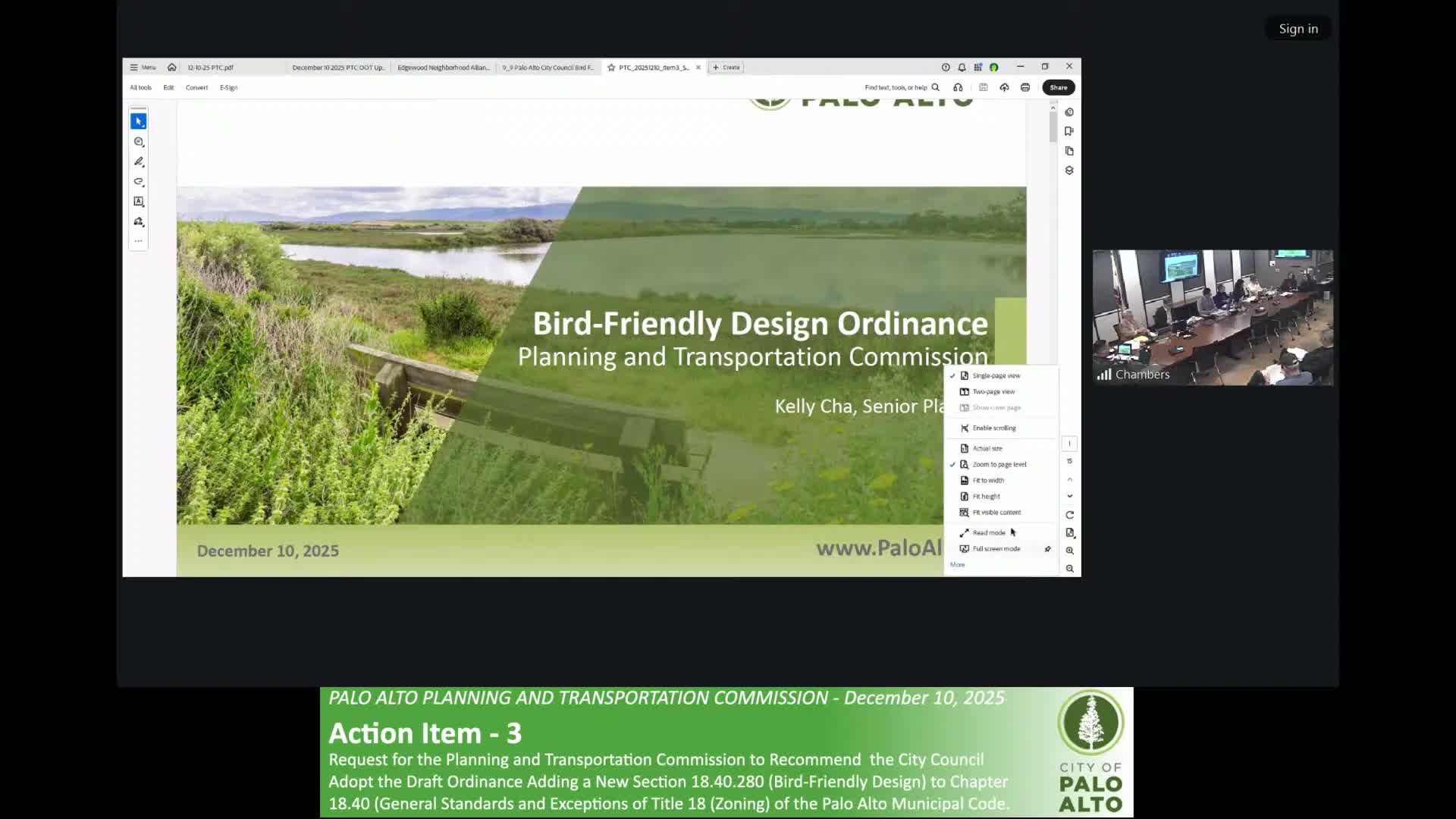
Summary
After lengthy public comment and debate over scope and cost, the commission voted 5–2 to send a revised bird‑friendly design draft to City Council, removing a 300‑ft creek buffer and exempting most single‑family residential portions under 35 ft in the urban area, while asking Council to weigh ordinance vs. guidance and local data needs.
The Palo Alto Planning & Transportation Commission voted 5–2 to forward a revised draft bird‑friendly design ordinance to City Council, with several substantive edits the commission requested during an extended hearing that included technical staff presentation and group testimony from environmental and neighborhood organizations.
Staff planner Kelly Cha presented the draft, which aims to reduce bird collisions by requiring treated glazing, permanent external features or other mitigations for new construction, major remodels and some window replacements in defined bird‑sensitive areas. Staff noted cost and local supply constraints for treated glazing, and suggested exemptions and alternatives for single‑family homes, replacement windows and small panes.
Environmental advocates told commissioners that patterned frit or ceramic fritting and other permanent visual cues have been shown in multiple case studies to sharply reduce collisions on treated facades, and urged targeted rules for high‑risk façades and near riparian corridors. Neighborhood and business groups urged caution: they said there is limited local data on collision frequency and expressed concern about enforcement burden and added costs for homeowners and small businesses.
Commissioners debated technical choices for more than two hours. Key PTC directions that passed with the motion included removing a 300‑foot buffer from the bird‑sensitive area definition (staff will maintain a citywide boundary east of U.S. 101/west of Foothill Expressway as the working sensitive area), exempting residential building portions under 35 feet in the urban area from the mandatory treatment (while retaining rules for higher or nonresidential façades), narrowing the replacement‑window applicability so ordinary window repairs are not automatically caught, and dropping prescriptive accreditation/years‑of‑experience language from the alternative compliance path.
The final motion also asked staff to transmit to City Council the PTC’s concerns that local quantification of collision magnitude is limited and that Council should consider the cost/benefit tradeoffs between an ordinance and nonmandatory guidelines. The motion passed 5–2 with Commissioners James and Heckman recorded as opposing.
What’s next: The Planning Department will prepare a staff memo for City Council that documents the PTC’s edits, the technical rationale, and the PTC’s request that Council consider whether to adopt a city ordinance or a guidance approach and whether to direct additional local monitoring studies.
Representative quotes from the hearing: Staff summarized the technical choices and told the commission that treated glazing is not widely stocked locally; an environmental advocate said patterned frit "is proven to significantly reduce bird strikes;" and a neighborhood representative urged an exemption for single‑family homes consistent with other nearby cities.
The commission’s recommendation is a policy‑level step; City Council retains full discretion to adopt, modify or reject the ordinance and to direct further study.