
Easley council debates acceptable‑use policy for elected officials, including social‑media limits and retention rules
Get AI-powered insights, summaries, and transcripts
Subscribe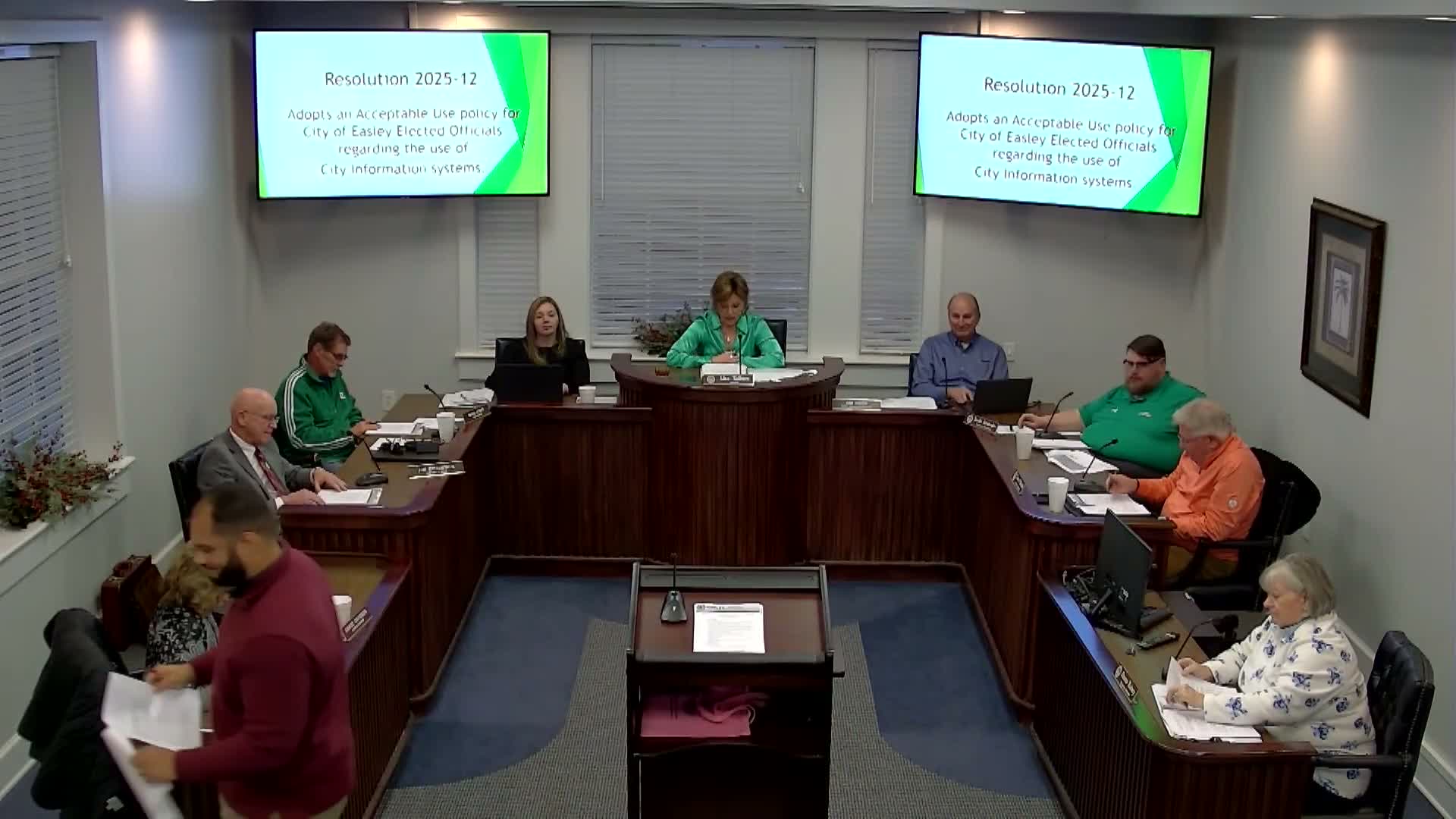
Summary
Council reviewed resolution 2025-12, an acceptable‑use policy clarifying retention obligations for city‑issued devices and recommended limits on elected officials' social‑media conduct. Debate centered on whether section 11 (social networking) and language banning 'disparagement' are overly broad or needed to protect the city from FOIA and litigation risk.
EASLEY, S.C. — Easley city staff presented resolution 2025-12, an acceptable‑use policy (AUP) for elected officials intended to clarify expectations for city‑issued laptops, email accounts and other information systems.
Jordan, who presented the proposal, said the policy's purpose is to protect city information assets, ensure compliance with South Carolina retention and public‑records requirements and to reduce legal risk. "As municipality, we are legally required under South Carolina law to retain public data and communications, including emails and social media records for FOIA compliance and records retention purposes," Jordan said, noting a five‑year retention requirement cited in the presentation.
A central focus of the debate was whether the policy's social‑media guidance applies only to city devices and accounts or extends to officials' personal accounts when used for city business. Jordan said the policy "does not govern or access your personal accounts or personal devices" and described the social‑media language largely as guidance to help elected officials retain records; other council members contended some provisions read as mandatory and could chill protected speech.
Section 7's prohibition on harassment, threats, discrimination and "disparagement" drew particular scrutiny. One councilor asked who would decide whether a post is "disparaging"; Jordan responded that anyone who sees an issue could raise it with administration (constituents, employees or the official themselves) and staff would handle it. Several councilors debated whether the word "disparage" is overly broad; one moved to strike the entire section 11 on social media posts, prompting further discussion on legal risk versus free‑speech concerns.
Legal counsel present said the policy was intended to be narrowly tailored to avoid First Amendment problems while protecting the city from litigation — for example, lawsuits arising when an official deletes public comments on social media. Counsel noted national litigation over elected officials using personal social accounts in ways that triggered First Amendment claims and said reasonable time, place and manner restrictions have been upheld in some circumstances.
Council members also discussed alternatives to providing city‑issued laptops and email to officials; staff said removing equipment would not absolve officials of FOIA responsibilities for city business conducted on personal devices. The transcript records detailed debate and a motion to remove section 11 but does not show a final vote in the provided excerpt.